
Keep Your Assets Running Smoothly with ALM
Why Your Manufacturing Assets Are Costing You More Than They Should
Asset lifecycle management is the strategic approach to tracking and optimizing every stage of your equipment's life—from the moment you plan a purchase to the day you retire it. It's how you maximize performance, control costs, and avoid the gut-punch of unplanned downtime.
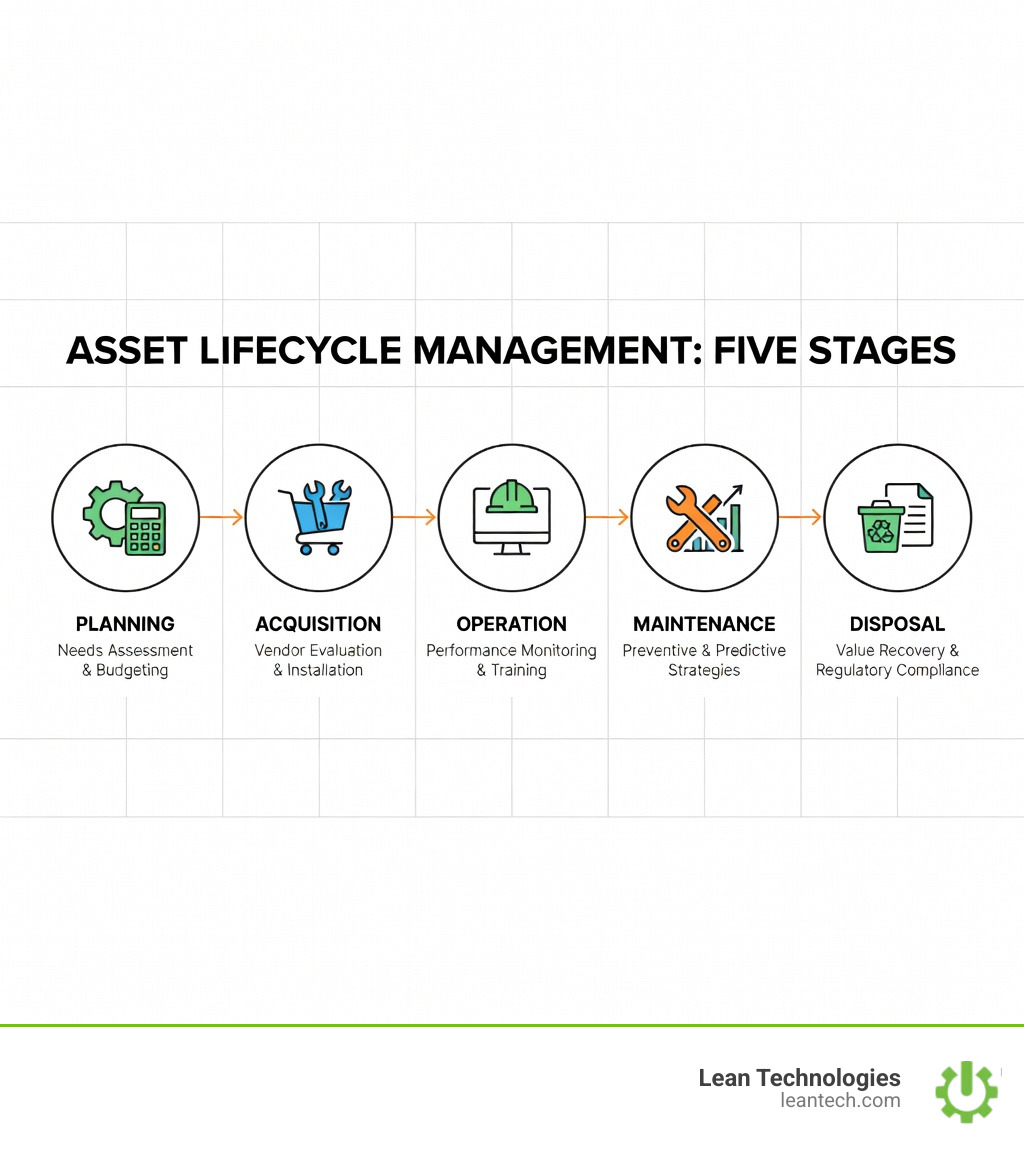
Here's what asset lifecycle management covers:
Planning – Evaluating needs, budgeting, and forecasting ROI before you buy
Acquisition – Purchasing, installing, and integrating new equipment
Operation – Running assets at peak performance with proper training and monitoring
Maintenance – Preventing failures through scheduled, predictive, or condition-based upkeep
Disposal – Retiring equipment responsibly while recovering maximum value
Most manufacturers don't have a structured approach to ALM. They're reacting to breakdowns, scrambling for parts, and making replacement decisions based on guesswork instead of data. The result? Reactive maintenance costs 3 to 9 times more than preventive maintenance, and over 80% of companies experience unplanned downtime of critical assets at least once every three years.
When you lack visibility into how your assets are performing—or how much they're really costing you—you're flying blind. You're patching problems instead of preventing them. You're replacing equipment too early or running it into the ground. And you're losing money every single shift.
Asset lifecycle management flips that script. It turns your equipment into a strategic advantage by giving you the data and processes to make smarter decisions at every stage. Organizations that implement a connected asset lifecycle strategy cut operational costs by up to 15%. Those using advanced asset management systems see 47% less unplanned downtime.
The difference between a plant that's constantly putting out fires and one that runs like clockwork? A system that tracks, maintains, and optimizes assets from day one.
What is Asset Lifecycle Management?
At its core, What is asset lifecycle management (ALM)? is a systematic process of deploying, operating, maintaining, and disposing of assets in the most cost-effective manner. While a Wikipedia definition of an asset might include anything from a pencil to a building, in the manufacturing world, we are talking about the heavy hitters: CNC machines, conveyor systems, fleet vehicles, and IT infrastructure.
ALM isn't just a fancy way to say "fixing things when they break." It is a strategic approach to operational excellence. It bridges the gap between the shop floor and the finance office. By making data-driven decisions, you stop guessing when a machine needs an overhaul and start knowing based on its historical performance and current condition. This applies to both physical assets (the hardware) and digital assets (the software and licenses that run the hardware).
Why Asset Lifecycle Management Matters for Manufacturers
If you’re a maintenance manager or a director of operations, you know that uptime is the only metric that truly keeps the lights on. When a critical asset fails, production stops, but the costs don't.
The research shows that 78% of facilities that track maintenance history and optimize preventive maintenance report seeing a significant increase in equipment lifespan. Think about that: simply by paying attention to the data, you can delay a multi-million dollar capital expenditure for years.
Furthermore, implementing a connected asset lifecycle management strategy can lead to a 15% reduction in operational costs. How? By eliminating the "scramble." You aren't paying for overnight shipping on emergency parts or calling in contractors at triple-time rates on a Sunday afternoon.
Unplanned downtime is the ultimate profit killer. Statistics show that 80% of companies face unplanned downtime at least once every three years. However, organizations using advanced asset management systems report a 47% reduction in unplanned downtime. For more info on how to streamline these processes, check out our maintenance services.
The 5 Key Stages of the Asset Lifecycle
Managing an asset isn't a linear "start to finish" task; it’s a cycle of continuous improvement. Every time you dispose of an old asset, the data you gathered during its life should inform how you plan for the next one. This is where asset tracking becomes your best friend.
Planning and Budgeting for New Assets
The first stage is where most mistakes happen. Too often, a new asset is purchased because "the old one died" or "we need more capacity," without a proper needs assessment.
Effective planning requires a deep dive into the Total Cost of Ownership (TCO). The purchase price is just the tip of the iceberg. You have to account for installation, energy consumption, operator training, and the cost of spare parts over the next decade. Greg Markham on sustainability and energy efficiency emphasizes that these two factors are now driving forces in how businesses plan for acquisition.
Modern tools like digital twins—virtual representations of physical assets—allow you to run simulations before you even cut a check. You can forecast ROI and conduct a risk analysis to see how a new machine will integrate with your existing line. This stage ensures you aren't buying a Ferrari when a pickup truck will do the job.
Optimizing the Operation and Maintenance Phase
This is the longest stage of the asset lifecycle management process and where the real money is made or lost. The goal here is uptime.
You have three main paths for maintenance:
Reactive: Run it until it smokes. (The most expensive way to work).
Preventive: Change the oil every 500 hours, whether it needs it or not. This is estimated to save 12-18% over reactive maintenance according to the U.S. Department of Energy.
Predictive: Using sensors and condition monitoring to catch a bearing failure before it happens.
By using predictive tools and maintaining real-time visibility on the shop floor, you move from "fixing" to "managing." When an operator logs a minor vibration issue on a tablet at the source, the maintenance team can schedule a 20-minute fix during a planned changeover instead of a 10-hour repair after a catastrophic failure.
EAM vs. CMMS: Choosing the Right Tools
For many years, people used the terms CMMS and EAM interchangeably. They aren't the same. While both help with work order management and inventory control, their scope is different.
Feature CMMS (Computerized Maintenance Management System) EAM (Enterprise Asset Management) Primary Focus Maintenance operations and uptime The entire asset lifecycle (cradle to grave) Users Maintenance teams and technicians Maintenance, Finance, IT, and Operations Asset Register Detailed maintenance history Financial data, TCO, and performance metrics Integration Often standalone or limited Deeply integrated with ERP and Finance Goal Fix it and keep it running Maximize ROI and strategic value
If you are a smaller shop, a CMMS might be all you need to ditch the paper logs. But as you scale, an EAM approach becomes necessary to manage the complexity of multiple facilities and long-term financial planning. For more on managing complex organizational tasks, see our info about project management.
Leveraging Technology for Asset Lifecycle Management
The "management" part of ALM is only as good as the data you collect. If your team is still writing downtime reasons on a clipboard and someone else is typing them into Excel on Friday afternoon, your data is "real-late," not real-time.
Modern asset lifecycle management relies on a stack of technologies:
RFID Tags & QR Codes: Give every asset a digital identity. Scan a code on a machine to see its entire manual, parts list, and repair history instantly.
GPS Tracking: Essential for fleet and mobile equipment to monitor location and usage hours.
IoT Sensors: Collect real-time data on temperature, vibration, and energy draw.
Cloud-Based Platforms: Ensure that whether you are in the office or on the shop floor, you have mobile accessibility to automated alerts.
Best Practices for Asset Disposal and Value Recovery
Eventually, every asset reaches the end of its road. But "disposal" shouldn't just mean a trip to the scrapyard. A solid asset disposal plan ensures you meet regulatory compliance and ESG goals while recovering as much cash as possible.
Value recovery through remarketing can be surprisingly lucrative. Some organizations report up to a 45% recovery value by selling used equipment to secondary markets rather than scrapping it.
Furthermore, you must have a plan for e-waste management. Modern manufacturing equipment is packed with electronics that can't just be tossed in the bin. Proper decommissioning includes secure data wiping of onboard computers and responsible recycling of hazardous materials. This isn't just "being green"—it’s a requirement for many modern audits and sustainability certifications.
Frequently Asked Questions about ALM
What is the difference between EAM and CMMS?
A CMMS focuses primarily on the maintenance phase—scheduling work orders and tracking repairs. An EAM system covers the entire asset lifecycle management process, including the financial planning, procurement, and disposal stages across the whole enterprise.
How does asset lifecycle management reduce operational costs?
ALM reduces costs by shifting the team from reactive to preventive maintenance (saving 12-18% on average), optimizing spare parts inventory to prevent overstocking, and extending the total lifespan of expensive equipment.
What are the main stages of an asset's life cycle?
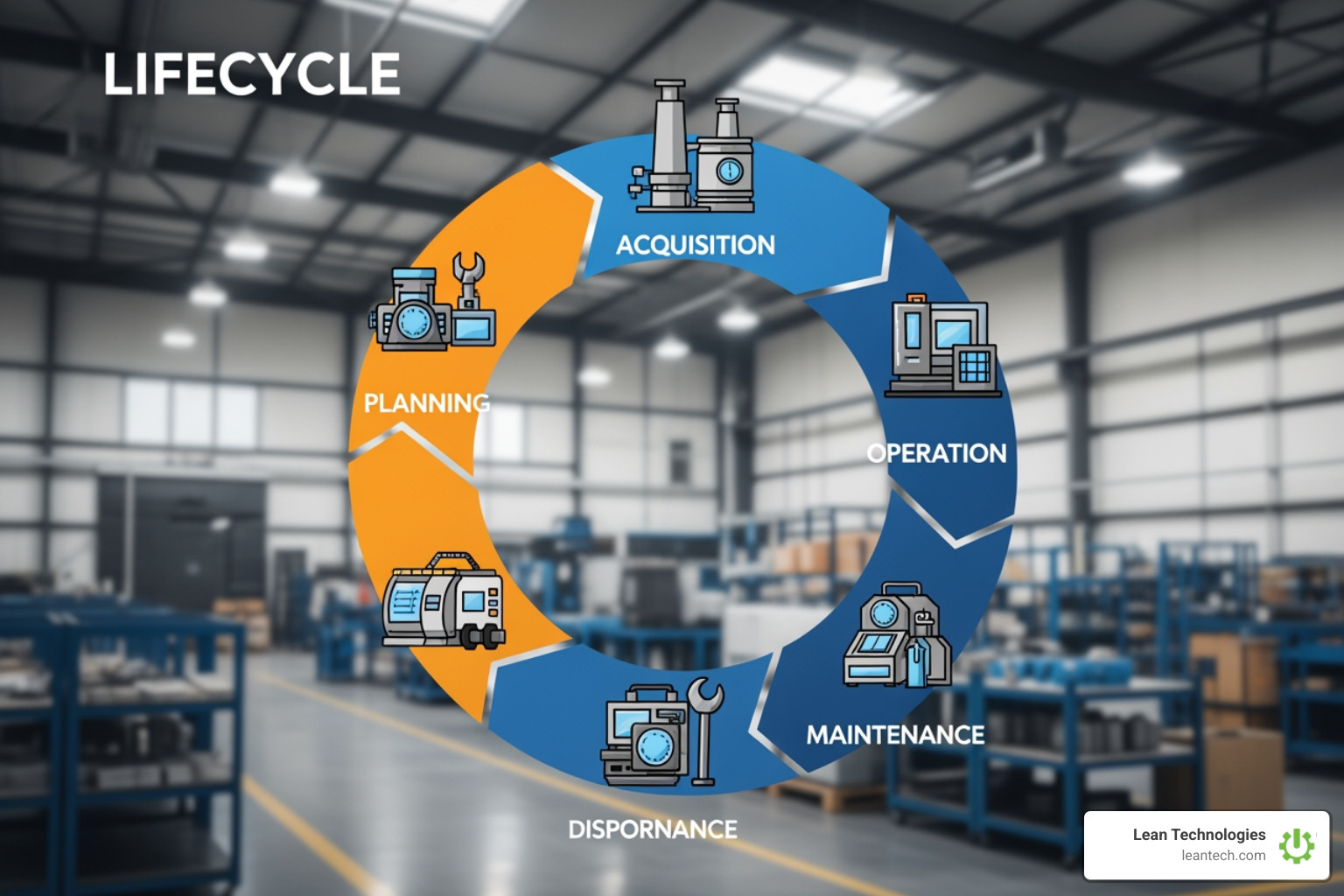
The five core stages are Planning, Acquisition, Operation, Maintenance, and Disposal. Some frameworks break these down further into six stages to include "Deployment" or "Replacement" as distinct steps.
Stop Managing Your Shop Floor Through Spreadsheets
Let’s be honest: if your asset management strategy lives in a spreadsheet that only one person knows how to update, you don't have a strategy—you have a bottleneck.
At Lean Technologies, we built Thrive to solve this exact problem. Thrive isn't another clunky ERP that takes three years to implement. It’s a customizable shopfloor platform developed by manufacturing experts who have actually stood on a greasy floor and wondered why the line stopped.
Thrive gives you real-time visibility into your equipment status and maintenance needs. When an operator sees an issue, they log it. When a technician completes a PM, the data is captured instantly. You get actionable data that helps you drive digital lean processes without the fluff.
Stop reacting to the "fire of the day." Start managing your assets with the precision your business deserves.
Want faster problem-solving? It starts with better visibility.
Check out Thrive Maintenance and let your team run lean—with real-time visibility and fewer workarounds.