

An Essential Guide to Behavior Based Safety
Why Behavior Based Safety Matters on the Shop Floor
Behavior based safety is a proactive approach to workplace safety that focuses on observing, analyzing, and changing unsafe behaviors before they lead to injuries. Instead of reacting to incidents after they happen, BBS programs train workers to spot at-risk actions, provide feedback to peers, and address the root causes that drive unsafe habits.
Quick Answer: What is Behavior Based Safety?
What it is: A systematic process where employees observe each other's work behaviors, identify safe and unsafe actions, and provide immediate feedback to prevent injuries
How it works: Uses the ABC model (Antecedent → Behavior → Consequence) to understand why unsafe acts happen and how to change them
Who's involved: Everyone from operators to supervisors, with peer-to-peer observation at the core
The goal: Create a culture where safety is owned by the team, not just enforced from the top
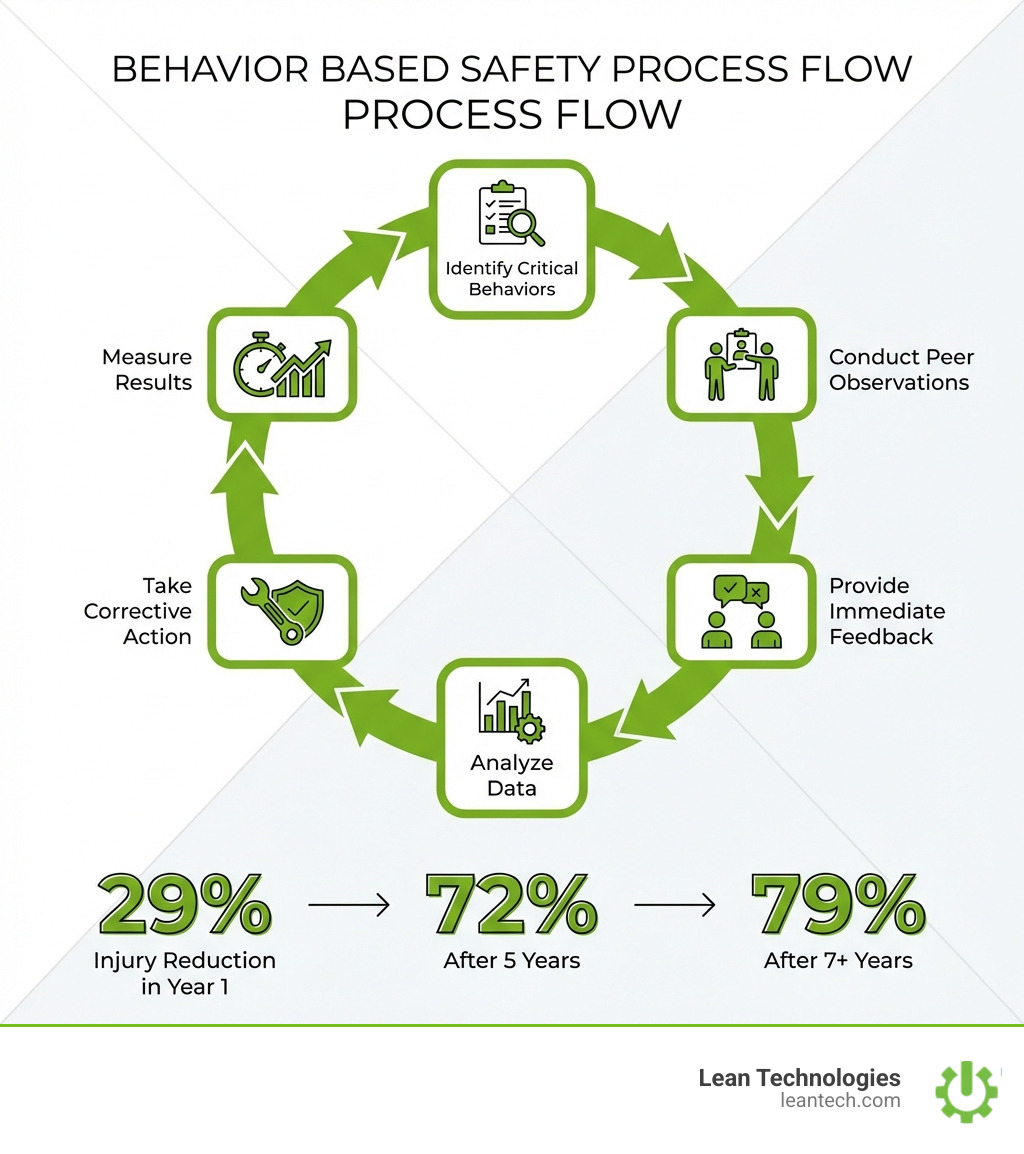
The impact: Organizations see an average 29% reduction in injuries after one year, growing to 72% after five years
Here's the problem most plants face: you can't improve what you can't see. Safety incidents don't just happen—they're the result of behaviors that pile up over time. A shortcut here. A skipped step there. Pressure to keep moving. By the time someone gets hurt, it's too late.
Nearly 3 million nonfatal workplace accidents were reported in the U.S. in 2011, along with nearly 4,700 fatal injuries. The national cost of occupational injury and illness hit approximately $250 billion in 2007. Most of these incidents involve an unsafe habit or behavior—something that could have been observed, corrected, and prevented.
That's where behavior based safety comes in. It's not about blaming workers. It's about giving them the tools and structure to identify risk, speak up, and fix problems before anyone gets hurt. When done right, BBS shifts safety from a top-down mandate to a team-owned process.
But here's the catch: real-time visibility only works when the process is structured and data is captured at the source. If observations are logged on paper and entered at the end of the shift, you're already too late. The shop floor moves fast. Safety programs need to move faster.
What Is Behavior Based Safety (and What It's Not)
Behavior based safety (BBS) is a scientific approach to improving workplace safety by focusing on observable behaviors and their underlying causes. At its core, BBS is the "application of science of behavior change to real world safety problems." It's a proactive strategy that helps organizations understand why people do what they do and then applies research-supported interventions to improve those actions.
This isn't just a management fad; it's rooted in the larger scientific field of organizational behavior management. The goal is to create a safety partnership between management and employees, continually focusing attention and actions on daily safety behavior. This means moving beyond just rules and regulations to foster a culture where safety is ingrained in every action.
One common misconception is that BBS is solely about blaming workers. A poorly implemented program can certainly feel that way, leading to resentment and underreporting. However, a well-designed behavior based safety program aims to address the conditions and systemic issues that lead to unsafe acts, empowering employees to be part of the solution rather than the sole problem. It acknowledges that people often work in conditions that force them to choose between working safely or taking shortcuts, and then finds solutions to encourage safe behavior. It focuses on identifying and changing unsafe behaviors, not punishing individuals.
The ABC Model: Understanding Why Unsafe Acts Happen
To truly understand and change behavior, BBS often uses the Antecedent-Behavior-Consequence (ABC) model. This well-established strategy helps analyze and potentially change how people act by breaking down the factors influencing their choices.
Antecedent (A): These are the triggers or events that come before a behavior. They can be external factors (like a supervisor's instruction, a warning sign, or a tight deadline) or internal emotions (like stress or fatigue). For example, a supervisor telling an employee not to bend their back while lifting is an antecedent.
Behavior (B): This is the observable action or inaction that occurs. In BBS, we focus on safety-related behaviors—both safe and unsafe. It's what you can see someone doing, or not doing. For instance, an employee bending their back while lifting, or an employee using proper lifting technique.
Consequence (C): These are the events that happen after a behavior, which then influence whether that behavior is likely to be repeated. Consequences can be positive (reinforcing the behavior) or negative (discouraging it). For example, if an employee takes a shortcut and nothing bad happens, they might continue that unsafe behavior. If they use proper lifting technique and receive positive feedback, they're more likely to do it again.
The ABC model is deeply tied to the psychological principles of operant conditioning, pioneered by B.F. Skinner. This theory explains how consequences shape behavior.
Positive reinforcement: A desirable stimulus is introduced to encourage a certain behavior. "Henry, thank you for moving those supplies out of the path. That's the kind of housekeeping that prevents people from tripping and falling." This makes Henry more likely to keep the path clear.
Negative reinforcement: An undesirable stimulus is removed to encourage a behavior. For instance, if a noisy machine stops making noise when an employee properly secures a guard, they're more likely to secure the guard in the future to avoid the noise.
Positive punishment: An undesirable stimulus is introduced to discourage a behavior. "Jackie, you were driving pretty fast when you took that corner, and you didn't use your horn. You could have hit someone. Next time, please slow down and use your horn to make sure everyone knows you're coming." This aims to reduce speeding.
Negative punishment: A desirable stimulus is removed to discourage a behavior. For example, if a safety incentive (like a bonus) is withheld due to an unsafe act, it discourages that unsafe act.
In the context of BBS, the focus is largely on positive reinforcement to encourage safe behaviors, while carefully using corrective feedback to address unsafe acts without instilling fear. For an in-depth look at these concepts, consider exploring resources on the ABC Model explained.
Traditional vs. Behavior Based Safety Approaches
For years, many organizations relied on traditional safety methods. But how does behavior based safety stack up against these older approaches? It’s not about replacing everything you’ve done, but enhancing it.
Feature Traditional Safety Approaches Behavior Based Safety (BBS) Primary Focus Conditions, equipment, compliance with regulations, incident rates (lagging indicators) Observable behaviors, actions, root causes of unsafe acts, proactive interventions (leading indicators) Approach Reactive (after incidents), top-down, management-driven, enforcement-heavy Proactive (before incidents), employee-led, peer-to-peer observations, positive reinforcement, data-driven Responsibility Primarily management, safety department Shared by everyone, from leadership to frontline workers Intervention Engineering controls, administrative rules, PPE, investigations after incidents Feedback, coaching, behavior modification, addressing systemic issues that drive unsafe acts Culture Impact Compliance-driven, often seen as "rules imposed" Ownership, engagement, continuous improvement, fostering a "total safety culture" Data Usage Incident reports, injury statistics Observation data, near-misses, analysis of safe/unsafe behaviors, trends
Behavior based safety differs from traditional safety approaches by shifting the focus from solely fixing hazards or enforcing rules to understanding and influencing human actions. Traditional methods are crucial for addressing physical hazards and ensuring compliance. However, BBS dives deeper, recognizing that even with the safest equipment and procedures, human behavior plays a significant role in incidents.
BBS is a complementary system, not a replacement. In a robust safety management system, BBS may be applied to internalize hazard avoidance strategies or administrative controls, but it should not be used in preference to the implementation of reasonably practicable safety measures further up the hierarchy of controls (like elimination or engineering controls).
The Core Components of a Successful BBS Program
A successful behavior based safety program isn't just a set of rules; it's a dynamic system built on active participation and continuous improvement. It relies on a few key elements working in harmony to drive sustainable change on the shop floor.

Key Elements of a Behavior Based Safety Program
For a BBS program to truly take root and thrive, it needs several essential components:
Critical Behavior Checklists (CBCs): These are the backbone of observations. CBCs identify specific, observable behaviors that are critical to safety in your workplace. They must be:
Observable: You can see or hear the behavior.
Reliable: Multiple observers would describe it the same way.
Controllable: The employee has direct control over performing the behavior.
Positive: Described in terms of what should be done, not what shouldn't. For example, instead of "Didn't wear safety glasses," a CBC item would be "Wears safety glasses correctly." These checklists help standardize observations and focus on the most impactful actions.
Peer-to-Peer Observation: This is where the magic happens. Employees are trained to observe their colleagues performing tasks, using the CBCs. The observations are not about "catching" someone doing something wrong, but about gathering data on current safety practices. This fosters a sense of shared responsibility and builds trust.
Immediate and Constructive Feedback: The power of BBS lies in timely feedback. After an observation, the observer provides immediate, specific, and objective feedback to the observed employee.
Positive feedback: Reinforces safe behaviors. "Henry, thanks for moving those supplies. Your housekeeping prevents trip hazards and keeps everyone safe." This encourages more safe acts.
Corrective feedback: Addresses unsafe behaviors. "Hey Jackie, we appreciate your hard work. Just one note for added safety, remember to take corners a bit slower and give a quick horn. Thanks for keeping safety in mind!" This focuses on the behavior, not the person, and explains the why. The goal is to coach, not scold, and to collectively identify and remove barriers to safe work performance.
Data-Driven Root Cause Analysis: All those observations generate valuable data. This data isn't just for show; it's analyzed to identify trends, common unsafe behaviors, and their underlying causes. Is it a lack of training? Faulty equipment? Pressure from production goals? This analysis helps pinpoint systemic issues, not just individual failings. This is where a platform like Thrive truly shines, making it easy to log, track, and analyze observation data in real-time.
Setting SMART Safety Goals: Based on the data analysis, the team sets Specific, Measurable, Achievable, Relevant, and Time-bound (SMART) goals. For example, "Reduce observed hazardous behaviors by 10% over the course of the quarter" or "Achieve 98% compliance with proper personal protective equipment (PPE) use by the end of the year." These goals provide clear targets for continuous improvement.
The Role of Employees and Management
A behavior based safety program requires buy-in and active participation from everyone. It's a team sport, not a spectator event.
Employee Involvement: This is non-negotiable. Employees are involved in every step: designing the program, developing checklists, conducting peer observations, providing feedback, and analyzing data. This ownership is crucial for success. When employees feel they own the process, they're more engaged and committed. They become the "eyes and ears" on the shop floor, identifying issues and coaching each other on safe and risky behaviors.
Peer Observations: This is a cornerstone of employee involvement. It shifts the responsibility of safety from a top-down mandate to a shared team effort. The goal is to create a supportive environment where workers coach each other, not an atmosphere of "gotcha."
Process Ownership: When employees are empowered to design and manage the BBS process, it leads to higher active involvement and a more positive approach compared to purely management-driven safety audits. They're solving their problems, for their safety.
Management Commitment: No program, especially one focused on cultural change, succeeds without unwavering management commitment. This isn't just about giving lip service; it's about providing resources, removing barriers, and actively participating. Managers and supervisors must lead by example, conduct observations themselves, and show that safety is a value, not just a priority. They must ensure the organization aggressively addresses physical hazards and unsafe working conditions, demonstrating that they are fixing the system, not just blaming the person. This builds the trust essential for employees to accept the program. For insights on building a strong safety culture, check out our guide on creating a strong safety culture.
Providing Resources: This includes training, time for observations, and the right tools. If employees are expected to conduct observations and analyze data, they need the training and digital tools to do it efficiently.
Removing Barriers: Management must be proactive in identifying and removing obstacles that force employees into unsafe behaviors. Is equipment faulty? Are procedures unclear? Is there pressure to meet unrealistic production targets that encourage shortcuts? Addressing these systemic issues is critical.
Building Trust: Trust is the foundation. If employees fear punishment or blame, they won't participate authentically. A successful BBS program fosters open dialogue and communication, where feedback is seen as an opportunity for improvement, not an accusation.
How to Implement and Measure a BBS Program
Implementing behavior based safety is a journey, not a destination. It requires a structured approach, careful planning, and a commitment to continuous improvement.
Step-by-Step Implementation Guide
Here’s how to get a BBS program off the ground and keep it flying:
Assess Readiness: Before diving in, evaluate your organization's culture. Do employees believe management is committed to safety? Is management demonstrating this commitment through proper facilities and maintenance? Are employees willing to work with management to minimize injury risk? An honest assessment helps prepare the ground.
Form a Design Team: Create a cross-functional team, ideally composed primarily of employees and representatives from different departments. This team will design the specifics of your BBS program. Their involvement is key to fostering ownership and ensuring the program fits your unique shop floor environment.
Identify Critical Behaviors: The design team, with input from frontline workers, identifies the specific, observable behaviors that are most critical for safety in your workplace. These become the items on your Critical Behavior Checklists. Focus on high-frequency, high-severity behaviors first.
Train Observers and Employees: Everyone needs training. Observers need to learn how to conduct observations objectively, how to use the checklists, and, most importantly, how to deliver immediate, specific, and constructive feedback. Employees being observed need to understand the purpose of the program and how to respond to feedback. This training is vital for the program's credibility and effectiveness. For effective training strategies, explore resources on train every employee about behavioral based safety.
Launch and Observe: Roll out the program! Start conducting peer observations. It's often beneficial to announce observational periods to mitigate initial negative perceptions, though authentic behaviors tend to emerge over time. The goal is to gather data, not to play "gotcha."
Analyze Data: Collect the observation data. This is where digital tools make a world of difference. Instead of sifting through paper forms, a platform like Thrive can help you log observations in real-time, instantly aggregating data on safe/unsafe behaviors, trends, and areas needing improvement. This data forms the basis for action.
Take Corrective Action: Based on the data analysis, the design team (and often broader employee groups) develops action plans. These plans should address the root causes of unsafe behaviors, whether they involve training gaps, equipment issues, procedural changes, or even cultural factors. This is a critical step in project management for implementation to ensure solutions are tracked and completed.
Review and Refine: A BBS program is never "done." Continuously evaluate its effectiveness, solicit feedback from participants, and make adjustments as needed. This iterative process ensures the program remains relevant and impactful.
Measuring Success: Are We Getting Safer?
Measuring the success of your behavior based safety program means looking beyond just lagging indicators (like injury rates) to include leading indicators that show proactive safety efforts.
Leading Indicators: These are forward-looking metrics that predict future performance and show what you're doing before an incident.
Percent Safe: The percentage of observed behaviors that were performed safely. This is a direct measure of the program's impact on daily actions.
Observations Completed: The number of observations conducted, indicating engagement and activity levels.
Feedback Given: Tracking the quantity and quality of both positive and corrective feedback.
Corrective Actions Implemented: The number of issues identified through observations that have been addressed.
Lagging Indicators: These are backward-looking metrics that tell you what has already happened. While not the sole focus of BBS, they are the ultimate measure of impact.
Injury Rate Reduction: This is the big one. Research shows significant reductions:
On average, one year after implementing BBS, the recorded injury rate at industrial sites decreases by 29%.
After five years, the reduction rate averages 72%.
After seven or more years, the average recorded injury rate has dropped by 79%.
Severity Rate Reduction: Beyond just the number of injuries, BBS can also reduce how severe those injuries are. For example, one automobile plant saw a 96% drop in injury severity rate after implementing BBS.
Near-Miss Reporting: An increase in near-miss reporting can paradoxically be a sign of success, indicating a more open culture where employees feel safe reporting potential issues without fear of blame.
Case studies consistently show the power of BBS. For instance, Pool California Energy Services implemented a BBS approach that led to a 52% drop in hand, wrist, and finger injuries over 12 months. Another example saw a 92% reduction in "first-time occupational visits" compared to sister plants without the intervention. These results highlight that focusing on behaviors directly translates to a safer, more productive workplace. For more examples, explore Behavior-Based Safety Case Studies.
BBS, the Hierarchy of Controls, and OSHA
Understanding where behavior based safety fits within the broader safety landscape is crucial. It's a powerful tool, but it's part of a larger system—one that prioritizes hazard elimination.

Where Behavior Based Safety Fits in the Hierarchy of Controls
The Hierarchy of Hazard Controls is a fundamental principle in occupational safety, outlining the most effective ways to minimize or eliminate exposure to hazards. It's often visualized as a pyramid, with the most effective controls at the top.
Elimination: Physically remove the hazard (e.g., stopping a dangerous process).
Substitution: Replace the hazard (e.g., using a less toxic chemical).
Engineering Controls: Isolate people from the hazard (e.g., machine guards, ventilation systems).
Administrative Controls: Change the way people work (e.g., safe work procedures, training, job rotation).
Personal Protective Equipment (PPE): Protect the worker with equipment (e.g., safety glasses, gloves).
Behavior based safety primarily falls under Administrative Controls. It's about influencing how employees interact with their environment and follow procedures. For example, BBS can reinforce the proper use of machine guards (an engineering control) or ensure adherence to lockout/tagout procedures (another administrative control).
However, BBS should never be used as a substitute for higher-level controls. If a hazard can be eliminated or engineered out, that should always be the priority. For instance, if a machine consistently causes injuries due to its design, the first step should be to redesign the machine (engineering control), not just to observe workers to see if they're "behaving safely" around the inherently dangerous design. BBS shines when it reinforces safe work practices around unavoidable hazards or ensures the effective use of existing engineering controls and PPE.
Does OSHA Require Behavior Based Safety?
This is a common question, and the answer is straightforward: OSHA does not specifically mandate organizations to implement a behavior based safety program. There's no regulation that says "Thou shalt have a BBS program."
However, this doesn't mean OSHA is indifferent to behavioral safety. OSHA strongly recommends practices for safety and health programs that include the involvement of employees and managers in safety and hazard identification and assessment. A strong BBS program directly assists organizations in meeting these recommendations by:
Promoting employee involvement: BBS is inherently employee-driven, encouraging active participation in safety.
Facilitating hazard identification and assessment: Through observations and feedback, employees are constantly identifying potential hazards and unsafe conditions.
Supporting continuous improvement: The data-driven nature of BBS helps organizations continually refine their safety efforts.
While BBS programs cannot stand alone for OSHA compliance (because they largely focus on administrative controls, and hazards must be addressed by elimination, substitution, or engineering controls first), they are a powerful tool to support a comprehensive safety management system. OSHA's training mandate, for example, requires employers to train employees on the hazard itself, how to recognize specific hazards, why they're dangerous, and the potential safety and health consequences. BBS can reinforce this training through practical application and feedback. For more on OSHA's recommendations, refer to their recommended practices for safety and health programs.
Frequently Asked Questions about Behavior Based Safety
Is BBS just a way to blame workers for accidents?
No, a properly implemented program focuses on fixing systemic issues that lead to unsafe acts. It empowers workers to identify and remove hazards, moving away from blame and toward solutions.
How long does it take to see results from a BBS program?
Organizations often see a measurable reduction in incidents within the first year. Statistics show an average injury rate decrease of 29% after one year, growing to 72% after five years as the safety culture matures.
Can we implement BBS without outside help?
While possible, creating a successful program from scratch is challenging. The key is a structured approach, strong leadership commitment, and genuine employee involvement to build the trust necessary for the program to work.
Putting Behavior Based Safety into Action
Behavior based safety is a powerful, proactive tool for creating a sustainable safety culture, but only when it's part of a complete safety system. It succeeds when it focuses on fixing the system, not blaming the person. A structured approach requires the right tools. Platforms like Thrive help manufacturing teams digitize safety processes, track observations, and manage corrective actions in real-time, turning data into a safer shop floor. Stop managing safety with spreadsheets. See how you can build a stronger safety culture.