
All About Breakdown & Preventive Maintenance
Start with the Pain: Why Maintenance Strategy Matters
Breakdown and preventive maintenance are two fundamentally different approaches to keeping your equipment running—and the choice between them directly impacts your shop floor stability, budget, and team's sanity.
Quick Answer: What's the Difference?
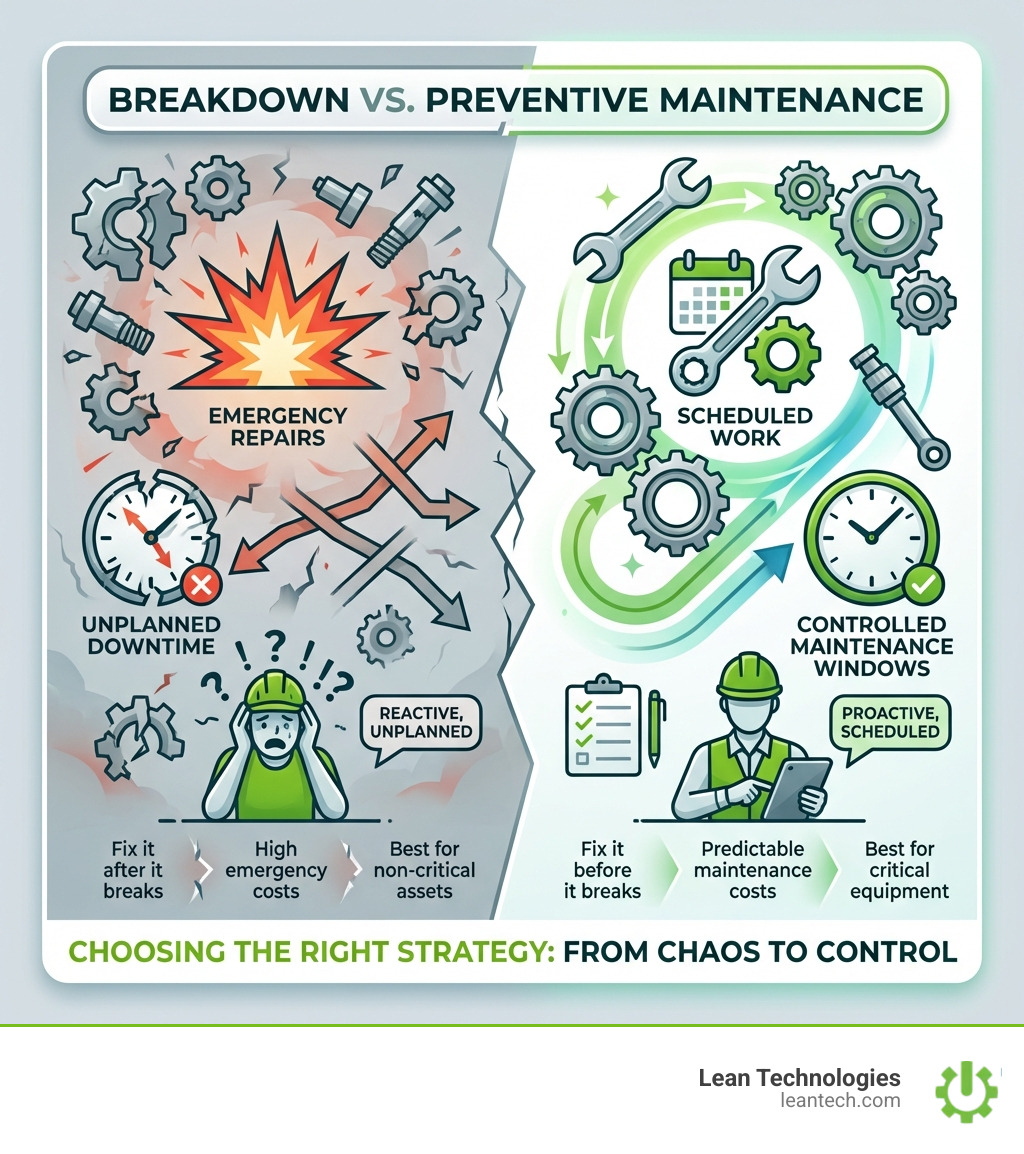
Breakdown Maintenance Preventive Maintenance Fix it after it breaks Fix it before it breaks Reactive, unplanned Proactive, scheduled High emergency costs Predictable maintenance costs Unplanned downtime Controlled downtime Best for non-critical assets Best for critical equipment
Here's the reality most plant managers face every week:
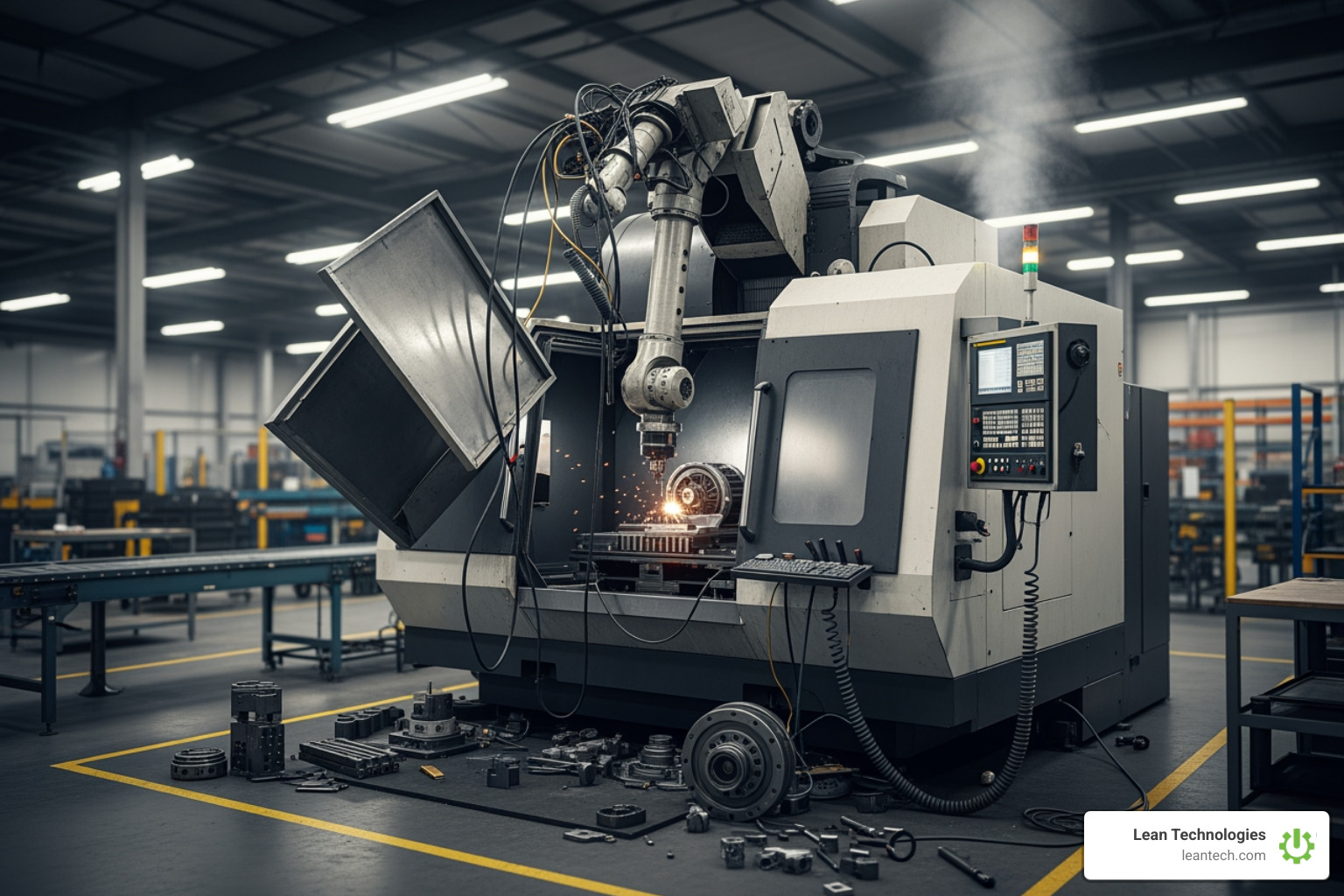
A critical machine goes down mid-shift. Production stops. Your team scrambles to find the problem. You're calling suppliers for rush parts. Operators are standing around. Your schedule is blown. And you're explaining to leadership why you missed the day's targets—again.
This is breakdown maintenance in action. You run equipment until it fails, then react.
Now imagine a different scenario: Your maintenance team wraps up a scheduled 30-minute inspection on that same machine during a planned window. They catch a worn bearing, swap it out with a part you already had on hand, and the line keeps humming. No surprises. No scrambling. No missed targets.
That's preventive maintenance. You plan the work before problems force your hand.
The gap between these two approaches isn't just operational—it's financial and cultural. Unplanned downtime can cost 10x more than planned downtime, according to industry research. Emergency repairs mean overtime labor, rush shipping, collateral damage to other components, and lost production time you can't get back.
But here's what we see in real manufacturing plants: most teams are stuck in firefighting mode not because they want to be, but because their systems don't give them a better option. Paper logs, scattered spreadsheets, and end-of-shift data entry mean problems are finded too late—when they've already become crises.
The path forward isn't complicated. You need to know which assets deserve proactive care, which ones can run to failure, and how to capture maintenance data in real time so you can actually act on it. That's what this guide is about.
The Real Difference: Reactive vs. Proactive Maintenance
Every piece of equipment on your shop floor needs attention. The question isn't if it needs maintenance, but when and how. This decision shapes everything from your daily workflow to your annual budget. It's the core difference between reacting to chaos and proactively building stability.
At its heart, the fundamental difference between breakdown and preventive maintenance lies in their approach, triggers, and planning.
Breakdown maintenance (BM) is reactive. Its primary trigger is equipment failure. The machine stops, production halts, and then—and only then—does the maintenance team spring into action. It's a "run-to-failure" mindset. Think of it like waiting for your car to break down on the highway before you ever consider an oil change. There's no planning beyond hoping for the best and scrambling when the worst happens. This approach often leads to shop floor instability, unpredictable downtime, and a constant state of firefighting.
Preventive maintenance (PM), on the other hand, is proactive. It's triggered by a schedule—based on calendar time, asset runtime, or other predefined periods. The goal is to catch potential issues before they cause a breakdown. This involves planning work orders, scheduling inspections, and performing routine tasks like lubrication or part replacements. It's about maintaining shop floor stability by avoiding surprises. You're trying to maximize asset lifespan and runtime, keeping production smooth and predictable.
What is Breakdown Maintenance?
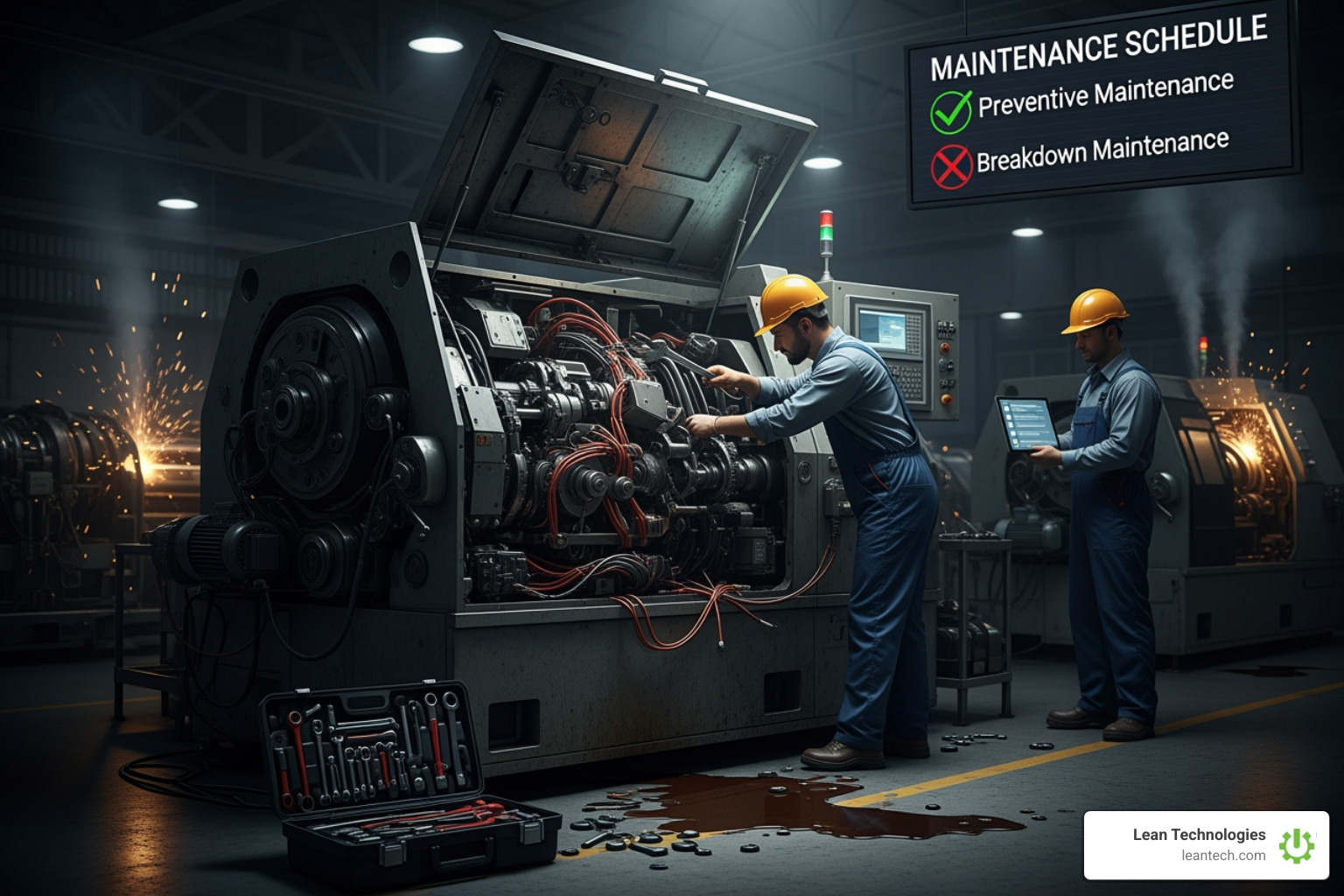
Breakdown maintenance is exactly what it sounds like: you fix it when it breaks. It's a reactive approach where equipment runs until it fails or stops working properly. This is also often called "run-to-failure" maintenance. There's no proactive plan; the trigger for action is simply a downtime event.
For instance, if a non-critical machine in a factory stops working, and its failure doesn't disrupt the main production line or pose an immediate safety risk, you might opt for breakdown maintenance. You fix or replace it only after it has failed. This strategy is simple: no maintenance is performed until an issue arises. While it might seem cost-effective initially due to minimal upfront planning, it carries significant risks and hidden costs.
There are even types of breakdown maintenance. "Unplanned breakdown maintenance" is the chaotic scramble when something unexpectedly fails. But there's also "planned breakdown maintenance," where you anticipate a failure for a non-disruptive issue and schedule the repair for a future date. This is typically reserved for assets where failure won't impact productivity or safety, or for short-life, inexpensive items. But make no mistake, even planned breakdown maintenance is still reactive to an eventual failure.
What is Preventive Maintenance?
Preventive maintenance is the opposite of breakdown maintenance. It's a proactive approach focused on avoiding unexpected failures through regular, scheduled upkeep. The trigger for PM isn't a breakdown, but a predetermined interval or condition.
This strategy involves a variety of tasks:
Routine checks and inspections: Regularly looking for signs of wear or potential problems.
Timely replacement of worn parts: Swapping out components before they fail catastrophically.
Regular lubrication and adjustments: Keeping machines running smoothly and efficiently.
Digital checklists: Using standardized procedures to ensure consistency and accountability.
For most equipment in a factory setting, preventive maintenance is a solid plan. It aims to identify and address issues before they escalate, extending the life of your assets and optimizing maintenance planning. For example, regularly inspecting a CNC machine's components and replacing them based on manufacturer recommendations, rather than waiting for a critical part to fail during a production run. This approach includes time-based maintenance (e.g., oil changes every 500 operating hours), usage-based maintenance (e.g., filter replacement every 10,000 cycles), and even condition-based maintenance (e.g., replacing a bearing when vibration levels exceed a threshold).
The True Cost: Breakdown vs. Preventive Maintenance
When we talk about breakdown and preventive maintenance, the discussion quickly turns to cost. But it's not just the immediate repair bill; it's the total cost of ownership (TCO) and the long-term impact on your budget and operations. Many leaders focus on the visible costs, missing the hidden expenses that eat into profitability.
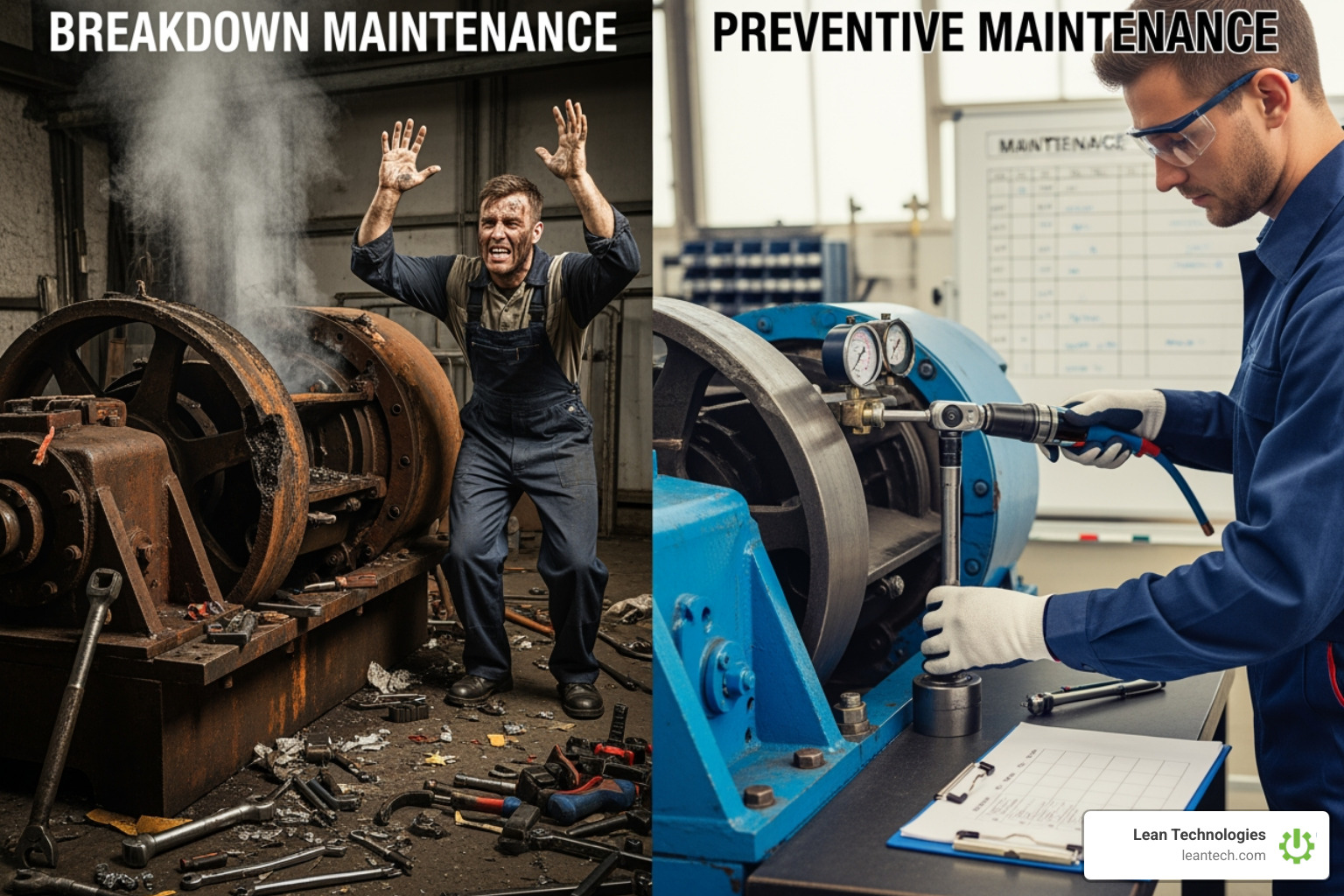
Industry research shows a clear picture: organizations that implement a robust preventive maintenance program can reduce their overall maintenance costs by 12% to 18%. This isn't just a hypothetical saving; it's a measurable reduction in your operational expenses. The difference boils down to predictability versus chaos, and planned investment versus emergency spending.
The High Price of Waiting: Breakdown Maintenance Costs
Waiting for equipment to fail might seem like a way to save money upfront. After all, you're not spending on maintenance until you absolutely have to. But this "low upfront-cost" model comes with a high risk later. The costs associated with breakdown maintenance are often far greater than the immediate repair.
Consider these impacts:
Unplanned Downtime: This is the big one. Production stops, and your team sits idle. Unplanned downtime can cost anywhere from $5,000 to $50,000 per hour in lost productivity, depending on your industry. This isn't just lost output; it's missed deadlines, unhappy customers, and potential contractual penalties.
Overtime Labor: When a machine breaks down, you need it fixed now. This often means calling in maintenance technicians after hours or on weekends, leading to emergency callouts that cost 1.5x to 3x more than scheduled visits.
Rush Parts: Finding the right replacement part quickly can be a nightmare. You're often paying premium prices for expedited shipping, bypassing your usual procurement processes, and tying up valuable resources in a frantic search.
Collateral Damage: A single failure often isn't isolated. A worn bearing that finally seizes can damage shafts, housings, or other interconnected components, turning a small repair into a major overhaul.
Safety Risks: Equipment failures can create hazardous conditions, leading to injuries or even fatalities. This carries immense human cost, legal liabilities, and reputational damage.
Lost Production and Quality Issues: Beyond the immediate stoppage, breakdowns can disrupt your entire production schedule, leading to delays, bottlenecks, and even quality defects in products made on a struggling machine.
Customer Headaches: Missed delivery dates and inconsistent product quality can erode customer trust and push them towards competitors.
The simplicity of breakdown maintenance is misleading. It often backfires, creating a silent liability that drains your budget and stresses your team.
The Smart Investment: Preventive Maintenance Costs
While preventive maintenance requires an upfront investment in planning, labor, and potentially spare parts, it’s an investment that pays off significantly in the long run. It shifts your cost structure from unpredictable emergencies to managed, budgeted expenses.
Here’s why PM is a smarter choice:
Predictable Cost Budgeting: You know when maintenance is scheduled, what parts you'll need, and how much labor it will take. This allows for accurate budgeting and avoids sudden, massive repair bills.
Scheduled Labor: Maintenance work is performed during planned downtime, often during non-peak hours or dedicated maintenance windows. This means regular labor rates, not costly overtime.
Parts on Hand: By anticipating needs, you can procure parts efficiently, negotiate better prices, and maintain a strategic inventory, avoiding rush shipping fees.
Controlled Downtime: Instead of abrupt, lengthy outages, PM involves short, planned stops. This means you can schedule maintenance around production, minimizing disruption and maximizing uptime.
Longer Asset Life: Regular care and timely component replacement significantly extend the operational lifespan of your equipment. Preventive maintenance can extend the life of assets by up to 25–30% longer for HVACs and chillers, for example. This delays costly capital expenditures for new machinery.
Fewer Safety Incidents: Proactively identifying and fixing issues before they become critical reduces the risk of equipment failure-related accidents, creating a safer work environment.
Smoother Audits and Compliance: Detailed records of scheduled maintenance provide documentation for regulatory compliance and internal audits, showing due diligence in equipment upkeep.
Preventive maintenance is engineered for long-term financial stability. It's not an expense; it's an insurance policy for your operations, reducing overall costs and improving reliability.
How to Choose: A No-Nonsense Framework
Deciding between breakdown and preventive maintenance isn't a one-size-fits-all answer. It's a strategic decision that depends on several factors specific to each asset on your shop floor. The goal is to strike the right balance, optimizing your maintenance efforts for maximum efficiency and minimum cost. This isn't about choosing one or the other exclusively; it's about intelligently combining them based on your assets' criticality and risk.
When evaluating which strategy to apply, consider:
Asset Criticality: How essential is this machine to your core production? If it goes down, does everything stop?
Failure Impact: What are the consequences of this asset failing? Is it just an inconvenience, or does it lead to safety hazards, significant production loss, or quality defects?
Repair Cost: How expensive is it to fix or replace the asset if it fails?
Redundancy: Do you have backup equipment that can step in if this asset breaks down?
Shop Environment: What are the regulatory, safety, and operational demands of your facility?
Here's a quick comparison to guide your decision-making:
Feature Breakdown Maintenance Preventive Maintenance Best For Non-critical, low-cost, redundant, easy-to-replace assets Critical, high-value, safety-sensitive, single-point-of-failure assets Cost Structure Low immediate spend, high emergency/unplanned costs Higher planned investment, lower long-term TCO Downtime Impact Unpredictable, lengthy, disruptive unplanned downtime Predictable, shorter, scheduled downtime Safety Risk Higher due to unexpected failures Lower due to proactive issue identification Asset Lifespan Shorter, accelerated wear and tear Extended, optimized operational life
When Breakdown Maintenance Makes Sense
While it's generally advisable to move towards proactive strategies, there are specific scenarios where breakdown maintenance is the most practical and cost-effective approach. These are typically for assets where the cost and effort of regular preventive checks would outweigh the cost of simply replacing them when they fail.
Breakdown maintenance works well for:
Non-critical assets: Equipment whose failure doesn't halt production or create significant bottlenecks.
Low-cost tools: Items that are inexpensive to replace rather than repair.
Redundant equipment: If you have multiple backups, the failure of one unit isn't catastrophic.
Easy swaps: Assets that can be quickly and safely replaced with minimal downtime.
Examples where breakdown maintenance is often the sensible choice:
Light bulbs: Replacing them only when they burn out is usually more cost-effective than scheduled replacements.
Non-essential hand tools: A broken wrench is simply replaced, not preventively maintained.
Office printers: Unless critical for a specific production process, these are often run to failure.
Disposable items: Some inexpensive components are designed to be used until they fail, with no repair expected.
When Preventive Maintenance is a Must
For many assets on your shop floor, preventive maintenance isn't just an option—it's essential. Relying on breakdown maintenance for these items would be irresponsible, leading to severe operational, financial, and safety consequences.
Preventive maintenance is non-negotiable for:
Critical machines: Equipment that directly impacts your main production line or is a single point of failure.
High-value assets: Expensive machinery where premature failure would mean significant capital expenditure.
Safety systems: Anything related to human safety and health, where failure could lead to injury or regulatory fines.
Compliance-driven equipment: Assets that must meet specific operational standards or have mandated maintenance schedules for certifications.
Examples where preventive maintenance is considered essential or non-negotiable:
CNCs: A core piece of manufacturing equipment where uptime is paramount.
Main power panels: Critical for facility operation and safety.
HVAC systems: Essential for environmental control, product quality, and employee comfort.
Production conveyors: Often part of an integrated line, a failure here can stop everything.
Medical equipment: In healthcare manufacturing, equipment reliability is critical for patient safety and product quality.
Fire safety systems: Absolutely non-negotiable for safety and regulatory compliance.
Aviation equipment: The airline industry has rigorous PM requirements for safety.
Making the Shift: From Firefighting to Proactive Maintenance
If your shop floor is stuck in a cycle of reactive maintenance, making the shift to a more proactive, preventive strategy might seem daunting. But it's a transition that pays dividends in stability, cost savings, and peace of mind. This isn't just about changing processes; it's about a culture change, driven by real-time data, better planning, and continuous improvement.
Organizations effectively transition by moving away from paper-based workarounds and embracing digital tools. This empowers your team to move beyond constant firefighting and towards systematic problem-solving.
Step 1: Map and Prioritize Your Assets
You can't maintain what you don't know you have, or what you don't know is critical. The first step in any effective maintenance strategy is to get a clear picture of your entire asset base.
Asset inventory: Create a comprehensive list of all equipment in your facility.
Criticality ranking: Prioritize each asset based on its importance to operations, the impact of its failure (production loss, safety risk, quality issues), and the cost of repair. This helps you focus your efforts where they matter most. Not all assets are created equal, and your maintenance strategy shouldn't treat them that way.
FMEA: While a deeper dive, understanding potential failure modes helps tailor your PM tasks.
Focus on what matters most: Dedicate your PM efforts to high-criticality assets first.
Step 2: Build and Use Digital PM Checklists
Once you know which assets need preventive care, the next step is to standardize how that care is delivered. This is where digital PM checklists become invaluable. They move beyond tribal knowledge and ensure consistency, accountability, and thoroughness.
OEM guidelines: Start with manufacturer recommendations for maintenance tasks and intervals.
Maintenance history: Use past repair data to refine your checklists, addressing recurring issues proactively.
Standard work: Define clear task definitions and pass/fail criteria for each checklist item. This ensures every technician performs the work the same way, every time.
Digital checklists for consistency: A digital checklist is a structured, repeatable reference that captures all necessary information—from meter readings to technician notes and photos. It ensures nothing falls through the cracks and provides an audit trail. Fleetio highlights that these checklists clarify what "done" looks like and create accountability.
Step 3: Get Real-Time Visibility with the Right Tools
The biggest hurdle for many manufacturing teams is the delay between an event happening and the data about that event becoming actionable. Paper logs and spreadsheets are "real-late." To truly shift to proactive maintenance, you need real-time visibility.
Ditch paper and spreadsheets: These legacy tools are inefficient, prone to errors, and create data silos. They make it impossible to track trends, manage resources, or respond quickly.
Use digital work orders: A Computerized Maintenance Management System (CMMS) or a shop floor platform allows you to create, assign, track, and close work orders digitally. This means instant updates, clear communication, and a centralized record of all maintenance activities.
Real-time tracking: When an operator logs an issue or a technician completes a task on a tablet or mobile device, that data is instantly available to managers. This allows for immediate decision-making and resource allocation.
Data-driven decisions: With real-time data, you can analyze trends, identify recurring problems, optimize maintenance schedules, and measure the effectiveness of your strategies. This moves you from gut feelings to informed choices.
Thrive gives you instant visibility—if it’s not logged at the source, it’s already too late. Our platform helps manufacturing teams digitize lean work processes in real time, enabling you to manage both planned and unplanned maintenance efficiently. It's about structuring your process so that data is entered at the source, giving you the visibility you need to act, not just react.
Frequently Asked Questions about Maintenance Strategies
What’s the main difference between breakdown and preventive maintenance?
The main difference is timing and approach. Breakdown maintenance is reactive; you fix equipment after it fails. The trigger is a breakdown event. Preventive maintenance is proactive; you perform scheduled tasks and inspections before failure occurs, based on time, usage, or condition. The trigger is a predetermined schedule or a warning sign.
Is breakdown maintenance ever the right call?
Yes, for certain assets. Breakdown maintenance is often the most cost-effective strategy for non-critical, low-cost, or redundant equipment where the expense and effort of planned maintenance would outweigh the cost of occasional replacement or repair. Examples include light bulbs, inexpensive hand tools, or non-essential office equipment.
How does a digital platform like Thrive help with both strategies?
Thrive provides a structured digital environment for managing maintenance. For breakdown maintenance, it allows teams to log failures instantly, track repair times, manage spare parts, and analyze root causes, turning reactive events into learning opportunities. For preventive maintenance, Thrive automates scheduling of routine tasks, digitizes checklists for consistency, and provides real-time tracking of work order completion, ensuring accountability and preventing issues from slipping through the cracks. It gives you the real-time visibility needed to manage both planned and unplanned work effectively.
What to Do Next
Stop managing maintenance with spreadsheets and guesswork. The days of reacting to every crisis are over. You need control, predictability, and the ability to make informed decisions about your equipment.
Get real-time visibility, structured work processes, and faster problem-solving across your shop floor. A proactive maintenance strategy is the backbone of a lean operation—and it starts with the right digital tools.