Continuous Improvement: The Cycle That Keeps on Giving
Why the Continuous Improvement Cycle Is the Backbone of Lasting Change
The continuous improvement cycle is a structured, repeatable process for making small, evidence-based changes that compound into lasting results — whether you're running a school district or a manufacturing plant.
Here's the short version:
What it is: A looping process of planning a change, testing it on a small scale, studying the results, and deciding what to do next
Core model: Plan-Do-Study-Act (PDSA) or Plan-Do-Check-Act (PDCA) — both are rooted in W. Edwards Deming's work from the mid-20th century
Key idea: No single change fixes a complex problem; improvement happens through repeated, informed cycles
Who uses it: Schools, hospitals, manufacturers, service organizations — any team trying to solve a specific problem systematically
Why it works: It forces teams to test before committing, learn from real data, and adapt to their specific context
Most organizations already know something needs to change. The real problem? They try to fix everything at once, skip the testing phase, or make decisions based on gut instinct instead of evidence. That's where most improvement efforts stall — not from lack of effort, but from lack of structure.
The continuous improvement cycle changes that. It gives teams a shared language, a clear process, and a built-in mechanism for learning from both success and failure.
The roots of this approach go back to Walter Shewhart's work at Bell Laboratories in the 1920s, later refined and popularized by W. Edwards Deming in post-war Japan. What started on factory floors has since spread to healthcare, education, financial services, and beyond — because the core logic is universal: small, tested changes beat large, untested overhauls every time.
But here's the catch. Research shows that even teams who adopt continuous improvement frameworks often struggle to follow through on the most important part — iteration. A review of 73 empirical studies in medicine found that only 20% documented multiple cycles of iterative change. In other words, most teams run one loop and stop. That's not continuous improvement. That's a one-time fix with extra paperwork.
True continuous improvement is a habit, not a project.
What Is the Continuous Improvement Cycle?
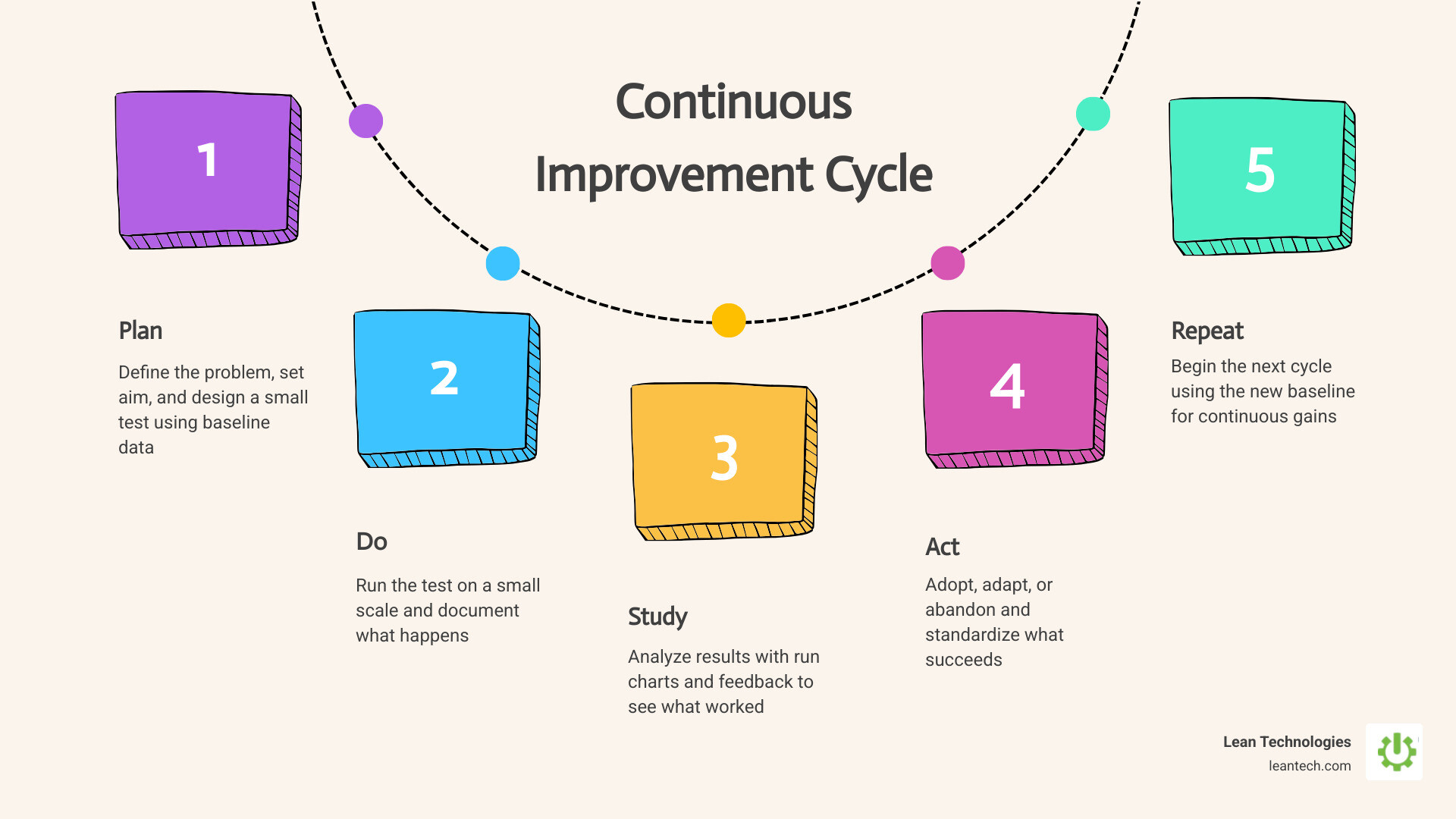
The continuous improvement cycle is an ongoing method for improving a process, service, or outcome through small, repeated tests. Instead of launching a giant fix and hoping for the best, teams make a change, observe what happens, learn from the result, and adjust.
That cycle is usually described as PDCA or PDSA:
Plan: define the problem, set a goal, and design a test
Do: run the test on a small scale
Check/Study: compare results to expectations
Act: adopt, adapt, or abandon the change
It is also called the Deming cycle or Shewhart cycle. Different industries prefer different names, but the logic stays the same: improve through disciplined learning.
Why the continuous improvement cycle works
It works because it lowers the risk of change.
Instead of betting the whole operation on one idea, teams run small tests. That makes it easier to spot weak assumptions, unintended side effects, and practical constraints before a full rollout. It also creates evidence-based decisions, not opinion contests dressed up as meetings.
A strong cycle usually includes:
A clearly defined problem
A prediction about what will happen
Baseline and follow-up data
Frontline input
Multiple rounds of learning
That last part matters. Improvement becomes sustainable when teams keep cycling. One test rarely solves a complex problem. The first round usually teaches the team what the real problem was.
Continuous improvement cycle in schools, districts, and operations
In education, the cycle helps teams focus on a specific problem of practice. A school might use it to improve attendance, reduce ninth-grade course failures, or strengthen reading intervention. A district might use it for scheduling, onboarding, or professional development.
In manufacturing and operations, the same structure applies to scrap reduction, downtime response, audit readiness, preventive maintenance completion, safety reporting, or first-pass yield.
Different setting, same headache: too many guesses, not enough learning.
That is why the model travels well. It is less about the industry and more about the discipline of solving problems in context.
The Core Principles Behind Continuous Improvement
At its best, continuous improvement is not just a tool. It is a way of working. Teams stop treating change like a dramatic one-time event and start treating it like a learning loop.

Three principles that make improvement stick
Research and practice point to three big ideas.
Change takes time and collective effort
Real improvement almost never comes from one person sending one email with one new policy. It takes coordination, follow-up, and shared ownership. Teams need leaders, frontline staff, and subject experts working together.
Context matters
What works in one classroom, department, or production line may fail somewhere else. Different staffing, schedules, materials, customer demand, or constraints change the outcome. That is why teams need local testing, adaptation, and solid data literacy.
Small changes can scale
Sustainable improvement often starts with a narrow test. A tiny change that works repeatedly is more valuable than a heroic overhaul that collapses in two weeks. Small wins also build confidence, which is useful when the team is already allergic to “another initiative.”
Continuous vs continual improvement
These terms are often used interchangeably, but some standards bodies make a distinction.
Continuous improvement usually refers to ongoing, step-by-step improvement
Continual improvement can refer more broadly to recurring improvement over time, including pauses between efforts
In practice, most teams do not need a philosophy debate in the middle of a problem-solving session. What matters is whether they are improving systematically and repeatedly.
Term Common meaning Practical takeaway Continuous improvement Incremental, ongoing improvement within existing processes Best shorthand for daily operational improvement Continual improvement Repeated improvement over time, sometimes in stages Often used in standards and management systems
How PDSA Structures the Improvement Process
PDSA is the clearest version of the cycle because it emphasizes learning, not just checking boxes. Deming preferred Study over Check because teams should do more than confirm whether something happened. They should compare predictions to actual results and update their thinking.
For more background, see Scientific research on PDSA cycle and Scientific research on PDCA cycle.
Plan: define the problem and design the test
The Plan step is where most success or failure gets decided.
A good plan includes:
A clear problem statement
An aim statement with a measurable target
Baseline data
Root cause analysis
A prediction
A small test design
Defined roles and timing
Example in education: A school team notices low homework completion among ninth graders. Instead of saying “students need to care more,” they define the issue more clearly: homework completion in Algebra I fell from 72% to 54% over eight weeks.
Example in operations: A plant team sees recurring delays in closing quality issues. They define the problem by shift, area, and average close-out time instead of blaming “poor accountability.”
That level of specificity matters.
Do and Study: test on a small scale and learn fast
The Do phase should be a pilot, not a full rollout. Small-scale testing reduces risk and makes learning faster.
During the test, teams should collect:
Quantitative data
Observation notes
Staff feedback
Customer or student feedback when relevant
Unintended consequences
Then comes Study. This is where teams ask:
What happened?
Did results match the prediction?
What surprised the team?
What side effects showed up?
What should change next?
Simple tools help here:
Run charts
Before-and-after comparisons
Brief learning logs
Short debriefs after the pilot
Act: adopt, adapt, or abandon
The final step is not “celebrate and disappear.”
Teams choose one of three paths:
Adopt: the change worked and should become standard work
Adapt: the change shows promise but needs adjustment
Abandon: the change did not help, or the side effects outweigh the benefit
If a change is adopted, it should be documented in standard work, training, checklists, or workflows. If it is adapted, the team starts the next cycle with a better test. That is the point: every Act step becomes the starting point for the next Plan step.
How to Plan a Continuous Improvement Effort
A lot of improvement work fails before it starts because the team jumps straight to solutions. Planning should cover readiness, people, cadence, scope, and measures.

A useful first step is assessing whether the culture and systems can support the work. Lean Technologies offers a Lean Culture Assessment that can help teams understand where they stand before launching improvement efforts.
Readiness checks before starting a continuous improvement cycle
Before a team starts, it should answer a few blunt questions:
Is there broad agreement that the problem matters?
Are there at least some ideas worth testing?
Does leadership support the effort?
Is there time, staffing, and meeting capacity?
Do team members have basic data skills?
Are there major barriers that could block execution?
If the answer to most of those is “not really,” the first improvement project may need to be readiness itself.
Common readiness checks include:
Shared urgency around the problem
Collaborative culture
Executive sponsorship
Access to usable data
Resource availability
Clear awareness of barriers
Build the right Improvement Team
Improvement teams do not need a crowd. Research suggests teams often work best with 3 to 12 people. Fewer than that can leave blind spots. More than that can turn every meeting into a panel discussion nobody wanted.
Typical roles include:
Sponsor: removes barriers and supports decisions
Facilitator: keeps the team moving through the method
Data lead: manages collection, displays, and interpretation
Frontline staff: bring reality into the room
Subject matter experts: add process knowledge
Recorder or coordinator: captures actions and follow-up
Meeting structure matters too. A practical rhythm is regular working meetings of about 90 minutes, with occasional longer sessions around 120 minutes for planning or deep review.
Set the aim, scope, and measures
Every improvement effort needs boundaries. Otherwise, the team ends up trying to “improve communication” across the entire organization, which is not a project. It is a cry for help.
Set:
Aim: what should improve, by how much, and by when
Scope: where the team will test first
Outcome measures: the final result to improve
Process measures: whether the new practice is being used
Balancing measures: whether the fix creates new problems elsewhere
For example:
Outcome: reduce late corrective actions by 30%
Process: complete daily issue review at each shift handoff
Balancing: monitor supervisor admin time so the new routine does not create hidden overload
Problem-Solving Tools That Make the Work Practical
The cycle is simple. The work is not. That is why good teams use practical tools.
Helpful supports include Project Management for keeping actions visible and Leader Standard Work for making follow-up part of the daily routine instead of a once-a-month ritual.
Use fishbone diagrams to define the real problem
A fishbone diagram helps teams look past symptoms and sort possible causes into categories.
Typical categories include:
People
Process
Equipment
Materials
Environment
Policy or management system
In education, categories might include curriculum, scheduling, staffing, family communication, or student support. In manufacturing, teams might look at setup, training, work instructions, inspection, tooling, or handoff breakdowns.
The fishbone is useful because it forces teams to ask, “What could be causing this?” before they jump to “Who messed this up?”
Use driver diagrams to connect causes to solutions
A driver diagram helps teams connect the big goal to the smaller drivers that influence it.
A basic driver diagram includes:
The overall aim
Primary drivers
Secondary drivers
Change ideas
It acts like a theory of action on one page. If the aim is to improve on-time completion of corrective actions, primary drivers might include issue visibility, ownership clarity, and escalation discipline. Secondary drivers break those down further, and then the team identifies testable change ideas.
Track results with simple visuals
Teams do not need fancy dashboards to learn, but they do need visibility.
Useful visuals include:
Run charts
Trend lines
Baseline comparisons
Open action boards
Short learning logs
The key is accessibility. If data lives in a spreadsheet no one opens until Friday, the team is driving by looking in the rearview mirror.
That is exactly where digital systems help. Instead of paper forms, scattered emails, or late Excel updates, teams can structure issue logging, ownership, due dates, and follow-up in one place. That is the kind of gap platforms like Thrive CI are built to close.
Benefits, Challenges, and How to Make the Cycle Last
The continuous improvement cycle has real benefits, but it is not magic. It works when teams use it with discipline.
For broader context, see Scientific research on continuous improvement model and Lean Technologies’ Guide to Digital Lean Manufacturing.
Benefits of the continuous improvement cycle in real settings
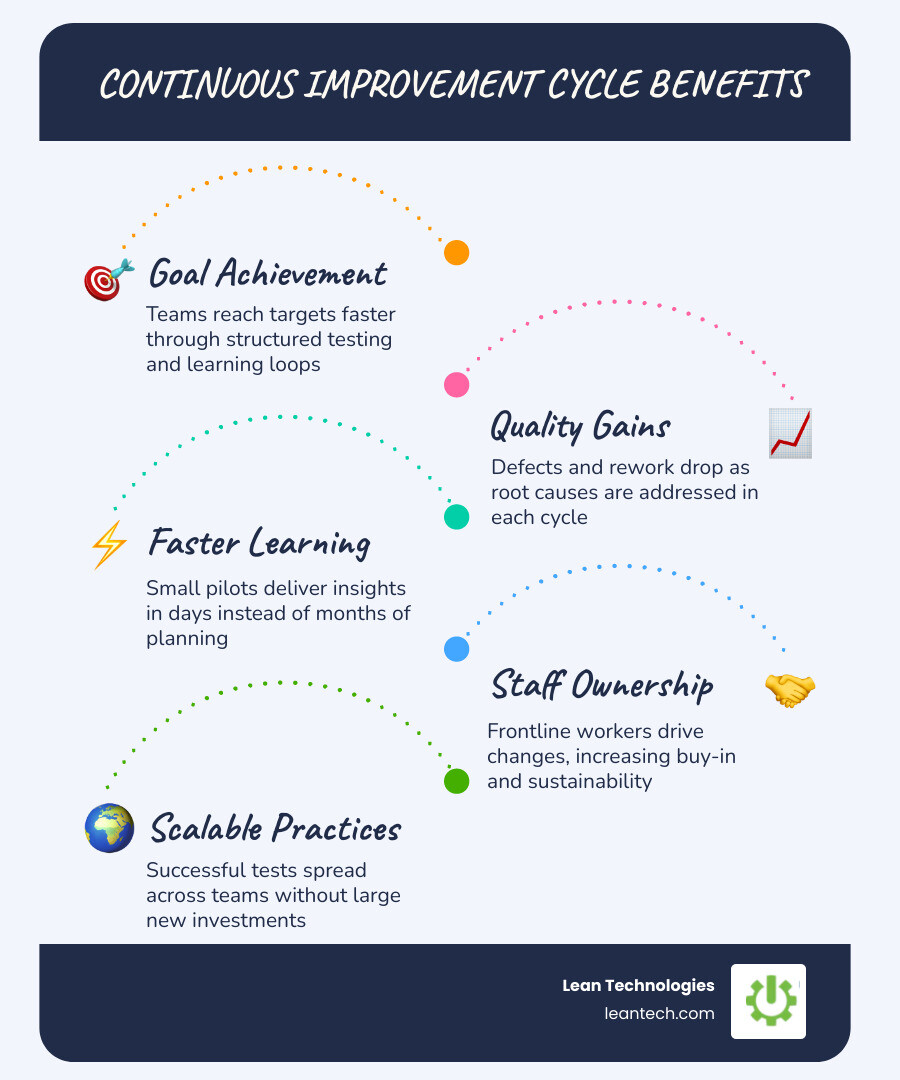
When done well, the cycle can lead to:
Better goal achievement
Faster learning
Less waste and rework
Stronger staff ownership
Better process consistency
More scalable practices
Evidence across sectors is mixed but promising. One randomized controlled trial in primary care facilities in the Netherlands found that organizations using continuous improvement methods achieved more of their improvement goals than those not using the same structured process.
That does not prove every effort will work. It does show that a systematic approach can outperform ad hoc change.
Common challenges teams run into
The biggest problems are usually not with the model itself. They are with execution.
Common failure points:
One-and-done efforts: teams run one cycle and stop
Weak problem definition: the team solves symptoms, not causes
Poor data quality: late, incomplete, or unreliable information
Pilots that are too large: too much risk, too many variables
Leadership drift: support disappears after kickoff
Meeting fatigue: too much talking, not enough testing
Poor fidelity: teams say they are using PDSA but skip core steps
That 20% statistic from the medical literature is a warning. Even when people use the language of continuous improvement, many do not actually run multiple iterative cycles. The method only works when the wheel keeps turning.
What to do next
If a team wants the continuous improvement cycle to last, it needs more than enthusiasm.
It needs:
Standardized workflows
Clear ownership
Real-time issue visibility
Action tracking
Documented follow-up
Leadership routines that reinforce the process
This is where digital lean systems matter. Lean Technologies’ Thrive CI helps manufacturers move improvement work out of paper binders and disconnected spreadsheets into a structured system teams can actually use in real time.
That means operators can log issues at the source. Supervisors can see open actions without chasing updates. CI leaders can track whether problems are getting solved or just renamed.
In short: stop managing improvement through spreadsheets and wishful thinking.
Frequently Asked Questions about Continuous Improvement Cycle
What is the continuous improvement cycle in simple terms?
It is a repeatable process for improving work through small tests. A team plans a change, tries it on a limited scale, studies the results, and decides what to do next. Then it repeats the cycle.
How is PDSA different from PDCA?
They are closely related. Both use four stages. The difference is emphasis:
PDCA uses Check
PDSA uses Study
Study pushes teams to compare predictions with actual results and learn more deeply from the test. In practice, both refer to the same improvement logic, but PDSA better highlights learning.
How can schools, districts, and plant teams adapt the cycle to different problems?
They adapt the cycle by keeping the structure the same and changing the measures, participants, and tests.
For example:
A school may test a new attendance follow-up routine with one grade level
A district may pilot a revised teacher onboarding process
A plant may test a new escalation method for downtime or quality issues on one line
The cycle is flexible because it is built around local context. The team defines the problem, chooses measures that matter, runs a small pilot, studies what happened, and then expands or adjusts.
What to do next
The continuous improvement cycle works because it is practical. It does not ask teams to predict the future perfectly. It asks them to test, learn, and improve faster than the problem grows.
For teams dealing with paper-based workarounds, delayed updates, and weak follow-through, that matters. A lot.
Internal next reads that fit this topic well:
Want faster problem-solving? It starts with better visibility, tighter follow-up, and a continuous improvement cycle your team can actually sustain.