
Mastering Continuous Improvement Practices That Drive Success
Why Real-Time Visibility Matters More Than Ever
Continuous improvement practices are the structured methods manufacturing teams use to eliminate waste, reduce defects, and optimize processes over time. These practices—like Kaizen, Lean, Six Sigma, and the PDCA cycle—help plants move from reactive firefighting to proactive problem-solving.
Core continuous improvement practices include:
Kaizen – Small, incremental changes driven by frontline employees
Lean – Eliminating the 8 types of waste to maximize value
Six Sigma – Data-driven defect reduction using DMAIC (Define, Measure, Analyze, Improve, Control)
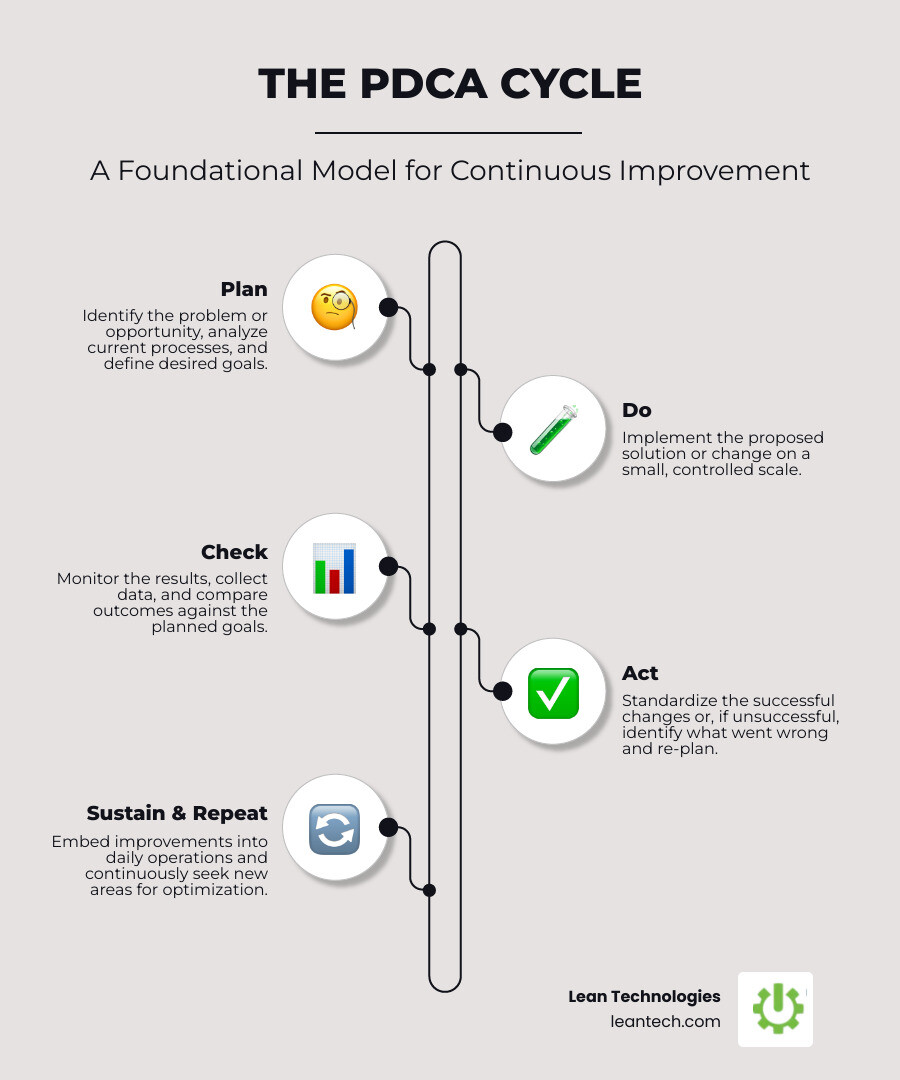
PDCA Cycle – Plan, Do, Check, Act for ongoing testing and refinement
Value Stream Mapping – Visualizing workflows to identify bottlenecks and inefficiencies
You know the drill. Your team logs downtime on paper. Issues get entered into a spreadsheet at the end of the shift—or worse, the end of the week. By the time you see the data, the problem's already happened three more times.
This is the gap between knowing you need to improve and actually improving in real time.
Toyota didn't save over $100 million in a single year through employee suggestions by waiting for weekly reports. Companies that successfully implement continuous improvement strategies see 20-30% gains in productivity and operational costs, according to McKinsey. But those gains only happen when the process is structured, data is captured at the source, and teams can act now—not later.
The good news? You don't need to rip out your ERP or reinvent your entire shop floor. You need a way to digitize the work that's already happening—downtime logs, quality checks, safety audits, maintenance tasks—so your team can see problems, assign ownership, and close the loop before small issues become big ones.
That's what this guide is about: the continuous improvement practices that actually work on a real shop floor, and how to build accountability and visibility into the process without adding more complexity.
The 5 Most Effective Continuous Improvement Practices
For manufacturers, the goal is always the same: produce more, with better quality, at a lower cost. Sounds simple, right? The trick is to do it consistently. That’s where effective continuous improvement practices come into play. These aren't just buzzwords; they're battle-tested methods for chipping away at inefficiencies and building a more robust operation.

Kaizen: The Foundation of Continuous Improvement Practices
Kaizen, a Japanese term meaning "change for the better," is all about making small, incremental improvements. Instead of waiting for a massive overhaul, Kaizen encourages everyone—from the plant manager to the newest operator—to identify and implement minor improvements daily. It’s about cultivating a mindset where "good enough" is just a starting point.
The power of Kaizen comes from its emphasis on employee suggestions. Who knows the process better than the people doing the work every day? Toyota, for instance, famously implemented over a million employee suggestions annually through its Kaizen program. This system, deeply embedded in the Toyota Production System, empowers workers, fosters a sense of ownership, and translates into significant savings. Toyota saved over $100 million in a single year through employee suggestions, showing that these small changes add up to big wins.
Lean and Six Sigma: Eliminating Waste and Variation
If Kaizen is about many small steps, Lean and Six Sigma are like strategic sprints. They tackle larger, more systemic issues that hinder productivity and quality.
Lean Methodology: This approach focuses squarely on eliminating waste. Lean identifies eight types of waste (often called "Muda"): defects, overproduction, waiting, non-used talent, transportation, inventory, motion, and extra-processing. By systematically identifying and removing these non-value-added activities, Lean helps streamline operations, reduce costs, and improve throughput. The goal is to create more value for the customer with fewer resources.
Six Sigma: Where Lean aims for speed and efficiency, Six Sigma targets near-perfect quality. It's a data-driven methodology that uses statistical analysis to reduce defects and variations in processes. The core framework is DMAIC: Define, Measure, Analyze, Improve, and Control. The ultimate goal of Six Sigma is to achieve a defect rate of 3.4 errors per million opportunities. This level of precision is critical in industries where quality is paramount.
Companies that successfully integrate Lean and Six Sigma can achieve significant improvements. McKinsey reports that organizations implementing these strategies can see 20-30% improvements in productivity and operational costs. This isn't just theory; it's a proven path to bottom-line impact.
Methodology Primary Focus Key Principles Typical Goal Kaizen Small, continuous improvement Employee involvement, incremental changes, daily practice Culture of continuous learning and adaptation Lean Waste elimination Value stream mapping, pull systems, flow, perfection Maximize value with minimal resources, faster throughput Six Sigma Defect reduction Data-driven decisions, statistical analysis, variation control Achieve near-perfect quality (3.4 defects per million)
Value Stream Mapping (VSM)
You can't fix what you can't see. That's the idea behind Value Stream Mapping (VSM). This powerful Lean tool visually maps out every step involved in producing a product or delivering a service, from raw materials to the customer. It's like an X-ray of your entire process.
VSM helps teams:
Visualize the current state: See where materials and information flow (or get stuck).
Identify waste and bottlenecks: Pinpoint delays, rework, excess inventory, and other non-value-added steps.
Design a future state: Create a streamlined, optimized process.
Originally developed in the Toyota Production System, VSM is invaluable for reducing waste and increasing efficiency across industries. It provides a clear, shared understanding of how work gets done and where the biggest opportunities for improvement lie.
Building a Culture of Ownership and Accountability
Even the best methodologies fall flat without the right people and the right mindset. Continuous improvement practices aren't just about tools; they're about changing how your team thinks and acts. Building a strong culture of ownership and accountability is paramount for sustained success.
Leadership plays a critical role in driving continuous improvement. Leaders must set a clear vision, promote a culture of problem-solving, and encourage employee participation. As Forbes highlights, continuous improvement starts at the top, with leaders fostering an environment of psychological safety where employees feel comfortable identifying issues and suggesting solutions. When leadership genuinely commits to these initiatives, it signals to the entire organization that their input matters.
Engaging the Shop Floor
The real magic of continuous improvement practices happens on the shop floor. Operators and technicians are the closest to the processes; they see the daily frustrations and often have the best ideas for fixing them.
Feedback Loops: Establish clear channels for employees to submit ideas and feedback. Toyota's success with employee suggestions isn't just about collecting ideas; it's about acting on them. When employees see their suggestions implemented, it reinforces their engagement.
Suggestion Implementation: Don't let good ideas die in a suggestion box. Create a system for reviewing, testing, and implementing viable improvements quickly. This shows respect for employee input and fuels further participation.
Skill Development: Invest in training that empowers your team. Whether it’s basic problem-solving, Lean tools, or specific technical skills, upskilling employees gives them the confidence and capability to contribute to improvement. Thrive's HR and training modules can be instrumental in managing and tracking these development initiatives, ensuring your workforce is always growing and adapting. More info about HR and training modules
Standardizing Continuous Improvement Practices for Long-Term Gains
Implementing a great idea is one thing; making it stick is another. Without standardization, improvements can easily slide back to old habits.
SOP Creation: Document new, improved processes in clear, easy-to-follow Standard Operating Procedures (SOPs). This ensures consistency and makes training new employees a breeze.
Process Consistency: Regularly audit processes to ensure everyone is following the standardized method. Deviations can creep in, so consistent oversight is key.
Preventing Backsliding: Integrate successful changes into daily routines and make them the new normal. Thrive's quality management features can help maintain process consistency and prevent regression by providing a centralized system for managing quality checks and ensuring adherence to new standards. More info about quality management
Leveraging Technology for Real-Time Visibility
In today's manufacturing environment, paper-based systems are a relic. They create delays, obscure data, and hinder real-time decision-making. Leveraging technology is no longer an option; it's a necessity for effective continuous improvement practices.
The right technology provides immediate access to critical information, turning raw data into actionable insights. This "Digital Lean" approach moves beyond manual tracking to automate data collection, provide real-time visibility, and enable data-driven decisions. Companies like Siemens use AI to analyze production data in real-time, automatically adjusting machine parameters to optimize quality and efficiency. This dramatically accelerates the improvement cycle.
Moving from Paper to Digital
The shift from paper to digital is perhaps the most impactful technological change for continuous improvement practices on the shop floor.
Real-Time Logs: Imagine logging downtime, quality checks, or safety incidents directly from a tablet or mobile device. The data is instantly available, eliminating delays and ensuring accuracy.
Accountability: Digital systems make it clear who is responsible for what, when, and where. This transparency fosters accountability and ensures tasks aren't overlooked.
Action Tracking: When an issue is identified, it can be immediately assigned, tracked, and resolved within the system. No more lost notes or forgotten follow-ups.
This digital change is a cornerstone of modern manufacturing. It’s about getting the right information to the right people at the right time, enabling faster problem-solving and proactive management. For a deeper dive into this shift, explore our Guide to digital lean manufacturing.
Predictive Maintenance and Safety
Technology also revolutionizes maintenance and safety, crucial areas for continuous improvement.
Uptime Optimization: Instead of reactive repairs or time-based preventive maintenance, predictive maintenance uses data to anticipate equipment failures. By monitoring machine health in real-time, maintenance teams can intervene before a breakdown occurs, optimizing uptime and reducing costly unplanned downtime. Thrive's maintenance tracking modules can centralize equipment data, schedule preventive tasks, and streamline work order management, supporting a proactive approach. More info about maintenance tracking
Incident Tracking and Risk Reduction: Digital platforms streamline safety documentation, incident reporting, and compliance checks. This ensures that safety protocols are followed, incidents are thoroughly investigated, and corrective actions are implemented to reduce future risks. Thrive's safety documentation features can help manage this critical aspect of operations. More info about safety documentation
Frequently Asked Questions about Continuous Improvement
What are the most common challenges in implementing continuous improvement?
Implementing continuous improvement practices isn't always a smooth ride. Several problems often trip up organizations:
Resistance to Change: People are creatures of habit. Employees may view new initiatives as extra work or a threat to their job security. Overcoming this requires clear communication, demonstrating the benefits, and involving employees in the process.
Lack of Data: Without accurate, real-time data, it's hard to identify problems, measure progress, or prove the value of improvements. This often stems from reliance on manual, paper-based systems.
Inconsistent Leadership: If leaders aren't fully committed or don't consistently champion continuous improvement, initiatives can lose momentum. Leadership must actively participate and model the desired behaviors.
Measurement Problems: Struggling to quantify the impact of improvements can make it difficult to justify continued investment. Establishing clear baselines and tracking relevant metrics is crucial.
Research on critical success factors for continuous improvement highlights that strong leadership commitment and employee involvement are key to overcoming these challenges.
How do you measure the ROI of continuous improvement initiatives?
Measuring the Return on Investment (ROI) for continuous improvement practices is essential to demonstrate their value and secure ongoing support. Key metrics typically include:
Cost Savings: This is often the most straightforward measure, encompassing reduced waste, lower energy consumption, fewer rework costs, and optimized inventory. Companies that successfully implement Lean and continuous improvement strategies can achieve significant improvements in operational costs, often in the range of 20–30%.
Productivity Increase: Look at metrics like increased throughput, reduced cycle times, and improved output per employee. Boeing, for example, reduced assembly time for the 737 by 50% through value stream mapping and process standardization.
Defect Reduction: Track quality metrics such as defect rates, error frequency, and customer complaints. Six Sigma aims for a defect rate of 3.4 errors per million opportunities, a clear measure of quality improvement.
Employee Engagement: While harder to quantify directly in monetary terms, higher employee participation in suggestion systems and satisfaction can lead to better retention and innovation, indirectly boosting ROI. Toyota's suggestion system generates millions of implemented ideas annually because employees know their input matters.
By establishing clear baselines before implementing changes and consistently tracking these indicators, organizations can effectively measure the financial and operational benefits of their continuous improvement efforts.
What is the difference between "continual" and "continuous" improvement?
While often used interchangeably, some quality practitioners and standards, particularly ISO, draw a distinction between "continual" and "continuous" improvement:
Continuous Improvement: This implies an unbroken, uninterrupted flow of improvement, often suggesting small, incremental changes happening constantly. It's like a steady, smooth uphill climb.
Continual Improvement: This term, favored by ISO standards like ISO 9001:2000, refers to improvement that occurs in steps or segments, not necessarily without interruption, but as an ongoing series of discrete improvements. It's more like a series of upward steps or phases, with potential pauses between them.
"Continuous" suggests a constant, linear progression, while "continual" implies an ongoing, iterative process with defined stages or projects. Both aim for betterment, but "continual" is seen as a more practical and enforceable term in structured management systems. Both concepts are integral to the ongoing evolution of processes, products, and services.
Moving Beyond Spreadsheets
The journey to mastering continuous improvement practices on the shop floor doesn't have to be a struggle. It starts with real-time visibility, accountability, and the right tools to empower your team. Stop managing your shop floor through spreadsheets and wishful thinking.
Lean Technologies offers Thrive, an all-in-one, customizable shopfloor software that helps manufacturing teams digitize lean work processes in real time—without replacing ERPs or MES systems. Thrive was developed by manufacturing experts to streamline operations, boost productivity, and improve profit through a cohesive, integrated platform. It’s the fastest path to structured, accountable work processes, giving you the power to let your team run lean—with real-time visibility and fewer workarounds.
Want faster problem-solving? It starts with better visibility. Start your journey with Thrive CI.