Manufacturing Marvels: The Best Continuous Improvement Tools for Your Plant
Why Most Improvement Efforts Stall (and What to Do About It)
Continuous improvement tools in manufacturing are the practical methods and techniques that help plants reduce waste, improve quality, and solve problems faster. The most widely used tools include:
Tool What It Does 5S Organizes workspaces for efficiency and safety PDCA Cycle Plan-Do-Check-Act framework for testing improvements Value Stream Mapping Visualizes process flow to identify waste 5 Whys Drills down to root causes by asking "why" repeatedly Kanban Visual workflow management to prevent overproduction Gemba Walks Direct observation on the shop floor Poka-Yoke Error-proofing mechanisms to prevent defects
Here's the reality: You're drowning in paper checklists, spreadsheets that don't match what's happening on the floor, and issues that don't surface until it's too late.
Your operators find problems. Then those problems sit in a notebook. Or get mentioned at shift change. Or disappear entirely.
By the time you hear about it? The scrap's already piled up. The line's been down for an hour. The customer's upset.
The pressure's real. Inflation's squeezing margins. Supply chains are still unpredictable. Good people are hard to find and harder to keep. You can't afford waste, rework, or "we've always done it this way."
That's where continuous improvement comes in—not as a buzzword, but as a daily practice. Small fixes, every shift. Problems spotted and solved before they spread. A team that actually owns the process.
The payoff? Less waste. Better quality. Lower costs. And a shop floor that runs like you always knew it could.
The best manufacturers don't just talk about improvement. They build systems that make it happen—tools that turn problems into data, data into action, and action into results.
Foundational Frameworks: The Blueprints for Better Manufacturing
Continuous improvement isn't just a grab-bag of tools; it's a mindset backed by proven frameworks. Think of these as the architectural blueprints that guide your plant's journey to operational excellence. Each offers a structured approach to identifying and eliminating inefficiencies, but they all share the common goal of making things better, every single day.
Lean Manufacturing: Cut waste, boost flow. Born from the Toyota Production System (TPS) in post-WWII Japan, Lean is all about maximizing customer value while minimizing waste. It focuses on eliminating activities that don't add value. At its heart lies the Toyota Production System (TPS), which aims to eliminate what doesn't add value. TPS combines just-in-time manufacturing with the philosophy of jidoka, or automation with a human touch.
Lean identifies three main types of waste, known as the 3M's:
Muda (Waste): Activities that consume resources but create no value for the customer. This includes the famous "seven wastes": Transportation, Inventory, Motion, Waiting, Overproduction, Over-processing, and Defects. An eighth waste, "Non-used talent," was later added.
Mura (Unevenness): Inconsistencies or fluctuations in production, often leading to overburden or underutilization of resources.
Muri (Overburden): Placing unreasonable demands on people or machines, leading to stress, burnout, and breakdowns.
A core principle of Lean is Just-in-Time (JIT) manufacturing, which means producing only what's needed, when it's needed, and in the exact amount needed. This drastically reduces inventory and associated costs.
Six Sigma: Reduce defects, tighten up processes. Developed by Motorola engineer Bill Smith in 1986, Six Sigma is a data-driven methodology focused on minimizing defects and variation in processes. Its ultimate goal is to achieve near-perfect quality, equating to a defect rate of just 3.4 parts per million. Six Sigma often uses the DMAIC cycle for improving existing processes:
Define: Clearly state the problem, project goals, and customer deliverables.
Measure: Collect data on the current process performance, establish a baseline, and validate measurement systems.
Analyze: Use data to identify the root causes of defects and waste.
Improve: Develop and implement solutions to address the root causes.
Control: Standardize the improved process and monitor it to ensure sustained gains.
Total Quality Management (TQM): Everyone owns quality. Originally developed by W. Edwards Deming, TQM is a management philosophy that emphasizes continuous improvement through a system-wide commitment to quality. It involves organization-wide participation, focusing on customer satisfaction and data-driven decision-making. The PDCA cycle (Plan-Do-Check-Act) is a fundamental tool within TQM, driving iterative improvements.
Theory of Constraints (TOC): Find the bottleneck, fix it, repeat. First presented by Eliyahu M. Goldratt in 1984, the Theory of Constraints focuses on improving overall system efficiency by identifying and managing the single biggest constraint (bottleneck) that limits an organization's output. By concentrating improvement efforts on this bottleneck, throughput can be significantly increased. Learn more about the Theory of Constraints.
Note: These frameworks are referenced for context—they’re not competing products or services. They are the foundational thinking behind many of the tools your team uses every day.
The Essential Continuous Improvement Tools in Manufacturing
Now that we've covered the blueprints, let's get down to the tools. These are the workhorses that help your team put continuous improvement into practice on the shop floor.
Tools for Root Cause Analysis & Problem Solving
When a problem hits, you need to get to the bottom of it, fast. These tools help you peel back the layers and find the real issue, not just the symptoms.
5 Whys: This simple yet powerful tool helps you dig into the root cause of a problem by repeatedly asking "why." Typically, asking "why" five times is enough to uncover the underlying issue. For example, if a machine stopped, you might ask:
Why did the machine stop? (The circuit breaker tripped.)
Why did the circuit breaker trip? (The machine was overloaded.)
Why was the machine overloaded? (Bearings weren't lubricated, causing friction.)
Why weren't the bearings lubricated? (Maintenance schedule was missed.)
Why was the maintenance schedule missed? (No clear owner for that task.) The root cause isn't the tripped breaker; it's the lack of clear ownership for maintenance. The 5 Whys is an indispensable problem-solving approach within the Toyota Production System.
Fishbone Diagram (Ishikawa): Also known as a cause-and-effect diagram, the fishbone diagram helps visually map out all potential causes for a specific problem or "effect." It typically categorizes causes into the 5Ms:
Manpower (or People): Issues related to skills, training, or human error.
Machine: Problems with equipment, tools, or technology.
Methods: Flaws in procedures, processes, or standard operating procedures (SOPs).
Materials: Defects or inconsistencies in raw materials or components.
Measurement: Inaccurate data, faulty gauges, or incorrect inspection methods. This diagram is excellent for brainstorming and ensuring all possible factors are considered. For instance, the Centers for Medicine & Medical Services (CMS) uses fishbone diagrams to investigate patient injuries, highlighting its broad applicability.
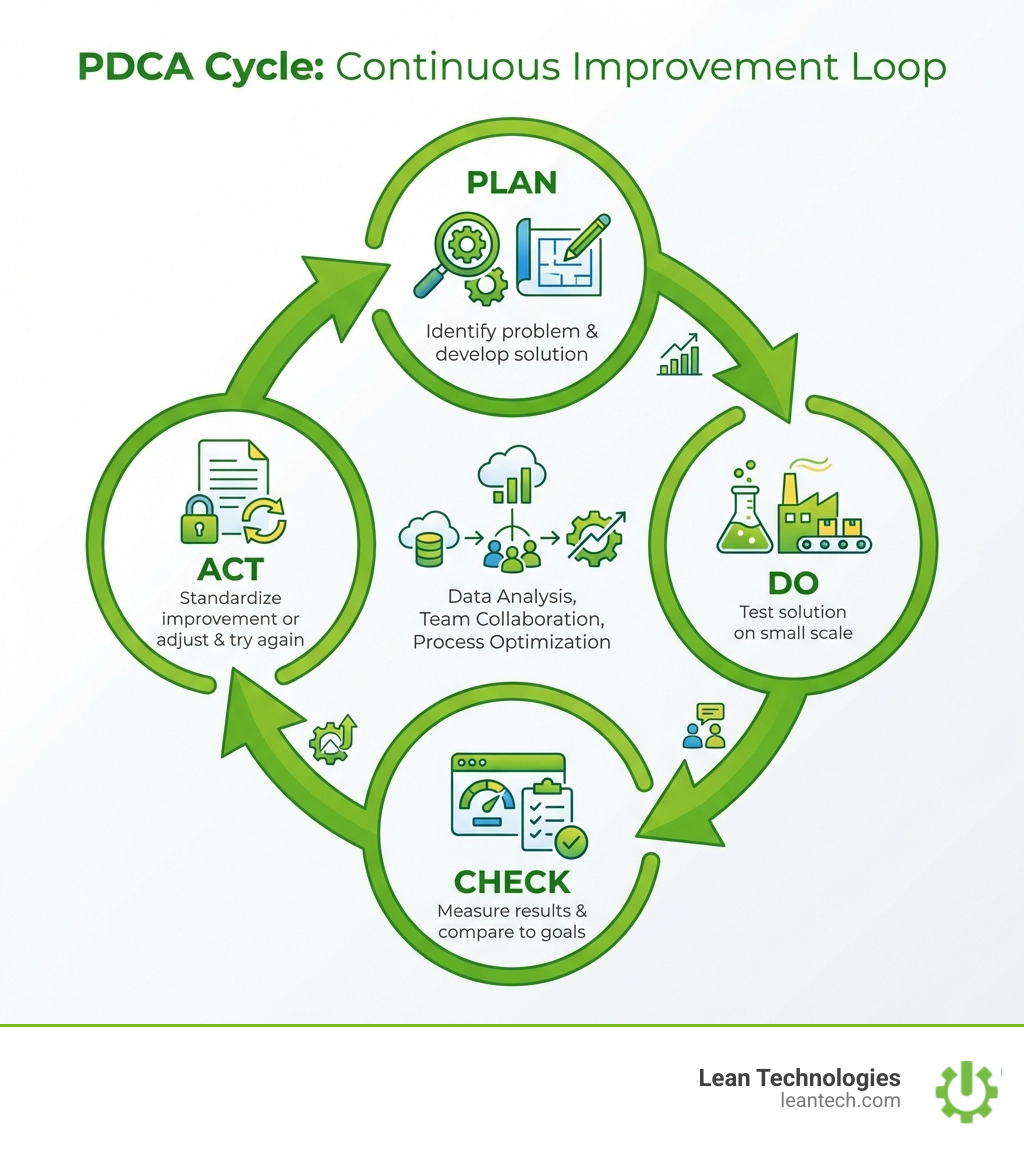
PDCA Cycle: The Plan-Do-Check-Act cycle (also called the Deming Cycle) is an iterative, scientific approach for implementing and testing improvements.
Plan: Identify the problem or opportunity, analyze the situation, and develop a plan for change.
Do: Implement the plan on a small scale or in a controlled environment.
Check: Measure the results, analyze the data, and compare them against your plan and goals.
Act: If the change was successful, standardize it. If not, learn from it, adjust the plan, and repeat the cycle. This cycle ensures that improvements are data-driven and continually refined.
Tools for Process Visualization & Workflow Management
You can't fix what you can't see. These tools make your processes visible, helping you spot bottlenecks, waste, and opportunities for a smoother flow.
Value Stream Mapping (VSM): This powerful Lean tool visually maps every vital step in a product or service delivery process, from raw materials to the customer. It highlights both value-adding and non-value-adding activities, as well as information flow. By drawing the "current state" and then designing a "future state," teams can identify waste, reduce lead times, and optimize the entire flow.
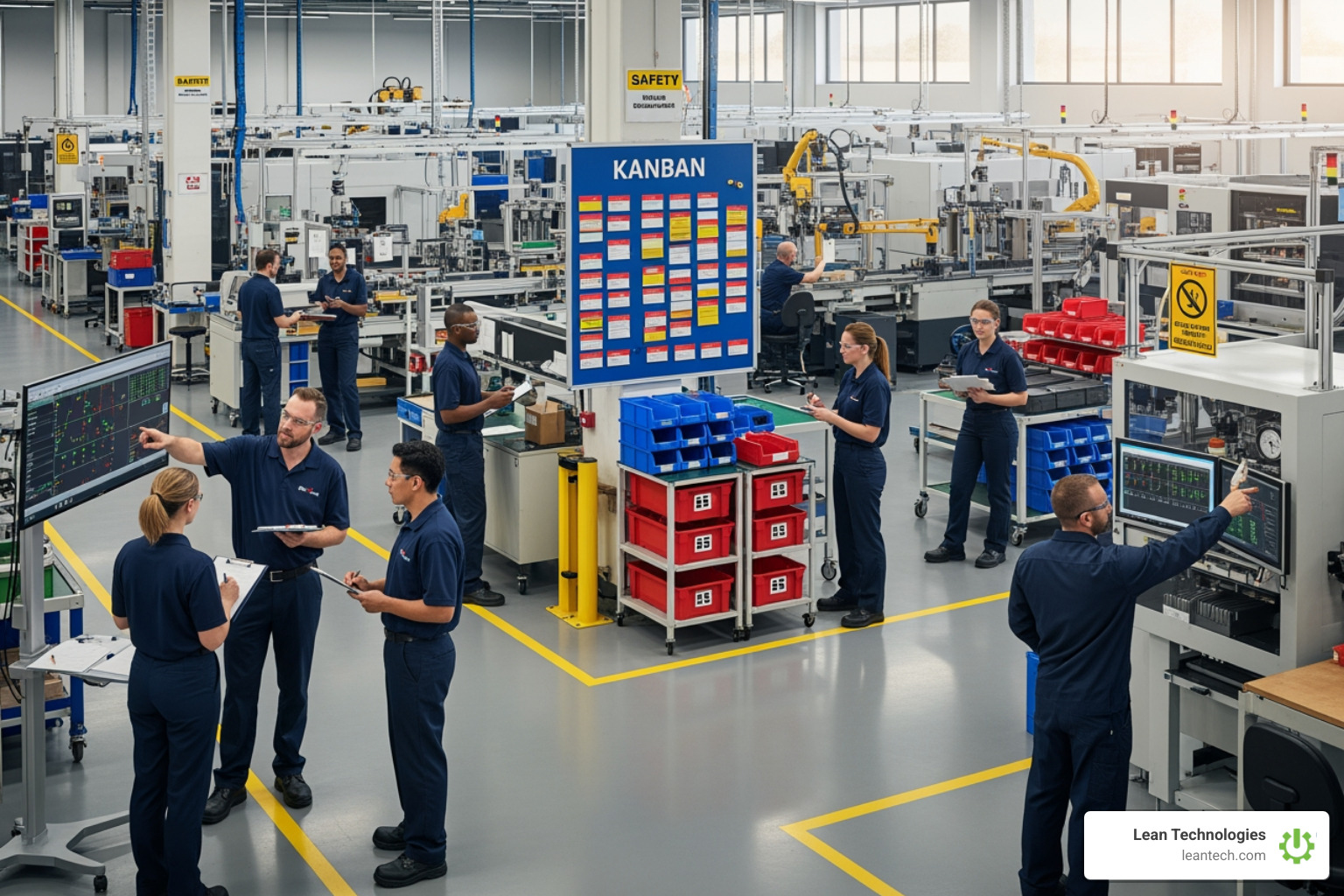
Kanban: Meaning "visual sign" or "signal card" in Japanese, Kanban is a visual system to manage and improve work across systems. It uses boards or cards to track work items through a workflow, limits Work In Progress (WIP) to prevent overload, and signals when capacity is available. Taiichi Ohno is credited with developing and refining this visual scheduling system for Just-In-Time manufacturing. Kanban helps eliminate waste from inventory and overproduction, and can even eliminate the need for physical inventories by relying on signal cards.
Gemba Walks: "Gemba" means "the actual place" in Japanese – on the shop floor, it's where the real work happens. A Gemba walk involves managers and leaders going to the shop floor to observe processes firsthand, ask questions, and engage with frontline workers. It's about "go and see," not "go and tell." The goal is to understand how work is actually done, identify problems and opportunities, and show respect for the people doing the work.
Tools for Workplace Organization & Error Prevention
Efficiency isn't just about speed; it's about doing things right the first time, in a well-organized environment.
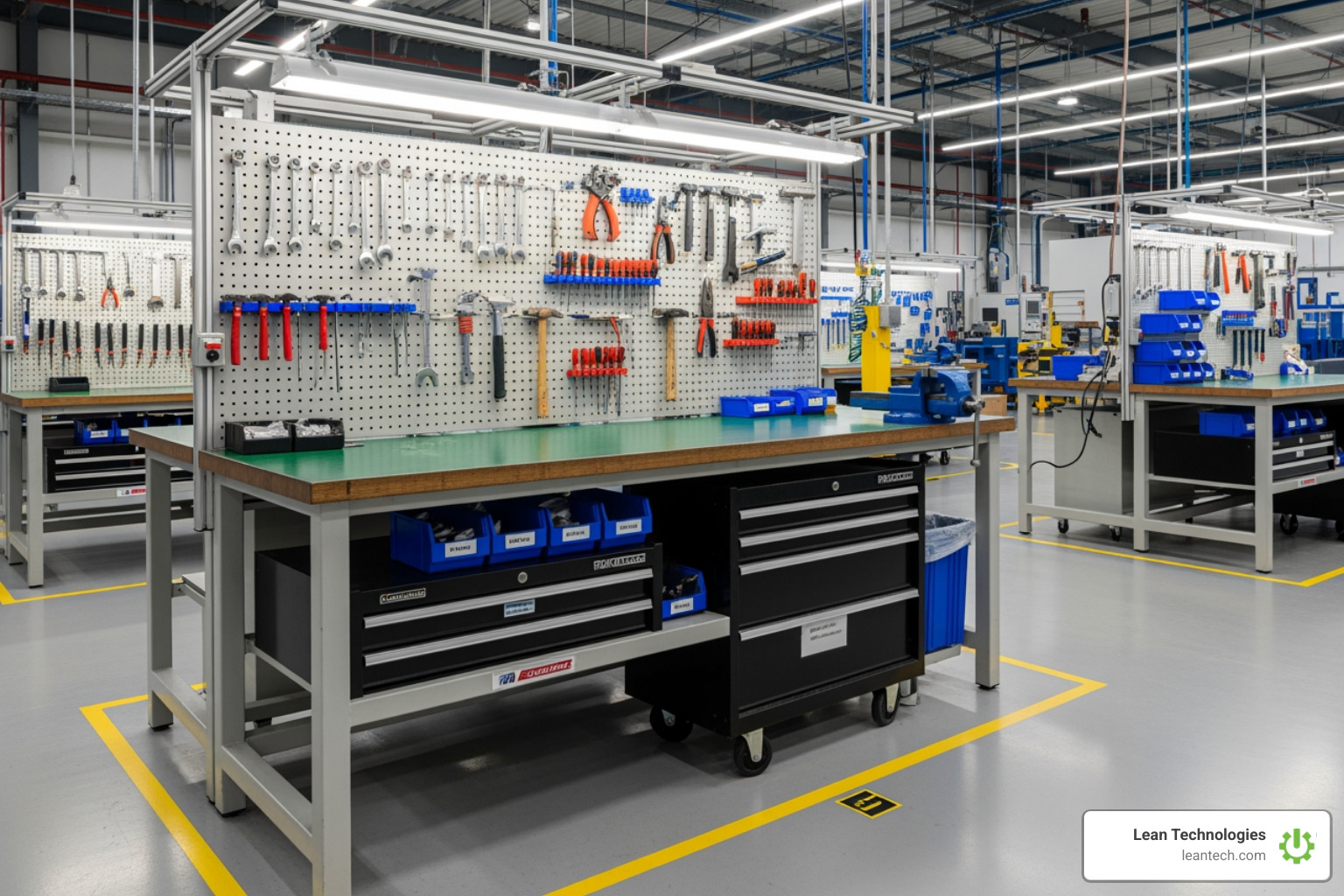
5S: This Lean method creates an organized, clean, and efficient workplace. The five steps are:
Sort (Seiri): Remove unnecessary items from the workspace.
Set in Order (Seiton): Organize and arrange necessary items for easy access.
Shine (Seiso): Clean the workspace and equipment regularly.
Standardize (Seiketsu): Create consistent procedures and schedules for the first three S's.
Sustain (Shitsuke): Maintain the discipline to keep 5S practices going. 5S helps eliminate waste from a poorly organized work area and forms the foundation for other continuous improvement efforts.
Poka-Yoke (Error Proofing): Coined by Shigeo Shingo at Toyota, Poka-Yoke involves designing processes or devices to prevent human errors from occurring or immediately detect them if they do. This ensures that a process step cannot be performed incorrectly, or if it is, the error is caught before it leads to a defect. For instance, a part designed to only fit one way, or a checklist that requires specific steps to be completed before moving on. Dell and Sony once lost roughly $400 million recalling millions of laptops due to faulty batteries, highlighting the huge cost of not preventing errors.
Standardized Work: This involves documenting the "one best way" to perform a task, capturing best practices, and defining the precise sequence, timing, and in-process inventory. Standardized work reduces variability, forms a baseline for future improvements, and makes training new employees much more effective. It eliminates waste by consistently applying best practices.
Supercharging Your Tools: The Role of Digital Change
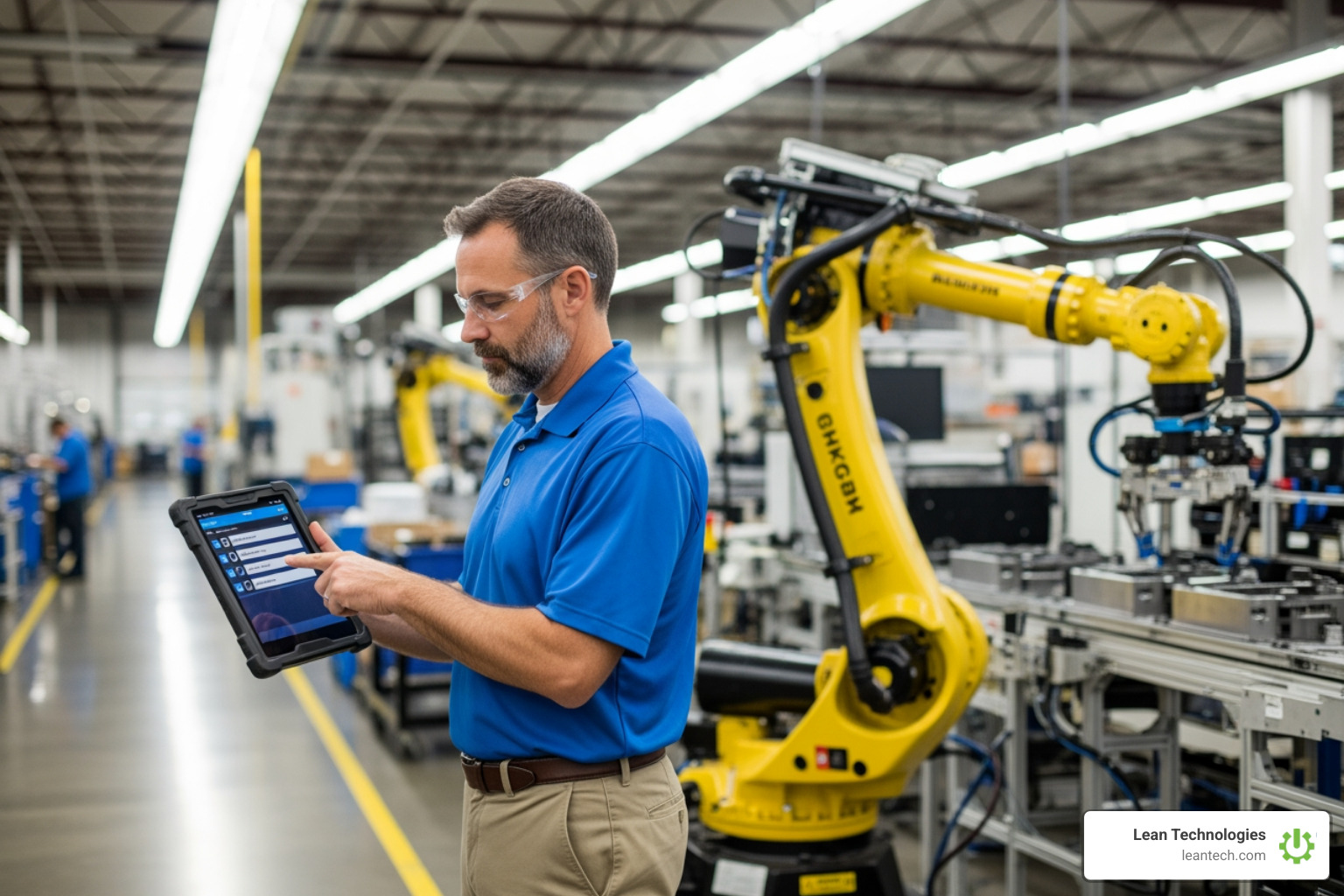
You've got the blueprints, you've got the tools. But in today's manufacturing world, you need a power-up. That's where digital change comes in. It's not just about fancy gadgets; it's about making your continuous improvement efforts more visible, more actionable, and more impactful.
Industry 4.0 meets Lean: Digital tools make improvement stick. The ability to collect, analyze, and act on real-time data is revolutionizing how plants approach continuous improvement. Technologies like AI, cloud computing, and the Industrial Internet of Things (IIoT) are no longer futuristic concepts; they're here, driving efficiency and problem-solving.
For instance, Wayfair applied AI to logistics and shipping, continuously adjusting product shipments to different ports. This helped reduce inbound logistics costs by a staggering 7.5% amid demand fluctuations. This kind of data-driven optimization is exactly what digital tools bring to manufacturing.
This is where a platform like Thrive fits in. It's not an ERP or MES system, but a flexible digital toolbox built to help operators and supervisors:
Log issues as they happen, right on the shop floor.
Track actions and accountability in real time.
Drive continuous improvement by making the process visible and structured.
No more paper, no more "I'll enter it later." Thrive captures data at the source—on mobile, tablet, or desktop—giving you real-time visibility into your operations. That's Digital Lean in action: faster feedback, instant visibility, and easier audits.
A guide to digital lean manufacturing
How Digital Platforms Improve Continuous Improvement Tools in Manufacturing
Connected Worker Tech: Manufacturers are achieving big successes with connected frontline worker technology. Four in five change leaders are seeing meaningful corporate value from implementation. This technology empowers operators to log issues, access digital checklists, and communicate problems and solutions instantly from their mobile devices.
Real-time data: Cloud computing remains a top driver of Industry 4.0 investments, expected to reach $597 billion in 2023. This enables manufacturers to store data in the cloud, deploying various applications without costly on-premise systems. This means no more waiting for end-of-shift updates. Data is captured and analyzed as it happens, allowing for immediate action.
IIoT and Edge Computing: Automotive manufacturers are using IIoT sensors on machinery to monitor performance data at the edge. This allows them to quickly pinpoint maintenance issues and inefficiencies, detecting abnormal machine vibrations and repairing equipment before it breaks down. This predictive capability significantly reduces unplanned downtime and streamlines continuous improvement efforts.
Digital checklists: Standard work, safety procedures, quality checks—all can be digitized. This ensures consistency, provides clear instructions, and makes compliance and audit trails robust and easily accessible.
Making It Stick: How to Build a Culture of Improvement
Having the right tools is one thing; making them a permanent part of your plant's DNA is another. Continuous improvement isn't a project with an end date; it's a cultural shift.
Overcoming Common Implementation Challenges
Even with the best intentions, continuous improvement efforts can stall. Here are some common roadblocks:
Resistance to change: The classic "We've always done it this way" mentality. People are comfortable with the status quo, even if it's inefficient.
Leadership not bought in: Without consistent support and active participation from the top, any improvement initiative is doomed to fail. Process improvement requires one hundred percent support from leadership.
Copy-paste fixes: Trying to blindly implement what worked for another company without adapting it to your unique environment often leads to frustration. Continuous improvement solutions must accommodate unique circumstances.
Unplanned downtime, hidden losses: If you can't see or accurately measure your losses, you can't fix them. For example, every hour of downtime in the automotive industry can cost $2.3 million. If you don't track it, that money just disappears.
Key Steps for Successful Implementation
So, how do you make continuous improvement stick?
Leadership commitment: This is non-negotiable. Leaders must provide the vision, allocate resources, and participate actively. They need to champion the "why" behind the changes and lead by example.
Clear communication: Everyone in the plant needs to understand the goals, the process, and the benefits of continuous improvement. Transparency builds trust and reduces resistance.
Empower your team: Frontline operators are closest to the work and often have the best ideas for improvement. Empower them to identify problems, suggest solutions, and take ownership of their processes. Providing training for tools like Kaizen events and root cause analysis builds internal expertise.
Start small: Don't try to change everything at once. Pick a pilot area, implement a few tools, and demonstrate quick wins. This builds momentum and confidence. A global tire manufacturer, for example, used nonconformance findings to trigger a fast look across related machinery, quickly identifying systemic issues.
Measuring What Matters: KPIs for Continuous Improvement
You can't manage what you don't measure. Key Performance Indicators (KPIs) are essential for tracking progress and demonstrating the impact of your continuous improvement initiatives.
OEE (Overall Equipment Effectiveness): This is a gold standard for measuring manufacturing productivity. It combines Availability, Performance, and Quality into a single metric. World-class manufacturers achieve OEE scores of 85% or higher; below 60% indicates significant improvement opportunities.
Takt Time: The pace of production required to meet customer demand. It aligns your production rate directly with what the customer wants, preventing overproduction.
First Pass Yield: The percentage of products that are manufactured correctly the first time, without any rework or scrap. Yield rates can differ massively, for instance, TSMC reports 80-90% yields for 5nm semiconductor chips but only 32% for 100 mm chips.
Defect Rate: A measure of the number of defective products or components per unit produced. Six Sigma aims for a defect rate of 3.4 parts per million, illustrating the drive for near-perfection.
On-Time Delivery: The percentage of orders delivered to customers by the promised date. This directly impacts customer satisfaction. A study representing data from over 300 companies revealed a direct positive correlation between continuous improvement practices and improved customer satisfaction.
Frequently Asked Questions about Continuous Improvement Tools
What is the most important continuous improvement tool?
There isn't one "most important" tool, as the best tool depends on the specific problem you're trying to solve. However, the PDCA Cycle provides the fundamental framework for structured improvement, and 5S creates the organized environment necessary for any other tool to be effective. Many experts recommend starting with these two to build a solid foundation.
How do I get my team to buy into continuous improvement?
Successful continuous improvement hinges on employee involvement. Start by involving them early in the process, listen to their ideas and concerns (Gemba Walks are great for this!), and show them how their efforts lead to quick, tangible wins. Celebrate successes, provide adequate training, and ensure leadership actively participates and sets a positive example. Fostering a culture where everyone feels empowered to suggest improvements is key.
What is the difference between Lean and Six Sigma?
Lean primarily focuses on eliminating waste (Muda, Mura, Muri) and streamlining processes to improve flow and speed. It asks, "How can we do this faster and with less effort?" Six Sigma, on the other hand, is a data-driven methodology focused on reducing variation and defects to improve quality. It asks, "How can we do this better and more consistently?" While distinct, they are highly complementary and often used together in Lean Six Sigma initiatives to achieve both efficiency and quality.
What to Do Next
Are you tired of managing your shop floor through spreadsheets and wishful thinking? Ready to ditch the paper and manual processes that hold your team back?
Thrive is built specifically for manufacturing teams like yours. It gives your operators, supervisors, and managers the digital tools they need to drive continuous improvement in manufacturing—without the headaches of big, clunky systems.
Let your team run lean—with real-time visibility and fewer workarounds. Want faster problem-solving? It starts with better visibility.