

The Quality Toolkit: Mastering Continuous Improvement in Management
Why Firefighting Quality Issues Kills Productivity
Continuous improvement tools in quality management help manufacturing teams identify problems, standardize fixes, and prevent defects before they multiply. These tools—like PDCA cycles, Kanban boards, root cause analysis, and value stream mapping—turn reactive firefighting into proactive process control.
Here's what you need to know:
Problem identification tools (5 Whys, Fishbone Diagrams, Pareto Charts) help you find root causes fast
Process visualization tools (Value Stream Mapping, Kanban, flowcharts) show where waste lives
Action frameworks (PDCA, Kaizen) turn insights into repeatable improvements
Real-time tracking systems make sure fixes stick, and problems don't repeat
The vast majority of quality headaches come down to the same handful of problems: late detection, unclear ownership, paper-based workarounds, and no closed loop between problem and fix.
You're running around putting out fires. Chasing defects that should've been caught upstream. Waiting until end-of-shift to find out a batch is scrap. Asking operators to fill out paper forms that no one reads. And wondering why the same issues keep showing up week after week.
Here's the truth: If your quality data lives on clipboards, whiteboards, or spreadsheets that get updated hours after the problem happens, you're already too late. Real-time beats real-late—every single time.
Continuous improvement isn't about fancy methodologies or expensive consultants. It's about giving your team the right tools to see problems when they happen, understand why they happened, and make sure they don't happen again. That's it.
The best manufacturers don't tolerate firefighting. They build systems that catch issues at the source, document the fix, and turn every problem into a process improvement. They use digital tools that keep the team aligned, the data clean, and the accountability clear.
This guide breaks down the core continuous improvement tools in quality management—and shows you how to put them to work on your shop floor without replacing your ERP or adding more complexity.
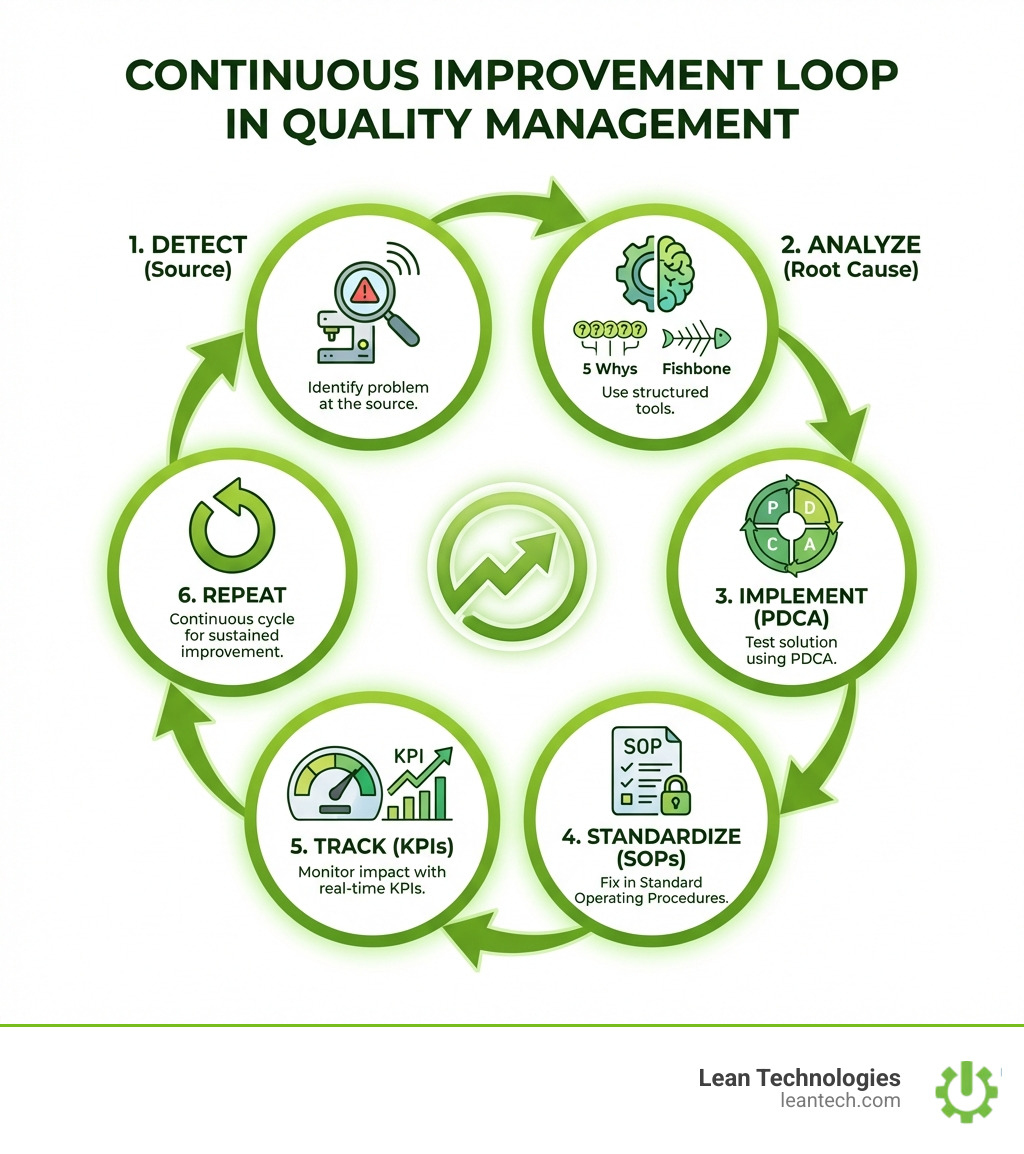
How many times have you walked onto the shop floor only to find your team scrambling to fix a problem that could have been prevented? These "firefighting" moments are more than just annoying; they're a massive drain on productivity, resources, and morale. When quality issues pop up, they don't just affect one product or one shift. They ripple through your entire operation, leading to:
Quality headaches: Constant rework, increased scrap, and customer complaints pile up.
Chasing defects: Your team spends valuable time trying to find the source of problems instead of focusing on production.
Lost time: Every minute spent fixing a preventable error is a minute not spent on value-added work. This directly impacts your bottom line.
Demotivated teams: No one likes solving the same problem repeatedly. It leads to frustration and a sense of futility.
The problem often starts with information—or the lack of it. If your quality data is trapped on paper, it's already too late to act decisively. You need real-time insights to catch issues at the source, understand why they're happening, and implement lasting solutions. Organizations that integrate quality management systems with real-time KPI dashboards can achieve significant savings, often between 15-30% on operational costs. This isn't just about saving money; it's about building a robust system that transforms reactive chaos into proactive control.
The Mindset Shift: Why Continuous Improvement Tools Matter
At its heart, continuous improvement is a mindset. It's the belief that everything—every process, every product, every service—can always be made a little bit better. It’s not about finding perfection overnight, but about consistently seeking ways to eliminate waste, focus on what truly adds value, and put the customer first.
This "Lean thinking" encourages a process-first approach. Instead of blaming individuals, we look at the processes themselves. Are they efficient? Are they standardized? Do they consistently deliver the desired quality? The goal is to create standard work—clear, repeatable processes that everyone can follow, ensuring consistency and quality.
For this to work, you need real-time visibility. You can’t improve what you can’t see. When you have a clear, up-to-the-minute picture of what’s happening on your shop floor, you can spot inefficiencies, identify bottlenecks, and address quality issues before they escalate. This shift from reactive to proactive is what truly empowers your team to master continuous improvement tools in quality management.
Lean vs. Six Sigma: What Actually Matters on the Floor?
When you dive into continuous improvement, you'll inevitably encounter Lean and Six Sigma. Both are powerful, but they tackle problems from slightly different angles.
Lean is all about efficiency. It focuses on identifying and eliminating waste (Muda) in all its forms. Think about the "8 Wastes" of manufacturing: defects, overproduction, waiting, non-used talent, transportation, inventory, motion, and over-processing. Lean aims to streamline your value stream, ensuring a smooth flow of materials and information from start to finish. The core idea is to deliver maximum value to the customer with minimum waste.
Six Sigma, on the other hand, is about consistency and quality. It’s a data-driven approach that focuses on reducing variation and minimizing defects. If Lean asks, "How can we do this faster with less waste?", Six Sigma asks, "How can we do this right every single time?" Six Sigma aims for near-perfect quality, minimizing defects to a staggering 3.4 per million opportunities. Companies like General Electric understood this, training more than 90,000 employees in their Six Sigma program to address quality issues.
On the shop floor, both matter. Lean helps you get rid of the junk that slows you down and adds no value. Six Sigma helps you make sure the stuff you are doing is consistent and high-quality. You can't just aim for "good enough" anymore. Reducing rework and scrap directly impacts your profitability and customer satisfaction. The best approach often combines the waste-fighting power of Lean with the defect-busting precision of Six Sigma.
Kaizen: Small Wins, Big Impact
If Lean and Six Sigma are the big strategies, Kaizen is the daily practice that makes them work. Kaizen is a Japanese term meaning "change for the better," often translated as "continuous improvement." It's about making small, incremental changes, every single day, involving everyone from the CEO to the newest operator.
The Kaizen mindset believes that everyone owns improvement. It empowers your team to look for small ways to make their jobs easier, safer, and more efficient. This often involves daily problem-solving sessions, where teams identify a minor issue, brainstorm a fix, implement it, and then check the results.
A core principle of Kaizen is the Gemba walk. "Gemba" literally means "the actual place." A Gemba walk involves leaders leaving their offices and going to the shop floor—the place where the real work happens. It’s not about finding fault, but about observing, asking questions, and understanding the process firsthand. This helps leaders get a true sense of what’s happening and support initiatives more effectively. Studies show that executive sponsorship is a key component of successful continuous improvement efforts.
Kaizen encourages you to standardize what works. Once a small improvement is made and proven effective, it becomes the new standard. This isn't just about projects; it's about building habits of continuous self-development.
The Core Continuous Improvement Tools in Quality Management
Now that we understand the mindset, let's look at the practical tools. These aren't just theoretical concepts; they're actionable techniques that your team can use right now to improve quality.
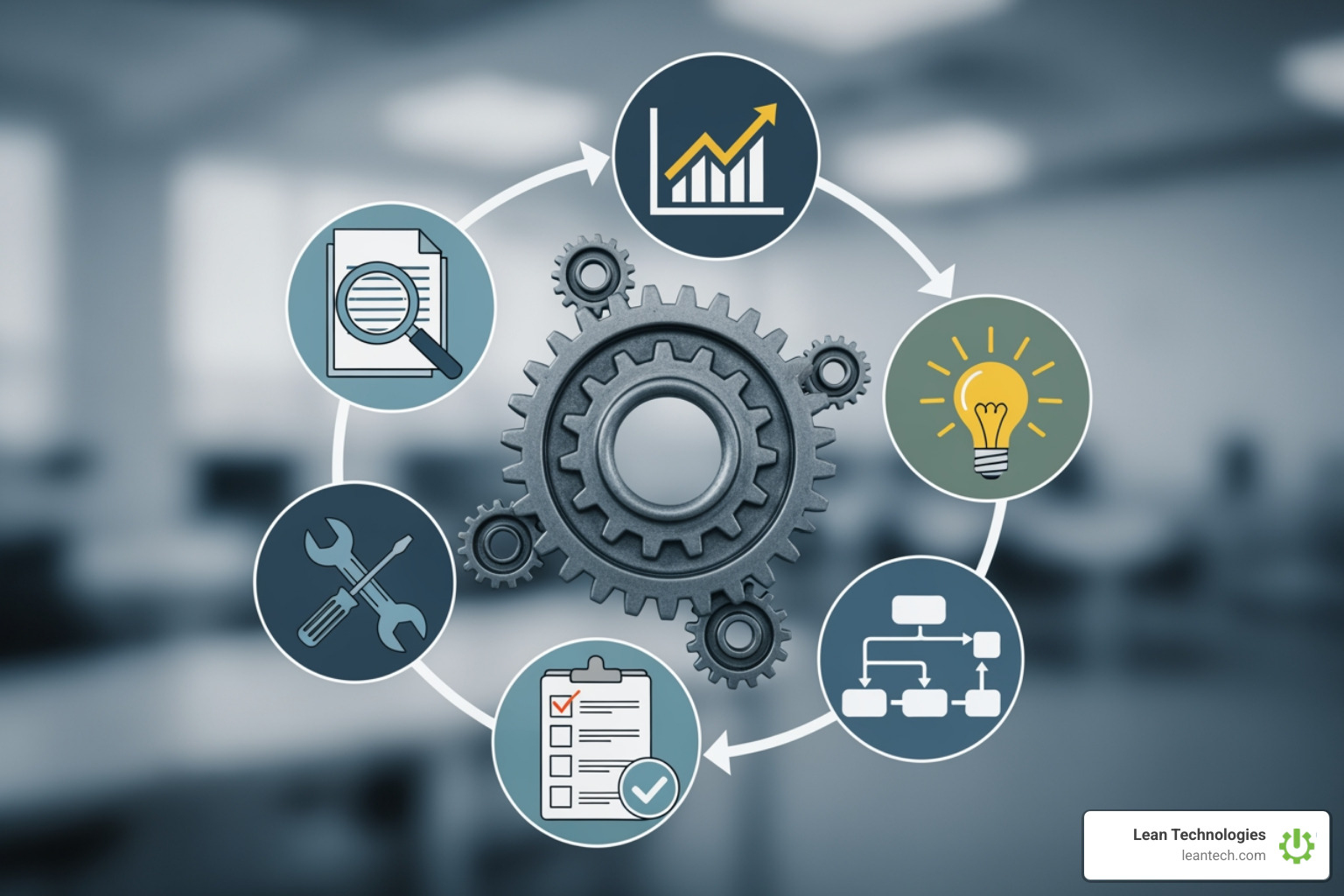
These tools help with problem-solving, process mapping, and getting data at the source for effective digital quality control.
Tools for Problem Identification and Root Cause Analysis
Before you can fix a problem, you need to know what's really causing it. These tools help you dig deep beyond the symptoms.
5 Whys: This deceptively simple tool helps you uncover the root cause of a problem by repeatedly asking "Why?" An operator reports a machine breakdown. Why? The bearing failed. Why? It wasn't lubricated. Why? The maintenance schedule wasn't followed. Why? The schedule is manual and often overlooked. By asking "why" enough times, you move past blame and get to the core issue.
Fishbone Diagram (Cause and Effect Diagram): Also known as an Ishikawa diagram, this visual tool helps you brainstorm all possible causes for a problem. It categorizes potential causes into major groups, often the "5Ms": Manpower (people), Machine, Materials, Methods, and Measurement. You can even add "Environment" for a "5M+E" approach. This structured approach, originating from the Toyota Production System, ensures you consider all angles. Click here to learn more about Cause and Effect Analysis.
Pareto Chart: Ever heard of the 80/20 rule? It states that roughly 80% of consequences come from 20% of causes. A Pareto chart is a bar graph that visually represents this principle, showing which factors are most significant. It helps you prioritize your efforts by focusing on the "vital few" problems that cause the most impact. This tool was popularized by Dr. Joseph Juran, building on the work of economist Vilfredo Pareto. Learn more about Pareto charts.
Root Cause Analysis (RCA): This is a systematic process that uses tools like the 5 Whys and Fishbone diagrams to identify the underlying causes of problems. RCA moves beyond quick fixes to implement long-term solutions, preventing issues from recurring.
The 7 Basic Quality Tools: First emphasized by Kaoru Ishikawa, these foundational tools include the Cause-and-effect diagram, Check sheet, Control chart, Histogram, Pareto chart, Scatter diagram, and Stratification. They provide a comprehensive toolkit for data collection, analysis, and problem-solving.
Thrive helps teams close the loop by providing digital tools to log issues, track actions, and ensure problems are addressed systematically, moving beyond paper-based tracking.
Tools for Process Visualization and Optimization
You can't optimize a process until you can see it clearly. These tools make your workflows transparent.
Value Stream Mapping (VSM): This Lean-management method visually outlines every step in a process, from product design to final delivery. The objective is to maximize productivity and minimize waste by identifying value-added and non-value-added activities. VSM encourages systems thinking, leading to better communication and collaboration. Teams can start by simply mapping out their process on a whiteboard. Click here to learn more about Value-Stream Mapping.
Kanban boards: Kanban is a visual system for managing work as it moves through a process. Using cards (digital or physical) on a board, you can visualize your workflow, limit work in progress (WIP), and focus on maintaining a smooth flow. Kanban helps you spot bottlenecks and optimize throughput. It's a powerful way to harness visual information and improve communication within your team.
Digital flowcharts and Swimlane diagrams: These visual tools graphically represent a process, showing steps, decision points, and the flow of work. Swimlane diagrams specifically show which department or role is responsible for each step, making accountability clear and identifying potential hand-off issues. They are invaluable for understanding complex workflows and identifying areas for improvement.
Bottleneck tracking and WIP limits: These aren't just tools, but core concepts, often used with Kanban. Bottleneck tracking identifies stages where work piles up, slowing down the entire process. WIP limits prevent overburden by restricting the amount of work in progress at any given time, forcing teams to focus on completing tasks before starting new ones.
Using Thrive, teams can map and monitor processes in real time, converting manual tracking into digital visibility. This allows for quick identification of bottlenecks and helps enforce WIP limits to maintain a smooth flow.
A Framework for Action: The PDCA Cycle
Once you've identified a problem and visualized your process, you need a structured way to implement and test solutions. That's where the PDCA Cycle comes in.
Plan-Do-Check-Act (PDCA): Developed by W. Edwards Deming, often called "the father of quality control," PDCA is an iterative, four-step management method for continuous improvement.
Plan: Identify an opportunity for improvement and plan for change. Define the problem, set goals, and predict the results of your proposed change.
Do: Implement the change on a small scale. This is a pilot phase where you test your hypothesis.
Check: Analyze the results of your change using data. Did it work as expected? What did you learn?
Act: If the change was successful, implement it on a wider scale and standardize it. If not, learn from your experience and begin the cycle again with a new plan.
PDCA emphasizes a test, measure, repeat approach. It’s about making hypothesis-driven improvement decisions based on data, not assumptions. This structured framework ensures that improvements are not only effective but also sustainable. Click here to learn more about the PDCA Cycle.
Thrive plays a critical role in tracking and documenting each step of the PDCA cycle. It provides the platform to plan changes, log implementations, collect real-time data for checking results, and document the final action, ensuring that valuable insights aren't lost.
Putting Your Quality Toolkit into Action
Having a great set of tools is one thing; putting them to effective use is another. This is where leadership, engagement, and the right digital platform make all the difference.

It's about fostering leadership buy-in, driving operator engagement, and building a true culture of accountability. This is how Thrive makes CI visible and actionable.
The Role of Leadership and Employee Engagement
Continuous improvement isn't a top-down mandate; it's a shared responsibility.
Leadership support: As mentioned with Gemba walks, leaders need to be present, engaged, and visibly committed to continuous improvement. Their support sets the tone for the entire organization.
Empowering teams: The best ideas for improving processes often come from the people doing the work. Empower your operators and supervisors to identify problems and propose solutions.
Clear communication: Explain the "why" behind continuous improvement initiatives. When employees understand the benefits—for them, for the company, and for the customer—they're more likely to accept change. Studies show that people often resist change, even when it's beneficial, so clear communication is essential.
Training on the tools: Provide practical training on how to use tools like the 5 Whys, Pareto charts, and PDCA cycles.
Accountability: Establish clear roles and responsibilities for continuous improvement efforts.
Thrive helps keep everyone in the loop by providing a centralized platform for communication, task assignment, and progress tracking, ensuring accountability from the shop floor to the top office.
How to Implement Continuous Improvement Tools in Quality Management
Ready to get started? Here’s a practical roadmap:
Start with a pilot: Don't try to fix everything at once. Pick a small, manageable area or process to start your continuous improvement journey. This allows you to learn and refine your approach without overwhelming your team.
Define clear metrics: What does success look like? Establish Key Performance Indicators (KPIs) that are directly tied to your improvement goals. These should be achievable and clearly linked to business priorities.
Document processes digitally: Move away from paper. Digitize your Standard Operating Procedures (SOPs) and work instructions. This ensures consistency, makes updates easy, and provides a single source of truth. Thrive allows you to embed SOPs directly into digital workflows, making them accessible exactly when and where they're needed.
Scale what works: Once your pilot is successful, standardize the new process, capture the learnings, and then apply them to other areas. Continuous improvement is an iterative process.
Overcoming Problems and Measuring Real-World Impact
Implementing continuous improvement isn't always smooth sailing. You'll encounter bumps in the road, but with the right approach and tools, you can steer them effectively.
This is where you move past resistance to change, close data gaps, break down siloed teams, and start measuring real ROI with real-time wins.
Common Challenges and How to Beat Them
Change fatigue: Employees can get tired of constant changes. Combat this by celebrating small wins and clearly demonstrating the positive impact of improvements.
Unclear goals: If goals aren't clear and achievable, teams will get demotivated. Ensure improvement goals are directly tied to business priorities so everyone understands their importance.
Poor communication: Misunderstandings can derail efforts. Foster open communication channels and ensure everyone understands the "why" behind changes.
Messy data: If your data is unreliable or hard to access, measuring progress becomes impossible. Invest in systems that capture accurate data at the source.
Budget battles: Continuous improvement is an investment. Clearly articulate the ROI to secure necessary resources.
Thrive helps teams stay focused and accountable by providing a structured platform for tracking initiatives, communicating updates, and accessing real-time data, thus minimizing the impact of these common challenges.
How to Measure the Success of Your Continuous Improvement Tools in Quality Management
Measuring success is crucial to demonstrate value and sustain momentum. Look beyond anecdotal evidence to concrete data:
Defect rates: Are you seeing fewer rejects, reworks, and customer returns?
Cycle time: Are processes becoming faster and more efficient?
On-time delivery: Are you meeting customer deadlines more consistently?
Customer complaints: Is customer satisfaction improving? A study representing data from over 300 companies revealed a direct positive correlation between continuous improvement practices and improved customer satisfaction.
Cost of quality: Are you reducing the costs associated with preventing, appraising, and failing quality? As noted earlier, significant savings are achievable.
Thrive dashboards provide real-time tracking of these and other KPIs, allowing you to see the immediate impact of your continuous improvement efforts and link them directly to customer satisfaction and business outcomes. This instant feedback loop is essential for making data-driven decisions and continually refining your processes.
Frequently Asked Questions about Continuous Improvement Tools
What’s the most important continuous improvement tool?
There isn't one single "most important" tool. The effectiveness of a tool depends on the problem you're trying to solve. However, foundational tools like the PDCA Cycle for structured problem-solving and Root Cause Analysis (RCA) methods (like the 5 Whys or Fishbone diagrams) are critical starting points for any continuous improvement journey.
How do you pick the right CI tool for your problem?
Picking the right tool involves understanding your problem, your process, and your goals.
Identify the problem: Clearly define what you want to improve. Is it a quality defect, an efficiency bottleneck, or a safety issue?
Understand the process: Use tools like Value Stream Mapping or flowcharts to visualize the current state.
Analyze the root cause: Use 5 Whys or a Fishbone Diagram to get to the core issue, not just the symptom.
Plan your solution: The PDCA Cycle helps you structure your proposed changes.
For example, if you have too many defects, a Pareto Chart can help you prioritize which defects to tackle first, and a Fishbone Diagram can help you brainstorm causes.
Can you use multiple CI tools together?
Absolutely! Continuous improvement tools are often most effective when used in combination. For instance, you might use Value Stream Mapping to identify waste, then apply the 5 Whys to understand the root cause of a specific waste, and finally use the PDCA Cycle to implement and test a solution. Many Lean and Six Sigma methodologies inherently combine multiple tools for comprehensive problem-solving.
What to do next
You've learned about the power of continuous improvement tools in quality management—from identifying root causes with the 5 Whys to optimizing workflows with Kanban and driving action with PDCA. The common thread is clear: real-time visibility and structured processes are non-negotiable for modern manufacturing.
Stop managing your shop floor through spreadsheets and wishful thinking. The traditional paper-based systems lead to late data, siloed information, and endless firefighting. A digital system like Thrive provides the real-time visibility you need to move from reactive to proactive.
Let your team run lean—with real-time visibility and fewer workarounds. Stop chasing problems—start solving them.