

The Blueprint for Success: Essential Steps in Equipment Maintenance Planning
Why Equipment Maintenance Planning is the Difference Between Running Smooth and Running on Fumes
Equipment maintenance planning is how you decide what needs to be maintained, when, by whom, and with what resources—before something breaks.
Here's what it includes:
Asset inventory – Know what equipment you have and where it is
Maintenance schedules – Define when tasks happen (time-based, usage-based, or condition-based)
Work orders – Document the work, assign it, and track completion
Spare parts management – Keep critical parts on hand without overstocking
Performance tracking – Measure downtime, costs, and equipment health
Done right, it cuts unplanned downtime, extends asset life, and keeps your team ahead of problems instead of always reacting to them.
Done wrong—or not at all—it costs you.
The average manufacturer loses 800 hours to equipment downtime every year.
That's nearly $50 billion annually across the industry.
Most of that is avoidable.
But here's the thing: most plants are still running maintenance off spreadsheets, paper logs, and memory.
That might've worked when you had fewer machines and a smaller team.
It doesn't work now.
Real-time problems need real-time systems.
When your maintenance data lives in a binder or gets entered at the end of the shift, you're already behind.
You can't spot patterns.
You can't prioritize the right work.
And you can't hold anyone accountable when the info shows up two days late.
I'm Jamie Gyloai, Vice President at Lean Technologies, and I've spent over 20 years in manufacturing operations—managing plants, running assembly lines, and building better equipment maintenance planning processes. I've seen what works, what doesn't, and what it takes to move from reactive chaos to proactive control.
What is Equipment Maintenance Planning (And Why Spreadsheets Are Failing You)
At its core, equipment maintenance planning is about being proactive, not reactive. It’s the strategic blueprint that guides all our maintenance activities.
It's about making sure our machines perform optimally, stay online longer, and don't surprise us with costly breakdowns.
Why is this so critical?
Because it directly impacts our bottom line.
Proactive vs. Reactive: The Costly Difference
Let's be honest. Many of us have been stuck in reactive mode.
We fix things when they break.
That feels efficient in the moment—no money spent until there's a problem, right?
Wrong.
Reactive maintenance, or "run-to-failure," might seem to save money upfront.
But it's typically the most costly and time-consuming approach.
It leads to unplanned downtime, which is a major hit to production and revenue.
It often means higher repair costs, expedited shipping for parts, and overtime for our teams.
A planned approach, however, focuses on preventing those failures.
It ensures our teams are working safely, our assets last longer, we experience less downtime, and we have more control over our operations.
Think of it this way:
Our primary objectives for any robust equipment maintenance planning program are to:
Cut maintenance costs: Proactive work is almost always cheaper than emergency repairs.
Protect equipment and lengthen lifespans: Regular care extends the life of our valuable assets.
Reduce unplanned downtime: Keep our production lines humming.
Increase safety: Well-maintained equipment is safer equipment.
When we plan effectively, we're not just fixing machines; we're investing in our company's success.
Why Paper and Excel Can’t Keep Up With the Pace of Your Shop Floor
We know the drill.
Maintenance requests come in on paper forms.
Schedules live in a sprawling Excel sheet.
Parts inventory is a best-guess scenario.
This might have been the norm, but it's holding us back.
Paper forms get lost.
Excel sheets become outdated the moment they're saved.
"Tribal knowledge"—the crucial information residing only in a veteran's head—walks out the door when they retire.
This leads to:
Unclear or delayed communication: Who's doing what, and when?
Poor equipment inventory practices: Leading to parts shortages or overstocking.
Lack of consistent procedures: Every repair is a new adventure.
Delayed data: If we're waiting until the end of a shift to log information, it's already too late to react effectively.
We need real-time visibility and structured processes to keep pace with modern manufacturing.
The Four Main Types of Maintenance Strategy
To build an effective equipment maintenance planning program, we need to understand the different strategies at our disposal. Each has its place, but the goal is always to move towards more proactive methods.
Reactive Maintenance (Run-to-Failure)
This is the "fix it when it breaks" approach.
Maintenance is performed only after equipment fails.
Pros: Minimal upfront planning, seems cheaper initially.
Cons: Unplanned downtime, high repair costs, potential safety hazards, secondary damage to equipment.
Best for: Non-critical assets where failure has minimal impact and repair is cheap.
Cost: Estimated at $18 per horsepower per year.
Preventive Maintenance (Scheduled Tasks)
We schedule maintenance activities at predetermined intervals to prevent failures.
This could be time-based (every 3 months), usage-based (every 1,000 operating hours), or meter-based (every 500 cycles).
Pros: Reduces unplanned downtime, extends equipment life, better resource planning.
Cons: Can lead to "over-maintenance" (servicing equipment that doesn't need it), still some risk of unexpected failure.
Best for: Critical assets with predictable wear patterns, where historical data shows clear maintenance needs.
Cost: Estimated at $13 per horsepower per year, offering 12-18% savings over reactive.
Condition-Based Maintenance (Based on Inspections or Data)
This strategy uses real-time data and inspections to determine the actual condition of equipment.
Maintenance is performed only when specific indicators show a need.
Think vibration analysis, thermography, or oil analysis.
Pros: Optimizes maintenance intervals, avoids unnecessary maintenance, minimizes downtime, significant cost savings.
Cons: Requires specialized monitoring equipment and training, higher initial investment.
Best for: High-value, critical assets where monitoring provides clear signals of impending failure.
Cost: Estimated at $9 per horsepower per year, potentially saving 8-12% over preventive.
Reliability-Centered Maintenance (RCM, Focused on Critical Assets)
RCM is a comprehensive approach that analyzes potential failure modes and their consequences for critical assets.
It combines elements of preventive, predictive, and even some reactive strategies, applying the most effective technique for each specific failure mode.
Pros: Maximizes equipment reliability, optimizes maintenance costs, focuses resources where they have the biggest impact, improves safety.
Cons: Complex to implement, requires significant data and analytical expertise.
Best for: Highly critical, complex systems where failure has severe consequences (safety, environmental, production loss).
Cost: Estimated at $6 per horsepower per year.
Here's a quick comparison:
Strategy Cost (per hp/yr) Complexity Best-Fit Scenarios Reactive $18 Low Non-critical, low-cost assets where failure impact is minimal. Preventive $13 Medium Assets with predictable wear, clear OEM recommendations, or regulatory requirements. Condition-Based $9 High High-value, critical assets where real-time monitoring can prevent significant failures. Reliability-Centered $6 Very High Highly critical, complex systems where maximizing uptime and minimizing risk are paramount.
The ideal mix for most organizations is around 80% proactive (preventive and predictive) and 20% corrective (reactive) work. We want to be smart about where we focus our efforts.
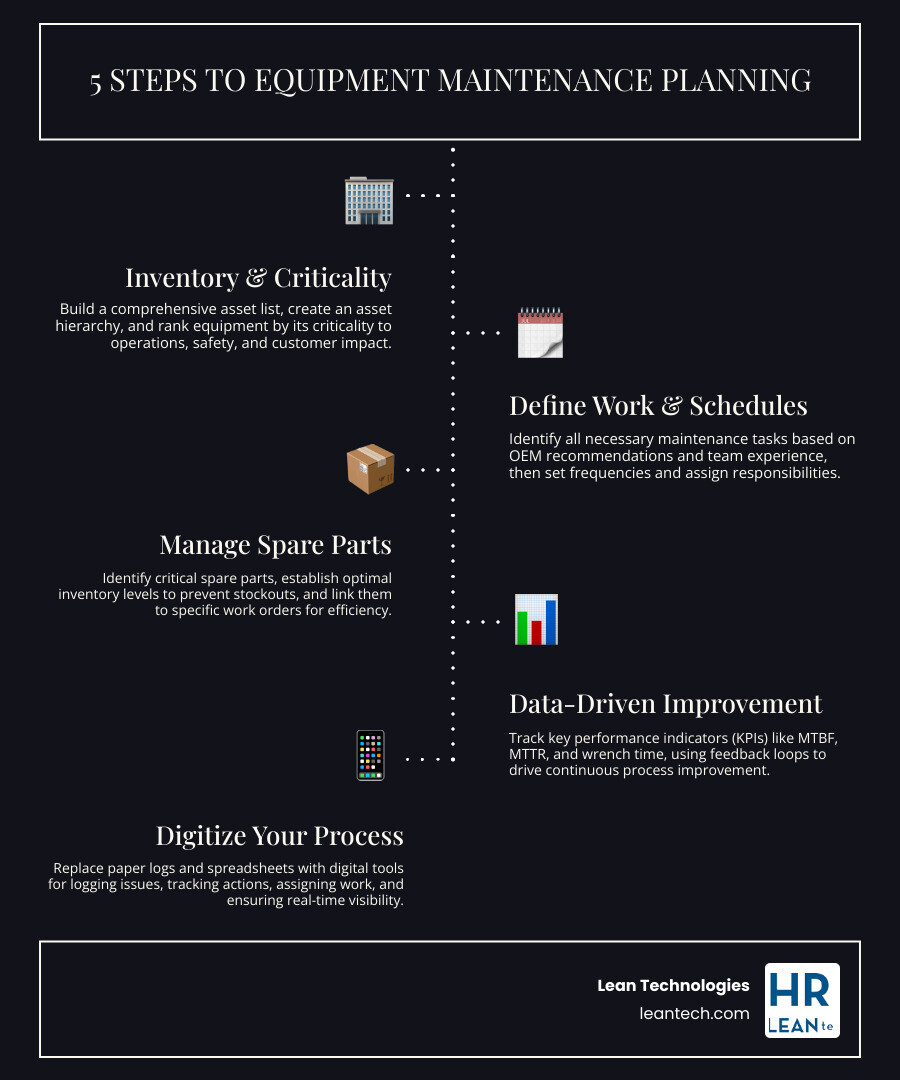
Building Your Equipment Maintenance Planning Program: A 5-Step Framework

This isn’t about a 100-page binder that nobody reads.
It’s about a living process your team actually uses.
It's about giving our teams the tools to make maintenance part of our daily rhythm, not a scramble.
Here’s how to start:
Step 1: Inventory Your Assets & Rank by Criticality
We can't maintain what we don't know we have.
Or what we don't know matters most.
First, we need to build our asset list.
This means documenting every piece of equipment, from major production lines to the smallest pump.
For each asset, we should note:
Make, model, and serial number
Specifications and capabilities
Location
Usage data (hours, cycles)
Maintenance history
Next, we create an asset hierarchy.
This helps us understand how our equipment relates to each other, like a family tree for our machines.
It clarifies parent-child relationships and helps us see the bigger picture.
Then, we analyze which assets are most critical.
Not all equipment is created equal.
A failure in one machine might halt our entire production, while another might just be an inconvenience.
We need to ask:
What's the impact on production if this asset fails?
Are there safety or environmental risks associated with its failure?
Does its failure affect product quality or customer satisfaction?
How much does it cost to repair or replace?
This asset criticality analysis helps us prioritize our maintenance efforts. We focus our precious resources on what truly matters.
We classify assets into high, medium, and low criticality categories.
This way, we prioritize what matters most and avoid wasting time over-maintaining non-critical items.
Step 2: Define Maintenance Work & Schedules
Once we know what we have and what's critical, it's time to get specific about the work itself.
We need to identify maintenance tasks for each asset.
This involves:
Consulting OEM (Original Equipment Manufacturer) recommendations.
Reviewing our own equipment history for recurring issues.
Leveraging our team's experience and insights.
Considering root cause analysis findings for past failures.
These tasks could range from simple inspections and lubrication to complex component replacements.
Next, we set task frequency.
How often does each task need to be done?
This could be time-based (monthly), usage-based (every 500 hours), or condition-based (when vibration levels exceed a threshold).
Then, we build a simple, visible maintenance schedule.
This isn't just a list; it's a calendar.
It shows when each task is due, ensuring we perform maintenance before failures occur.
It helps us balance maintenance needs with our production schedule.
Finally, we assign clear responsibilities.
Who is responsible for each task?
Who approves the work?
Who signs it off?
Clear roles prevent confusion and ensure accountability.
A well-defined maintenance schedule helps us work smarter and safer. You can find more information about improving safety by clicking here: More info about improving safety
Step 3: Get Control of Spare Parts & Inventory
Imagine this: a critical machine goes down.
We know exactly what the problem is.
But we don't have the part.
Production grinds to a halt while we wait for a rush order.
This is why spare parts and inventory management is so vital to equipment maintenance planning.
We need to identify critical spares.
These are the parts that, if unavailable, would cause significant downtime for our critical assets.
Based on our asset criticality analysis and historical data, we pinpoint these essential items.
Then, we set inventory levels to avoid both stockouts and overbuying.
We don't want capital tied up in parts we rarely use.
But we also can't afford to be caught without a crucial component.
Techniques like Economic Order Quantity (EOQ) and Just-In-Time (JIT) can help us optimize these levels.
For example, we might keep a few high-turnover, low-cost parts on hand, but rely on faster delivery for expensive, rarely used items.
It's also essential to link parts to work orders.
When a technician plans a job, they should immediately see if the required parts are in stock.
This prevents delays and ensures they have everything they need before they even start.
Where possible, we use just-in-time (JIT) principles.
This means receiving parts just as they are needed for scheduled maintenance, reducing storage costs and obsolescence.
Effective spare parts management ensures our maintenance efforts aren't derailed by missing components.
Step 4: Use Data to Drive Continuous Improvement
Our maintenance program is only as good as the data we collect and how we use it.
We need to move beyond gut feelings and make decisions based on real data.
First, we track the right KPIs (Key Performance Indicators).
These metrics tell us if our equipment maintenance planning is actually working.
Some key KPIs include:
Wrench Time: The percentage of time technicians spend actively working on repairs, not traveling or looking for parts. A benchmark of at least 60% is a best practice.
MTBF (Mean Time Between Failures): How long, on average, a machine runs before it fails. We want this to increase.
MTTR (Mean Time To Repair): How long, on average, it takes to repair a failed machine. We want this to decrease.
OEE (Overall Equipment Effectiveness): A comprehensive measure of availability, performance, and quality.
Next, we use feedback loops to improve.
After every maintenance task, we gather feedback from our technicians.
What went well? What didn't? Were the instructions clear? Were the parts available?
This feedback, combined with our KPI data, helps us identify inefficiencies and bottlenecks.
This continuous improvement cycle is crucial. We constantly review failure patterns, maintenance logs, and our KPIs to refine our plan.
It’s about learning from every repair and every scheduled task.
This data-driven approach allows us to optimize our schedules, adjust frequencies, and make our maintenance more effective and efficient over time.
For more insights into leveraging data in your operations, check out our guide on More info about digital lean manufacturing.
Step 5: Digitize Your Maintenance Process
This is where we leave the paper and spreadsheets behind.
We need to ditch paper logs and spreadsheets for good.
They're slow, error-prone, and don't give us the real-time insights we need.
Instead, we use digital tools to log issues, track actions, and assign work.
This means a system that allows our team to:
Create, assign, and track work orders instantly.
Access equipment history and procedures from anywhere.
Automate scheduling for preventive and condition-based tasks.
Monitor parts inventory and trigger re-orders automatically.
We need to give our team mobile/tablet access for real-time updates.
Our technicians are on the shop floor, not at a desk.
They need to be able to log issues, update work orders, and access information right where the work is happening.
This connected workforce is more likely to perform better.
It prevents important details from falling through the cracks and speeds up access to maintenance records.
The biggest win here? We get instant visibility—no more waiting for end-of-shift data.
We see what's happening, right now.
We can spot delays, reallocate resources, and make informed decisions in the moment.
This real-time data is how we transform our maintenance operations. It's how we move from reacting to problems that happened hours ago, to proactively managing our assets.
For tips on managing these efforts, explore our resources on More info about project management.
Overcoming Common Roadblocks
Change is tough.
Moving from “fix it when it breaks” to “plan it before it fails” takes time.
It's a shift in mindset, not just a new system.
Here’s what to expect, and how we can tackle it:
Getting Team & Leadership Buy-In
We often face two main challenges here:
Lack of management support: If leadership isn't on board, our efforts will fizzle out. We need to clearly articulate the "why"—the cost savings, increased uptime, and improved safety. We show them the return on investment (ROI).
Resistance from the floor (“We’ve always done it this way”): Our team might be comfortable with the old ways, even if they're inefficient. We need to communicate the "why" behind the change to them too. How will this make their jobs easier? Safer? Less stressful?
To build momentum, we need to communicate the “why” behind the change frequently and widely.
We highlight the benefits for everyone, not just the company.
And most importantly, we show early wins.
Even small successes can build confidence and prove that the new way works.
This isn't just about implementing a new process; it's about managing change. The 'DICE' framework (Duration, Integrity, Commitment, Effort) from Harvard Business Review offers a structured way to manage the hard factors of change, ensuring our improvements last. You can learn more about this by reading The Hard Side of Change Management.
Cleaning Up Your Data & Processes
Our maintenance efforts are only as good as the information we rely on.
Often, we start with:
Inaccurate or missing data: Our asset lists are incomplete, or past maintenance records are unreliable.
Inconsistent procedures: Every technician has their own way of doing things.
“Tribal knowledge” stuck in people’s heads: Critical information isn't documented; it's only known by a few experts.
We need to address these issues head-on.
This means a dedicated effort to clean up our CMMS backlog and inventory.
It means documenting every piece of equipment, its history, and its maintenance needs.
We need to standardize work and make instructions clear and accessible.
This involves creating detailed, step-by-step procedures for all common maintenance tasks.
And then, making sure our teams can access these procedures easily, perhaps through a mobile device right there on the shop floor.
This ensures consistency, reduces errors, and helps new team members get up to speed faster.
Frequently Asked Questions about Equipment Maintenance Planning
Which industries benefit most from maintenance planning?
Any industry that relies heavily on equipment for its operations benefits immensely. This includes:
Manufacturing: Keeping production lines running smoothly.
Construction: Ensuring heavy machinery like cranes and excavators are always available.
Energy: Maintaining power generation and distribution infrastructure.
Facilities: Managing HVAC, electrical, and plumbing systems in large buildings.
Healthcare: Ensuring critical medical equipment is always operational.
The more you rely on your machines, the more you need a plan.
What’s the difference between maintenance planning and scheduling?
It’s simple:
Planning is the “what” and “how.” It defines the job: what needs to be done, the parts and tools required, the safety precautions, and the step-by-step procedures. It prepares everything before the work starts.
Scheduling is the “when” and “who.” It assigns a specific time and a specific person (or team) to execute the planned work. It ensures the work fits into the overall production schedule and that resources are available.
Both are distinct but absolutely critical for effective equipment maintenance planning.
How do I measure the success of my maintenance plan?
We measure success by looking at key outcomes that impact our operations and our budget. A successful plan typically leads to:
Less unplanned downtime: Our machines are breaking down less often.
Higher OEE (Overall Equipment Effectiveness): Our equipment is more available, performs better, and produces higher quality output.
Lower maintenance costs: We're spending less on emergency repairs and more efficiently on planned work.
More wrench time (less admin): Our technicians are spending more time fixing things and less time searching for information or parts.
Fewer safety incidents: Well-maintained equipment is inherently safer for our team.
By tracking these metrics, we can clearly see the return on investment of our equipment maintenance planning efforts.
What to Do Next
Stop managing your shop floor through spreadsheets and wishful thinking.
A solid equipment maintenance planning process gives us control over our assets, our time, and our budget.
It turns firefighters into planners.
Thrive gives us the digital tools to bring our maintenance plan to life—real-time visibility, simple logging, and fewer workarounds.
Let your team run lean—with real-time visibility and fewer workarounds.