
The Ultimate Checklist for Daily Equipment Safety Checks
The Hidden Cost of Skipping Daily Equipment Safety Checks
Equipment safety checks are structured pre-operation inspections that verify machinery is safe to operate before each shift — and skipping them is one of the most expensive mistakes a plant can make.
Here's what a complete daily equipment safety check covers:
Inspection Area What to Verify Fluid levels Engine oil, hydraulic fluid, coolant, brake fluid Structural components Booms, arms, buckets, pins, fasteners Safety devices Backup alarms, ROPS, emergency stops, fire extinguisher Brakes and steering Function test before operation Hydraulics Hoses, cylinders, seals — check for leaks or seepage Operator qualification Valid certification, fit for duty, current training Controls and gauges Warning lights, instruments, transmission Tires or tracks Damage, wear, proper inflation
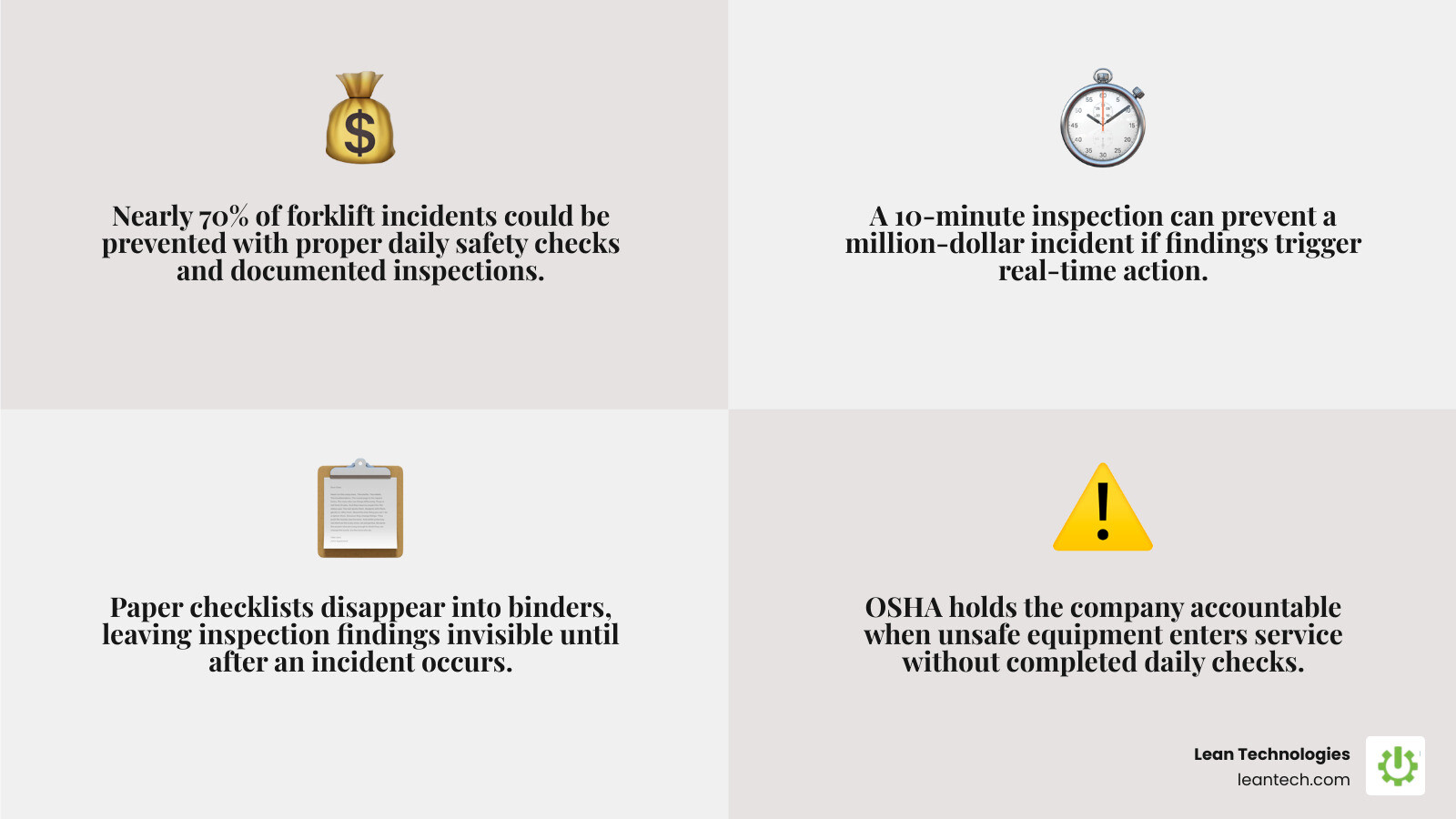
The stakes are real. Forklifts alone are involved in roughly 35,000 serious injuries and approximately 85 fatalities every year in the United States. Nearly 70% of those incidents could be prevented with proper operator training, routine maintenance, and a documented safety checklist. And OSHA doesn't just hold the operator accountable — the company is on the hook when equipment enters service in an unsafe condition.
Most safety failures on the shop floor don't come from a lack of effort. They come from fragmented processes — paper checklists that disappear into binders, inspection findings that never trigger a work order, and supervisors who don't know a machine was flagged until after something goes wrong.
A 10-minute inspection can prevent a million-dollar incident. But only if the findings go somewhere actionable — in real time.
That's the gap this guide addresses. Whether you're managing a fleet of forklifts, heavy construction equipment, or industrial machinery, what follows is a practical, regulation-grounded checklist system your team can actually follow — and one that turns daily inspections into a living part of your safety culture instead of a paper-filing obligation.
Regulatory Framework: OSHA and Global Standards for Equipment Safety Checks
Regulatory compliance is not just about avoiding fines; it is about establishing a baseline of operational integrity. Across the globe, safety agencies mandate strict inspection cycles to ensure machinery does not pose a hazard to operators or surrounding personnel.
In the United States, the Occupational Safety and Health Administration (OSHA) enforces rigid guidelines under various standards. For instance, the 1926.1412 standard outlines detailed inspection requirements for cranes and derricks in construction, mandating systematic checks before any shift. Similarly, in the United Kingdom, the Provision and Use of Work Equipment Regulations (PUWER) Regulation 6 dictates that equipment must be inspected whenever it is exposed to conditions causing deterioration that could result in dangerous situations. The HSE work equipment guidelines emphasize that these checks must occur at regular intervals and after any exceptional circumstances.
To stay compliant and protect your workforce, your organization must integrate these requirements into formal Safety Audits. These audits rely on four primary types of equipment safety inspections:
Daily/Shift Inspections: Conducted by the operator before beginning work. These are visual and functional walkarounds designed to catch immediate hazards like fluid leaks, damaged tires, or malfunctioning backup alarms.
Post-Assembly Inspections: Required after equipment is set up on a new site or reassembled. This ensures that the assembly process was executed correctly and all structural joints are secure.
Post-Repair Inspections: Completed after a maintenance event. Before a machine is put back into production, a qualified individual must verify that the repair was successful and did not inadvertently compromise other safety systems.
Post-Modification Inspections: Mandatory whenever a machine is altered in a way that affects its safety devices, control systems, or load-bearing capacity. These require rigorous functional testing.
Who is Qualified to Perform Equipment Safety Checks?
Not all inspections are created equal, and neither are the people who perform them. Regulatory frameworks distinguish between different levels of expertise to ensure complex systems are evaluated by those with appropriate training.
Competent Person: Defined by OSHA as someone capable of identifying existing and predictable hazards in the surroundings or working conditions, and who has the authorization to take prompt corrective measures. Operators are often trained to be competent persons for daily shift inspections.
Qualified Person: Someone who, by possession of a recognized degree, certificate, or professional standing, or who by extensive knowledge, training, and experience, has successfully demonstrated the ability to solve or resolve problems relating to the subject matter. These individuals typically handle post-repair and post-assembly inspections.
Registered Professional Engineer (RPE): A licensed engineering professional. Their expertise is required for structural modifications, custom-designed lift plans, or when verifying the safety of highly modified machinery.
In international contexts, such as Singapore's Workplace Safety and Health Act, safety verification is split into structured tiers. For example, the MOM machinery safety verification utilizes a two-part program (Part A self-check and Part B professional inspection) to verify industrial machinery safety.
For operations managers, keeping track of who is qualified to perform which check is a major administrative headache. Incorporating these verification steps into your regular Audits ensures that only certified personnel are signing off on high-stakes equipment inspections.
The Core Components of a Heavy Equipment Inspection Checklist
A generic checklist is a liability. If your operators are checking off the same generic boxes for a forklift, an excavator, and a stationary conveyor, they are going to miss critical failure modes. A comprehensive checklist must be tailored to the specific mechanical, hydraulic, and electrical systems of the asset in question.

To build an effective inspection framework, start with these core pillars:
Hydraulics and Pneumatics: Inspect hoses for cracking, abrasions, or swelling. Check cylinder rods for scoring or pitting, and examine seals for active seepage. A minor hydraulic leak under pressure can quickly escalate into a catastrophic line rupture or a high-pressure injection injury.
Braking and Steering Systems: Test service brakes, parking brakes, and emergency stopping systems before moving the machine. Verify that steering linkages are tight and power-steering fluid levels are adequate.
Structural Components: Look for cracked welds, bent frames, loose pins, and missing fasteners. On heavy earthmovers, check the condition of the Rollover Protective Structure (ROPS) and Falling Object Protective Structure (FOPS).
Safety and Emergency Devices: Verify that horns, backup alarms, headlights, and warning beacons function. Ensure fire extinguishers are fully charged, and verify that emergency stops (E-stops) immediately cut power to the machine.
For organizations looking to deploy structured inspection forms, resources like the BasinCheck equipment checklist offer excellent foundations for heavy machinery, while the WorkSafeBC machine safety checklist provides highly detailed points for general manufacturing and agricultural machinery.
To make these checklists highly effective, they should be tied directly to your Equipment Asset Tracking system. When an operator scans an asset's barcode or QR code, the correct, customized checklist should load immediately, preventing confusion and saving time.
Equipment-Specific Considerations for Daily Equipment Safety Checks
While the core pillars apply broadly, specific machinery types demand targeted attention:
Excavators: Operators must pay close attention to track tension, sprocket wear, boom and arm pins, and bucket teeth security.
Forklifts: Inspections must cover mast chains for stretch or rust, fork blades for heel wear exceeding 10%, and the legibility of the load rating data plate. For detailed guidance, consult the Forklift pre-op inspection guide.
Cranes: Wire rope condition (checking for broken strands, kinking, or bird-caging), hook safety latches, and load-moment indicators (LMI) are critical safety-critical check items.
Crushers and Conveyors: Guards and shields over rotating shafts, belts, and pulleys must be securely bolted in place. Operators must also look for material buildup that could cause belt slippage or fire hazards.
Furthermore, electrically powered machines require specialized checks. According to the HSE electrical equipment safety guidelines, users must inspect plugs, cables, and outer covers for damage before plugging in. In wet or conductive environments, additional precautions like Residual Current Devices (RCDs) are mandatory. Conducting a thorough Risk Assessment helps determine how often these specialized electrical and mechanical inspections must occur.
Managing Deficiencies: When to Tag Out and Remove Equipment
What happens when an operator finds a problem? If your safety process stops at "write it down on a piece of paper," the unsafe machine will likely keep running.

When an inspection reveals a deficiency, the machine must be triaged immediately. This is where the concept of nonconformance management comes in. If a safety-critical defect is found, the asset must undergo a formal Nonconformance workflow, resulting in immediate Lockout/Tagout (LOTO) and removal from service. Failing to do so increases the risk of severe accidents, which inevitably lead to complex, costly Accident Investigations.
To prevent subjective decision-making on the shop floor, establish a clear distinction between critical and non-critical defects:
Defect Classification Examples Required Action Critical Defect (Immediate Danger) Worn brakes, hydraulic leaks, broken safety guards, damaged LOTO devices, frayed electrical cords. Stop operation immediately. Tag out the machine and route a high-priority work order to maintenance. Non-Critical Defect (Monitored Wear) Minor cosmetic damage, cracked plastic trim, torn seat cushion, faded paint on non-safety markings. Document the finding. Schedule the repair during the next routine maintenance window. Operation may continue.
For portable electrical items, the HSE portable electrical maintenance guide notes that a simple visual check can catch 95% of faults. If an item fails, it must be labeled and physically quarantined to prevent accidental use.
As highlighted in the Safety Guide to Construction Inspections, a standard pre-operation check should take no more than 10 minutes, but it is the single most effective shield against catastrophic failures.
Frequently Asked Questions about Equipment Safety Checks
What happens if an operator fails to perform a daily pre-operation check?
Failing to perform a daily check exposes the organization to severe legal, financial, and physical risks. If a machine with an undetected defect causes an accident, OSHA can issue willful violations, which carry fines exceeding $15,000 per occurrence. Furthermore, the company faces massive liability in civil lawsuits, and insurance policies may be invalidated if a pattern of neglected inspections is proven. On an operational level, skipping checks leads to unexpected breakdowns, shorter equipment lifespans, and costly emergency repairs.
How long must equipment safety inspection records be maintained?
Record retention periods depend on your industry and local regulations. Under OSHA standards, daily pre-operation checklists should be kept for at least one year. However, for specialized equipment like cranes or aerial lifts, records of annual and monthly inspections must be maintained for several years or for the life of the machine. For liability protection, many safety managers recommend keeping all inspection logs digitally for at least three to five years to provide an indisputable audit trail in the event of a retrospective investigation.
Can digital checklists replace paper logs for OSHA compliance?
Yes, OSHA and global regulatory bodies like the HSE accept electronic records, provided they are secure, easily searchable, and readily available for inspection upon request. Digital checklists are far superior to paper logs because they prevent "pencil whipping" (operators blindly checking boxes without looking at the machine) by tracking the exact time, date, and user credentials for each entry. They also create a reliable, immutable audit trail that links safety observations directly to maintenance actions.
In Summary: Build a Culture of Real-Time Safety
Treating equipment safety checks as a paper-shuffling chore is a recipe for disaster. When checklists are filled out on clipboards, stuffed into binders, and reviewed only once a week, critical safety data is effectively dead. If an operator flags a hydraulic leak at 6:00 AM, but the maintenance manager doesn't see the paper slip until Friday afternoon, you are running a ticking time bomb on your shop floor.
Real-time visibility is the only way to close the loop on safety.
This is where Thrive by Lean Technologies changes the game. Thrive is not a bloated, rigid ERP or MES system. It is a highly customizable, mobile-first shopfloor platform designed by manufacturing experts to digitize your lean work processes.
With Thrive, your operators don't just check boxes; they log active issues at the source on tablets or mobile devices. When a critical defect is flagged, Thrive routes that data instantly—creating a clear, accountable workflow that alerts maintenance and safety managers before the machine can be operated.
Stop managing your high-risk machinery through spreadsheets and wishful thinking. Equip your team with the tools to capture real-time safety data, eliminate paper workarounds, and build an airtight audit trail. Explore how Thrive Safety can transform your daily inspections into a proactive shield for your workforce.