
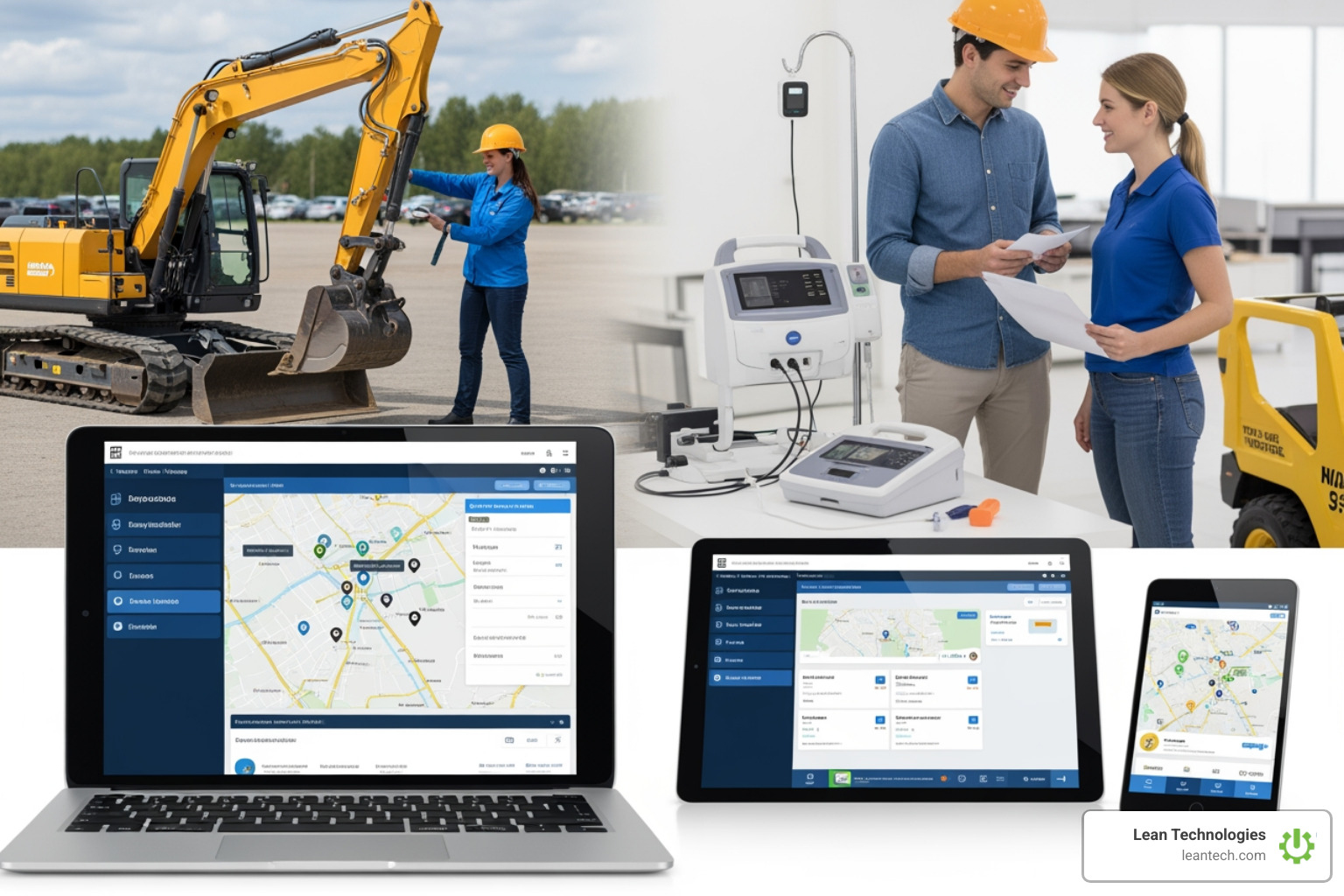
Equipment Tracking System: A Guide to Not Losing Your Assets
The Hidden Costs Hiding in Your Shop Floor Chaos
An equipment tracking system is a technology solution that monitors the location, usage, and condition of physical assets in real time using GPS, RFID, Bluetooth, or barcode scanning. It helps manufacturers reduce asset loss, prevent unplanned downtime, and optimize maintenance schedules through automated alerts and centralized dashboards.
Key benefits of equipment tracking systems:
Prevent costly downtime – Unplanned equipment failures cost businesses an average of $25,000 per hour
Reduce asset loss by 37% – Real-time location tracking cuts theft and misplacement
Automate maintenance – Schedule PMs based on actual usage hours, not guesswork
Improve utilization – Identify dormant equipment and redeploy underused assets
Streamline audits – Digital logs replace paper trails for compliance and safety
You've been there. A critical piece of equipment goes missing right when you need it most. The operator swears it's in Building 2. The maintenance log says it's out for repair. The spreadsheet hasn't been updated in three days. So you send someone on a scavenger hunt—wasting time, delaying production, and bleeding money.
This isn't a hypothetical. It's a daily reality for manufacturers running on paper logs, outdated spreadsheets, and "tribal knowledge" that only exists in someone's head. The typical factory floor can contain thousands of assets that must be tracked and maintained. When you can't find equipment—or worse, when it breaks down unexpectedly—you're not just losing productivity. You're losing profit.
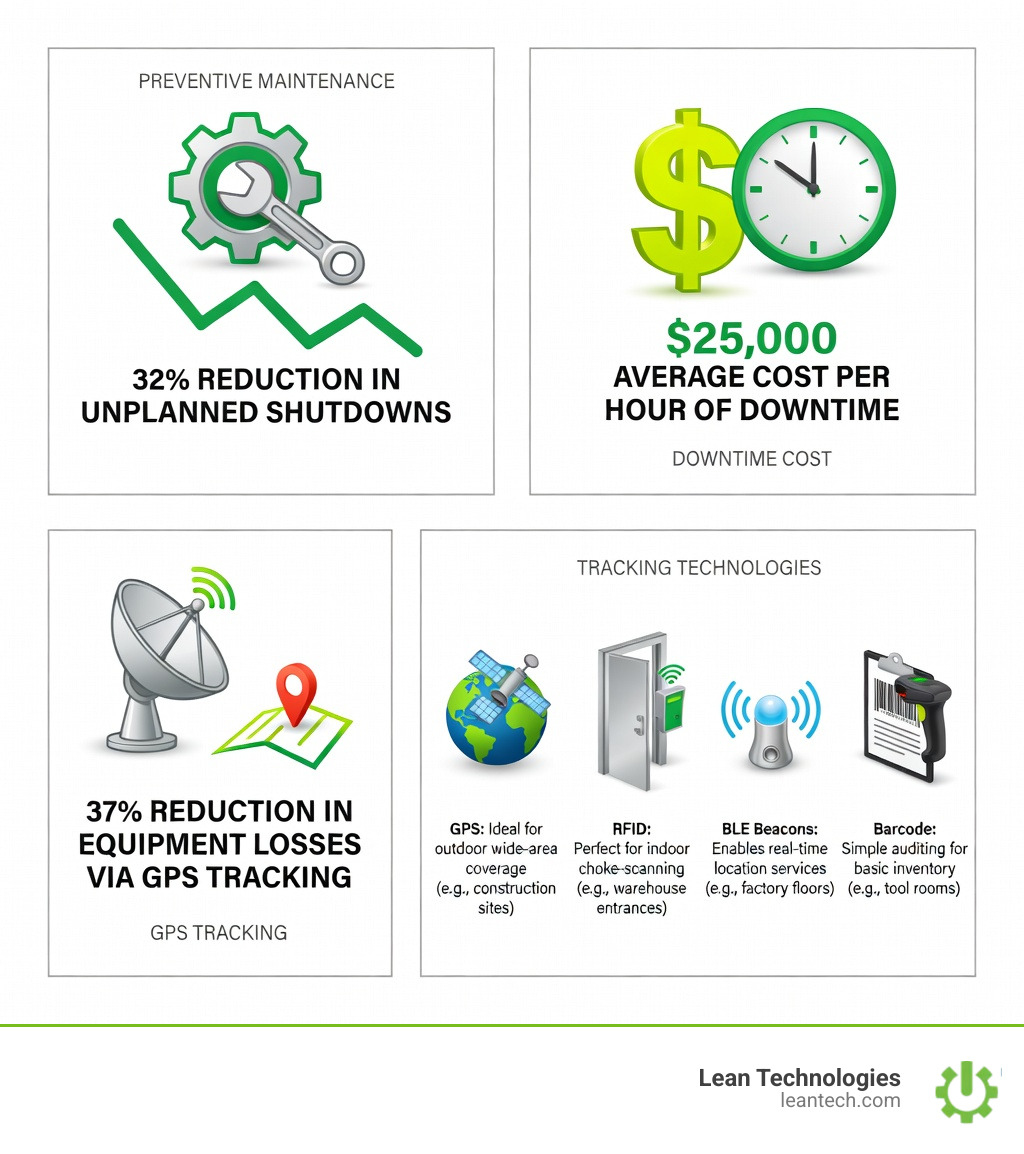
According to recent industry data, facilities that shift from reactive to preventive maintenance experience 32% fewer unexpected shutdowns. Yet most manufacturers still rely on manual processes that make real-time visibility impossible. By the time you enter data at the end of a shift, it's already too late.
An equipment tracking system replaces guesswork with real-time data. It tells you where every tool, machine, and asset is right now—and whether it's working, idle, or overdue for maintenance. It's not about adding complexity. It's about finally having the visibility you need to run a lean, accountable operation.
The High Cost of "Where is That Tool?"
When we talk about an equipment tracking system, we aren't just talking about a fancy digital map. We’re talking about stopping a massive financial leak. Unplanned downtime is a silent killer of manufacturing margins. Research shows that unplanned downtime costs businesses an average of $25,000 per hour. For larger enterprises, that number can skyrocket past $500,000 per hour when an entire line stops because a specific calibration tool or specialized container can't be located.
Beyond the clock, there is the literal loss of assets. Asset theft and misplacement are rampant in industries with high foot traffic or multiple jobsites. GPS tracking for rental equipment alone has been shown to cut losses by 37%. When equipment sits idle because nobody knows it’s available—a problem known as under-utilization—you’re essentially paying for "ghost assets" that provide zero ROI.
Maintenance delays add another layer of cost. If your maintenance manager doesn't know exactly where a machine is or how many hours it has actually run, preventive maintenance becomes a "best guess" game. Industry research confirms that reactive maintenance is significantly more expensive and disruptive than proactive tracking.
Primary Challenges in Manual Management
Manual management is the enemy of the lean shop floor. If you are still using paper-based logs or Excel sheets to track high-value gear, you are dealing with:
Ghost Assets: Equipment that is on the books but nowhere to be found.
Paper-Based Logs: Data that is illegible, lost, or entered days after the fact.
Spreadsheet Errors: One wrong keystroke can tell the team a $20,000 pump is in Building A when it’s actually in a technician’s truck three towns away.
Labor Waste: High-paid operators spending 20 minutes every morning searching for hand tools.
The Impact on Maintenance and Safety
Safety and compliance aren't optional. For organizations managing emergency response or hazardous materials, equipment must be tracked according to standards like the FEMA Authorized Equipment List. A dedicated equipment tracking system ensures that every firearm, medical kit, or disaster relief tool is accounted for and maintained.
Proactive maintenance isn't just about saving money; it's about safety. 65% of organizations report proactive maintenance as the most effective way to prevent disruptions. When you have an audit-ready digital chain of custody, regulatory compliance becomes a byproduct of your daily workflow rather than a stressful, week-long preparation event.
Choosing the Right Equipment Tracking System Technology
Not all tracking tech is created equal. The "best" system depends entirely on what you’re tracking and where it lives.
GPS (Global Positioning System): Best for outdoor, wide-area tracking. It provides precise location data but is power-hungry and generally requires a clear line of sight to the sky.
RFID (Radio Frequency Identification): Uses tags and readers. Passive RFID is great for "choke-point" tracking (like a tool room door), while active RFID broadcasts over longer distances.
BLE 5.1 (Bluetooth Low Energy): The current heavyweight champion for indoor tracking. It’s inexpensive, has a battery life of several years, and provides high accuracy for real-time location services (RTLS).
LoRaWAN (Long Range Wide Area Network): Ideal for large campuses or remote sites. It uses very little power and can transmit data over miles without a cellular connection.
Cellular Trackers: These use existing mobile networks to send data. They are reliable for roaming assets but require a SIM card and a monthly data plan.
For specialized equipment lists and responder gear, the InterAgency Board Interactive Standardized Equipment List provides a framework for how different technologies can be applied to critical inventory management.
Outdoor vs. Indoor Tracking Systems
Outdoor tracking relies heavily on satellite connectivity and cellular backhaul. Features like geofencing allow you to set a digital perimeter around a jobsite; if an excavator leaves that zone at 2 AM, the system sends an instant alert.
Indoor tracking faces different hurdles, like signal interference from steel beams and concrete walls. This is where BLE and RFID shine. By using a network of gateways, you can achieve real-time visibility into which room or bay a specific asset is in, even in a complex manufacturing environment.
Simple Identification and Auditing
Sometimes, high-tech isn't necessary. For thousands of small hand tools, a barcode system or QR codes might be enough.
Manual Scanning: Technicians scan an item in and out using a mobile app.
NFC Tags: Similar to tap-to-pay, these allow for quick identification with a smartphone.
Inventory Counts: Digital systems turn a three-day inventory audit into a two-hour walk-through.
Essential Features of an Industrial Equipment Tracking System
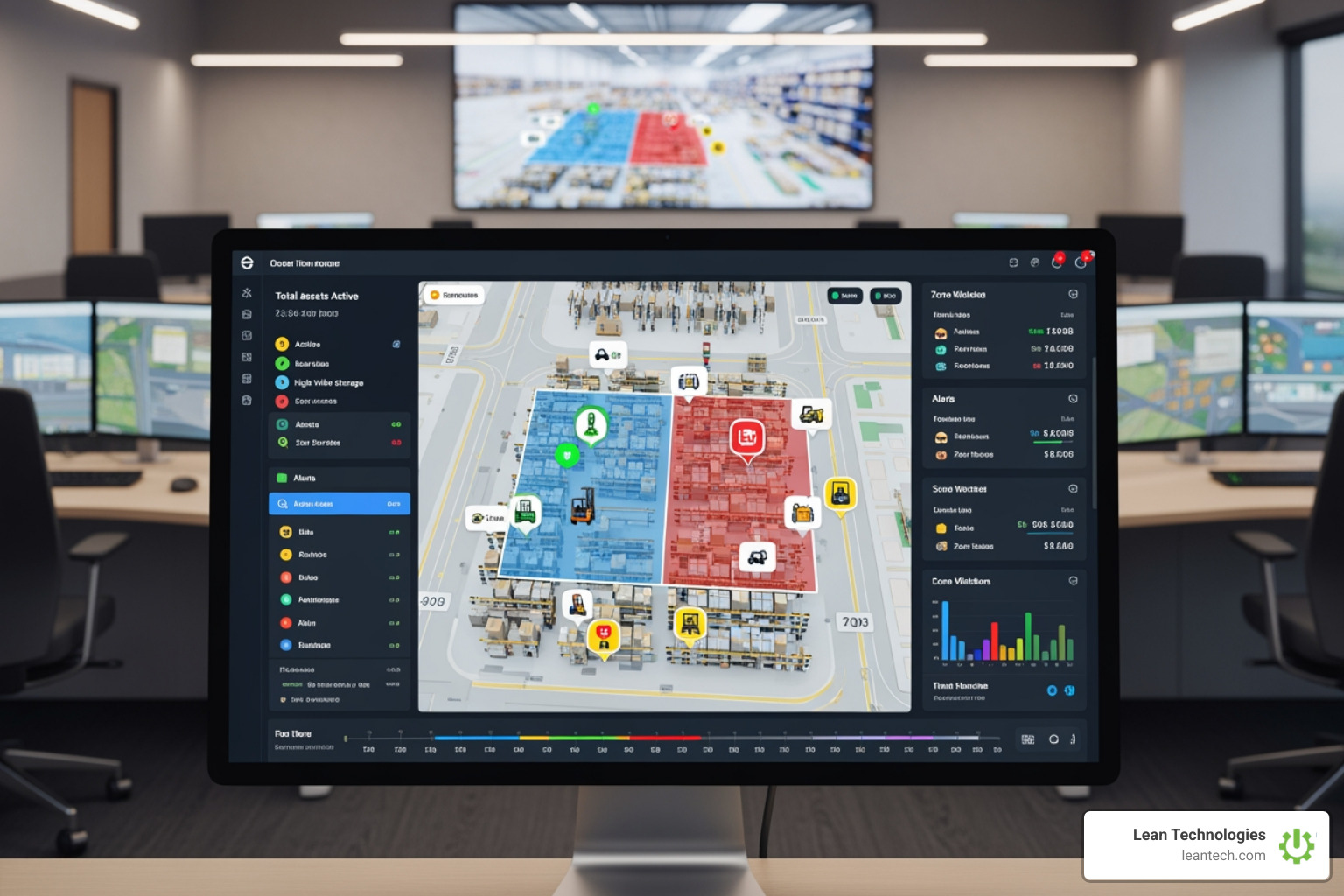
A modern equipment tracking system should do more than just drop a pin on a map. It needs to be the brain of your shop floor operations.
Key features to look for include:
Maintenance Scheduling: Automatically trigger work orders based on engine hours or date intervals.
Usage Analytics: See which machines are running 24/7 and which are gathering dust.
Movement Alerts: Get notified if expensive gear moves during unauthorized hours.
API Integration: Your tracking data shouldn't be an island. It needs to talk to your ERP and other shop floor tools. For more on how this fits into a broader strategy, check out our guide to digital lean manufacturing.
Real-Time Visibility and Utilization
True visibility means knowing the engine hours and historic usage of every asset. If a $150,000 piece of equipment has only been used for 10 hours in the last month, the system highlights that asset dormancy. This data allows managers to maximize revenue by redeploying assets to sites where they are actually needed.
Maintenance and Lifecycle Management
The goal is to extend asset life. By using work order automation and calibration tracking, you ensure that equipment is always in top working order. Digital audit trails provide a permanent record of every repair, which is invaluable for insurance and valuation reporting.
Technology Typical Battery Life Range Best For GPS 1-3 Months (Battery) Global Outdoor Vehicles BLE 5.1 3-5 Years 100-300 Meters Indoor Tools/Assets RFID (Passive) N/A (No Battery) < 10 Meters Inventory/Check-out LoRaWAN 5-10 Years 5-15 Kilometers Large Outdoor Sites
Why Consumer Trackers Fail the Shop Floor
It’s tempting to buy a pack of consumer-grade trackers and stick them on your $20,000 devices. Don't. While consumer trackers are great for finding your keys, they are a nightmare for business scalability.
Managed business accounts often cannot use consumer tracking services due to privacy restrictions. Furthermore, consumer devices are designed with anti-stalking features. If you hide a consumer tag on a piece of equipment to prevent theft, it will eventually alert the thief that an "unknown device is moving with them." Industrial environments also require a level of industrial durability that plastic consumer tags can't match. High-grade trackers come with an IP67 rating, meaning they are dust-sealed and can survive being submerged in water.
Limitations of Consumer Mesh Networks
Consumer networks rely on nearby smartphones to update location. If your equipment is in a remote steel shed or a basement with no foot traffic, the location won't update. Additionally, these systems lack API access, making it nearly impossible to integrate that data into your professional maintenance workflows.
Industrial-Grade Alternatives
Professional systems use:
Ruggedized Tags: Built to withstand vibrations, chemicals, and extreme temperatures.
Hardwired Trackers: Connected directly to the equipment's power source so they never die.
Solar-Powered Units: Perfect for non-powered assets like trailers or containers sitting in a yard.
Satellite Fallback: Ensures you can track assets in the middle of a desert or a mine where cellular signals die.
Implementing an Equipment Tracking System for ROI
At Lean Technologies, we built Thrive because we saw too many manufacturers struggling with "real-late" data. An equipment tracking system is only useful if the data is entered at the source and drives immediate action. When your team can see equipment status on a tablet in real-time, they stop fighting fires and start hitting production targets.
By digitizing these processes, companies like Interstate Waste Services saved over $340,000 annually, and others have saved millions by preventing equipment delays. This isn't just about software; it's about maintenance management that actually works for the people on the floor.
Industry-Specific Use Cases
Construction: Prevent theft of heavy machinery and track attachments across multiple sites.
Healthcare: Locate mobile pumps and wheelchairs instantly, reducing "search time" for nurses.
Logistics: Track returnable containers and pallets to ensure they aren't sitting idle at customer sites.
Mining: Monitor equipment health in harsh, remote environments to prevent catastrophic failures.
Integration with Existing Business Systems
Thrive doesn't replace your ERP; it makes it better. By integrating ERP connectivity and MES synchronization, you ensure that your high-level planning is based on the reality of your shop floor. When an operator logs a machine issue in Thrive, that data can flow directly into your CMMS workflows, triggering a repair before the machine actually breaks.
Frequently Asked Questions about Equipment Tracking
How does an equipment tracking system reduce operational costs?
By eliminating the average $25,000 per hour cost of unplanned downtime and reducing asset loss by up to 37% through real-time location data and preventive maintenance scheduling. It also improves labor efficiency by ending "scavenger hunts" for missing tools.
What is the difference between active and passive RFID for equipment?
Active RFID tags have their own power source and broadcast signals over long distances (up to 100 meters or more). They are great for real-time tracking. Passive tags have no battery and are powered by the radio waves of the reader. They are much cheaper and better for inventory audits at specific doorways or "choke-points."
Can I track equipment in remote areas without cellular service?
Yes. You can use trackers with satellite connectivity or deploy a LoRaWAN network. Some GPS trackers also have "store and forward" capabilities, where they save location data and upload it the moment they re-enter a service area.
In Summary
Stop managing your shop floor through spreadsheets and wishful thinking. An equipment tracking system is the foundation of a modern, lean operation that prioritizes uptime and accountability. By moving from reactive "firefighting" to proactive asset management, teams can ensure every tool is where it needs to be, exactly when it’s needed.
The transition from "where is that?" to "here it is" is the fastest way to boost your productivity. Ready to take control of your assets and stop the downtime bleed? Let your team run lean with Thrive.