
What is Factory Monitoring Software and Why Does Your Floor Need It?
Your Shop Floor Is Generating Data — But Is It Reaching You in Time?
Factory monitoring software is a digital system that collects, organizes, and displays production data from your shop floor in real time — so you can act on problems before they become losses.
Here's what it does at a glance:
Tracks machine status, output, downtime, and quality as it happens
Replaces paper logs, end-of-shift reports, and reactive firefighting
Gives operators, supervisors, and managers a shared, live view of performance
Feeds key metrics like OEE, scrap rate, and cycle time into dashboards
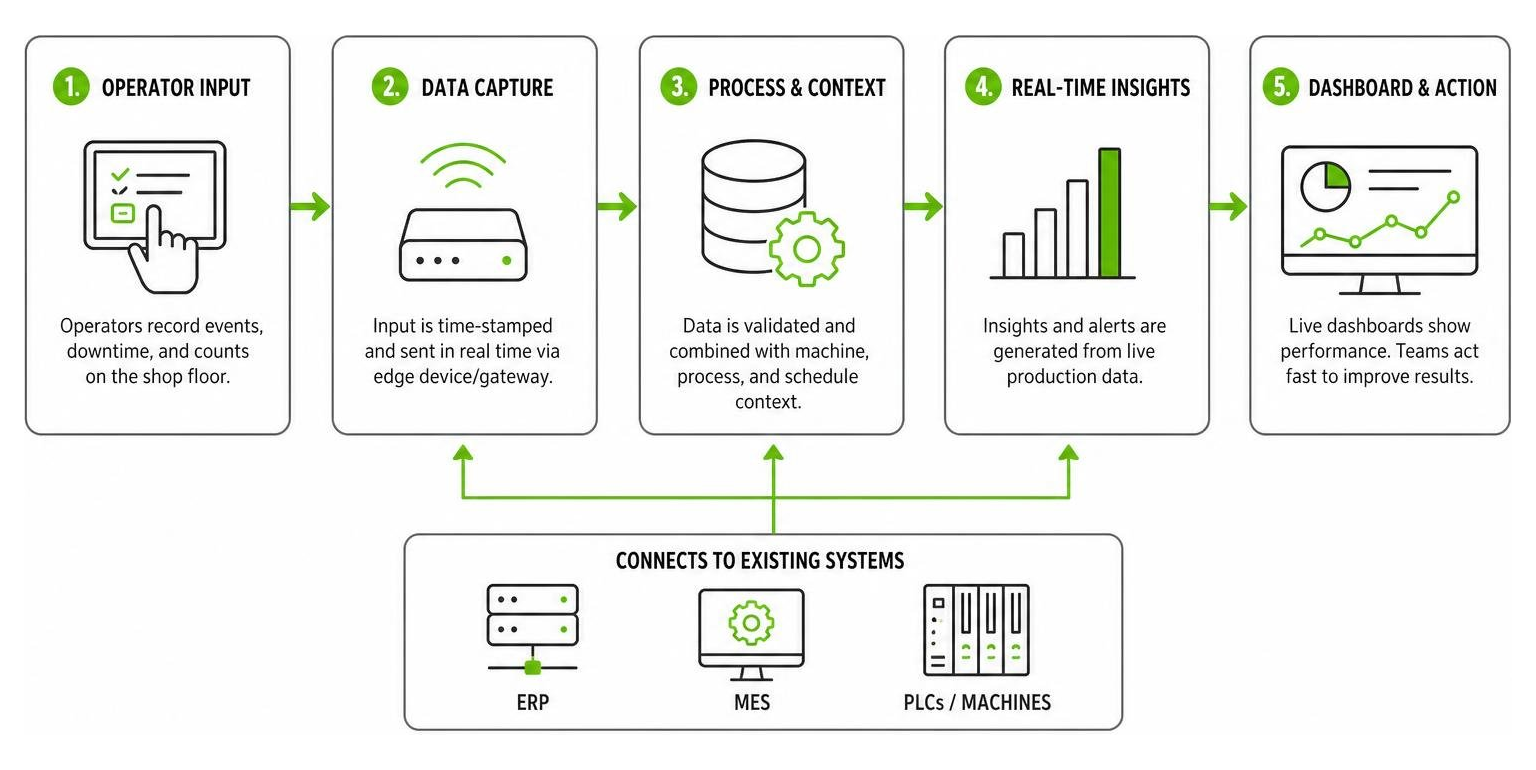
Connects to existing systems like ERPs, MES platforms, and PLCs
If you're an operations manager, you already know the problem. Shift reports come in late. Downtime gets logged after the fact — if at all. By the time you see the numbers, the shift is over and the damage is done.
That's not a people problem. That's a data timing problem.
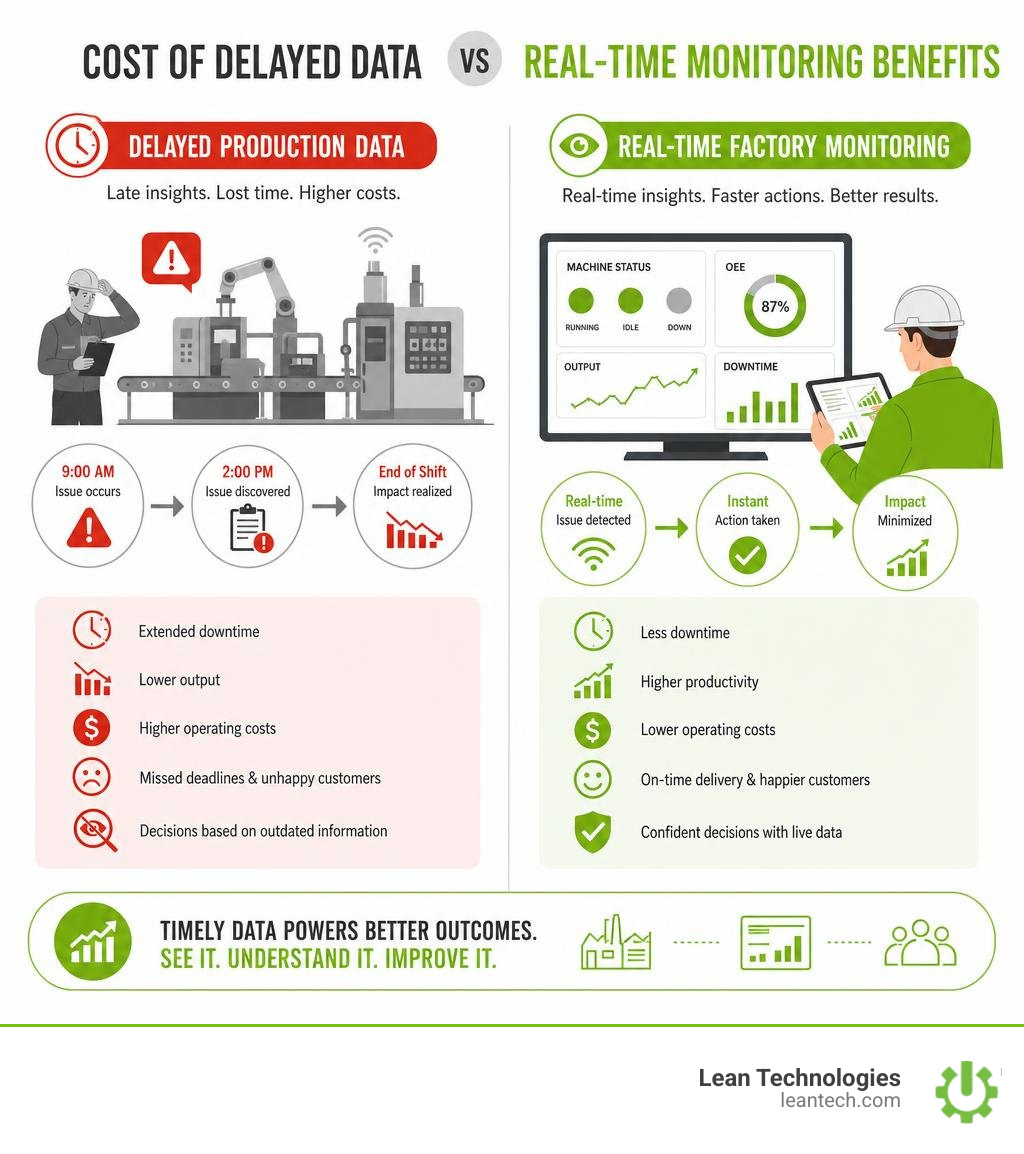
Most shop floors aren't short on data. They're short on data that arrives fast enough to do something with. A machine goes down at 9 AM. You hear about it at 2 PM during the standup. Five hours of lost production, and nobody escalated because the process for escalating lived on a clipboard in the corner.
Research shows that real-time production monitoring can reduce unplanned downtime by up to 50% and improve Overall Equipment Effectiveness (OEE) by 10–20%. Those aren't small numbers. On a mid-size line running tight margins, that's the difference between a profitable quarter and a painful one.
The shift from paper-based tracking to structured digital workflows isn't just about technology. It's about giving your team the visibility to actually fix things — while there's still time to fix them.
What is Factory Monitoring Software and How Does It Work?
At its core, factory monitoring software serves as the central nervous system of your manufacturing operation. It bridges the gap between what is physically happening on the shop floor and what management sees on their screens.
But how does it actually function? The process relies on a continuous loop of data acquisition, contextualization, and visualization:
Data Acquisition: Information is gathered directly from the plant floor. This can happen through automatic machine connections (using PLCs, IoT sensors, or edge devices) or through structured operator inputs on mobile tablets and rugged terminals.
Contextualization: Raw numbers—like "Machine 4 stopped at 10:14 AM"—are useless without context. The software pairs this signal with production schedules, active part numbers, and operator inputs to explain why the stop occurred (e.g., a specific tooling jam during a plastics extrusion run).
Visualization & Action: The system pushes this enriched data to live, shop-floor dashboards. Operators see their current performance against targets, while supervisors receive instant alerts if a bottleneck develops.
By utilizing a Guide to Digital Lean Manufacturing, modern plants move away from passive record-keeping and transition to active, real-time process management.
The Difference Between Standalone Tools and Factory Monitoring Software
It is easy to get lost in the alphabet soup of industrial software. To make the right investment, you must understand the distinctions between different types of monitoring:
Production Monitoring: Focuses primarily on output, cycle times, and target counts. It answers the question: Are we hitting our numbers today?
Manufacturing Monitoring: Takes a broader view of the entire manufacturing operation. It integrates production output, quality tracking, shift reports, and maintenance workflows into a centralized environment.
Condition Monitoring: Focuses strictly on machine health. It tracks physical parameters like vibration, ultrasound, temperature, and magnetic fields to predict when a component will fail.
While standalone condition monitoring tools stop at detecting physical anomalies, a comprehensive factory monitoring platform connects these signals to operational workflows. For example, rather than just sounding an alarm about a hot bearing, the platform links the issue to Equipment Asset Tracking and triggers an immediate maintenance request.
Why Legacy Systems Fail Without Modern Factory Monitoring Software
Many plants try to monitor their operations using the built-in modules of their Enterprise Resource Planning (ERP) or traditional Manufacturing Execution Systems (MES). In practice, this rarely works.
ERPs are designed for transactional accounting, inventory valuation, and long-term scheduling—not the rapid, minute-by-minute realities of the plant floor. Traditional MES platforms, on the other hand, are notoriously heavy, expensive, and require months of custom coding to implement.
When forced to use these rigid systems, shop floor teams default to manual workarounds. Operators scribble downtime reasons on paper logs or type them into isolated spreadsheets at the end of their shifts.
This creates delayed, inaccurate data. By the time a manager reviews the weekly Excel report, the root causes of major bottlenecks are forgotten, and the opportunity for continuous improvement is lost. Transitioning to a modern, lightweight factory monitoring solution is the only way to establish a single, trusted source of truth that operators will actually use.
Key Features and Benefits of Shop Floor Monitoring
Implementing factory monitoring software is not about adding more screens to your facility; it is about driving measurable operational excellence. When teams have immediate access to critical production data, they can make informed, data-driven decisions that immediately lower costs.
Eliminating Unplanned Downtime and Bottlenecks
Unplanned downtime is the single greatest profit killer on the shop floor. When a critical machine stops unexpectedly, the financial impact cascades through your entire supply chain.
Factory monitoring systems tackle this problem by replacing reactive firefighting with proactive, structured responses. When a machine stops or slows down, the system doesn't just record the event; it forces immediate accountability.
By integrating your monitoring tool with a digital CMMS, you can instantly route diagnostics to maintenance technicians. Instead of waiting for a supervisor to find a mechanic, the system automatically triggers a work order based on the specific failure mode. This ensures that Planned Maintenance and urgent repairs are executed before minor issues snowball into catastrophic equipment failures.
Tracking Key Shop Floor Metrics and KPIs
If you cannot measure it, you cannot improve it. Factory monitoring platforms provide instant, automated tracking of the metrics that define your profitability:
Overall Equipment Effectiveness (OEE): Calculated automatically by multiplying Availability (uptime), Performance (speed efficiency), and Quality (good yield vs. total output).
First-Pass Yield (FPY): Tracks the percentage of products that are manufactured correctly the first time without needing rework.
Scrap and Defect Rates: Identifies exactly which lines, materials, or shifts are producing the most waste.
Using dedicated tools for Defect Scrap Tracking and Nonconformance allows quality assurance managers to pinpoint the root causes of quality deviations. Instead of guessing why a batch failed compliance standards, they can correlate defect spikes with specific process parameters or operator actions.
Structured Workflows and Actionable Alerts
Data is only valuable if it leads to action. Modern monitoring platforms use automated rules to escalate issues before they ruin a shift.
For example, if a line's cycle time drops 15% below target for more than ten minutes, the software can automatically send an alert to the shift supervisor. By utilizing a digital Kanban Board Tool and robust Workflow Tracking, teams can visualize active issues, assign tasks to specific owners, and track resolution progress in real time. This keeps everyone aligned and ensures that problems are resolved systematically rather than forgotten.
How Real-Time Production Monitoring Integrates with Your Stack
A common fear among IT and operations managers is that introducing new software will disrupt their existing technology stack. However, modern factory monitoring software is designed to enhance—not replace—your current systems.
By connecting directly to your PLCs, ERPs, and maintenance tools, it acts as an orchestration layer that makes your existing investments more valuable.
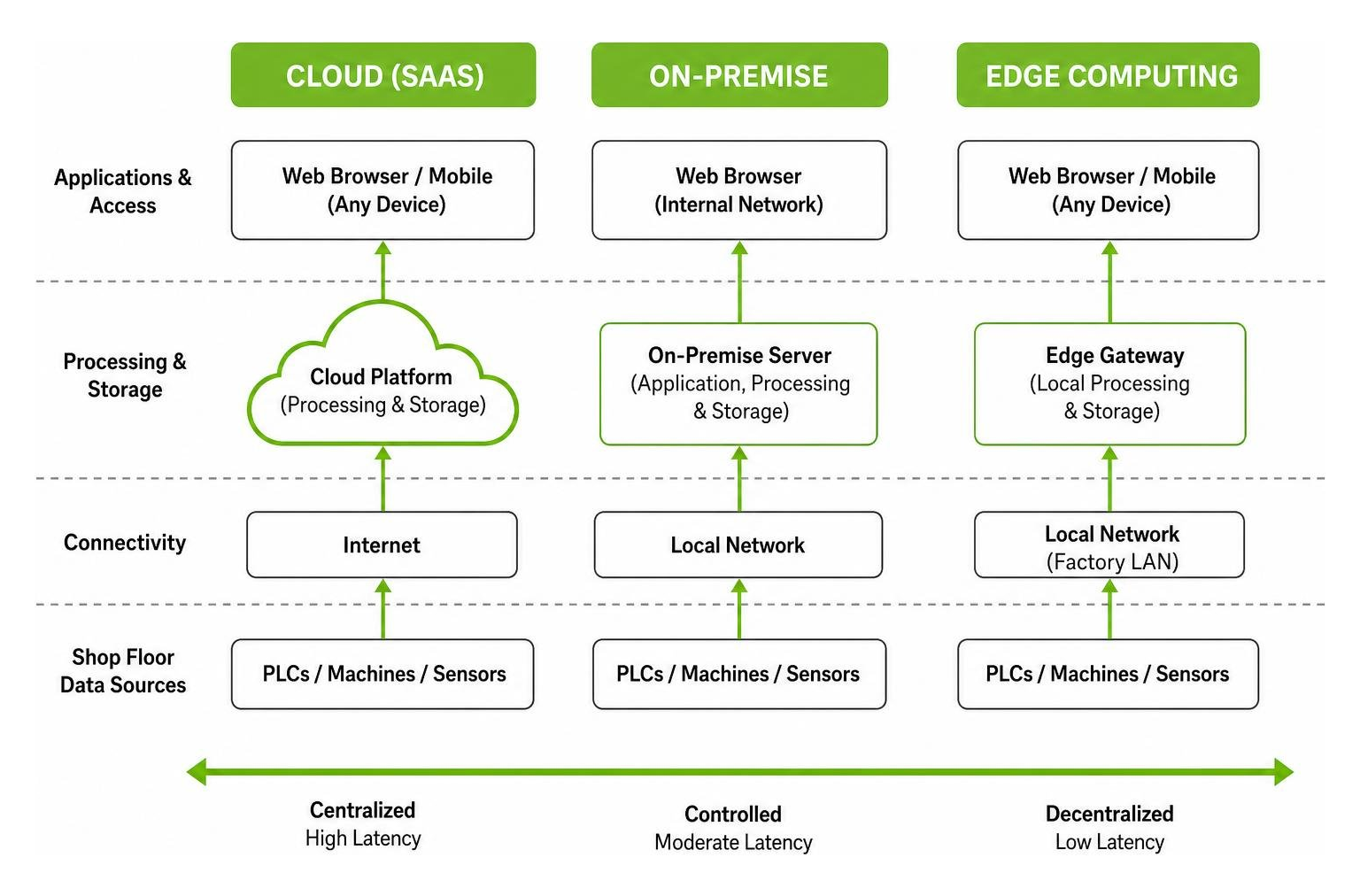
When evaluating how to deploy these solutions, manufacturers must choose a model that fits their IT infrastructure, security standards, and latency requirements:
Feature / Model Cloud (SaaS) On-Premise Edge Computing Setup Speed Extremely fast (days) Slow (weeks to months) Fast (days to weeks) Upfront Cost Low (subscription-based) High (hardware & licensing) Moderate (hardware + software) Data Sovereignty Managed by cloud provider 100% controlled internally Local storage with cloud sync Offline Resilience Dependent on internet connection High (runs on local network) Excellent (buffers data locally during outages) Maintenance & Updates Automatic (handled by vendor) Manual (requires internal IT) Hybrid (local updates via cloud push)
For most small to mid-size manufacturers, a hybrid Edge-to-Cloud model offers the best of both worlds. The edge layer handles real-time, latency-critical operations on the plant floor, while the cloud layer aggregates data for multi-site benchmarking, long-term trend analysis, and remote management access.
To explore how these integrations work in detail, you can read more about connecting your shop floor systems in this guide to Maintenance software integrations.
Implementation Timelines and Cost Expectations
The era of the multi-year, multi-million-dollar software rollout is over. Modern platforms utilize a "configure, don't code" approach that dramatically reduces deployment speed.
Phase 1: Pilot Line (Weeks 1–2): Start small. Connect one or two critical lines, define your core KPIs, and train a select group of operators.
Phase 2: Refinement (Weeks 3–4): Analyze initial data, refine your downtime categorization, and adjust alert thresholds based on operator feedback.
Phase 3: Scale (Week 5+): Clone the proven configuration to the rest of your facility and integrate it with your ERP or CMMS for closed-loop workflows.
Using structured Project Tracking ensures that your implementation team stays on schedule, allowing you to realize a return on investment (ROI) in weeks rather than quarters.
Frequently Asked Questions about Factory Monitoring
Is factory monitoring software worth the investment if we already run a CMMS?
Absolutely. A CMMS is an excellent tool for recording maintenance work, managing spare parts, and tracking history. However, a CMMS does not generate the real-time operational data that tells your team which work matters most right now. Factory monitoring software adds the diagnostic and production layer, turning real-time shop floor realities into prioritized, actionable maintenance tasks.
How long does it take to see a return on investment (ROI)?
Most manufacturers see measurable improvements within their first 30 days. By gaining immediate visibility into minor stops and slow-running equipment, teams can quickly identify and eliminate "micro-downtime" events that previously went unnoticed but collectively cost thousands of dollars each week.
Do we need specialized analysts or programmers to run these systems?
No. Modern platforms are built with intuitive, low-code interfaces designed for shop floor personnel. Operators can easily log issues via tablets, and continuous improvement managers can build custom dashboards using simple drag-and-drop tools without writing a single line of code.
In Summary: Take Control of Your Shop Floor
Leaving your production goals to end-of-shift reports and spreadsheet workarounds is a recipe for missed targets and rising operational costs. To remain competitive, your team needs immediate, actionable visibility at the source.
Lean Technologies offers Thrive, an all-in-one, customizable shopfloor software built by manufacturing experts to streamline operations, boost productivity, and improve profit through a cohesive, integrated platform.
Thrive is not a heavy ERP or MES that takes years to deploy. It is a flexible, digital toolbox designed to help your operators and supervisors log issues, track actions, and drive continuous improvement in real time.
By implementing structured digital processes like Leader Standard Work, visual Performance Goal Boards, and integrated Thrive Quality tracking, you empower your frontline workers to own their data and solve problems instantly.
Stop managing your shop floor through spreadsheets and wishful thinking.
Let your team run lean with real-time visibility, fewer workarounds, and a single source of truth. Explore our Guide to Digital Lean Manufacturing or visit Lean Technologies to learn how we can help you transform your shop floor operations today.