
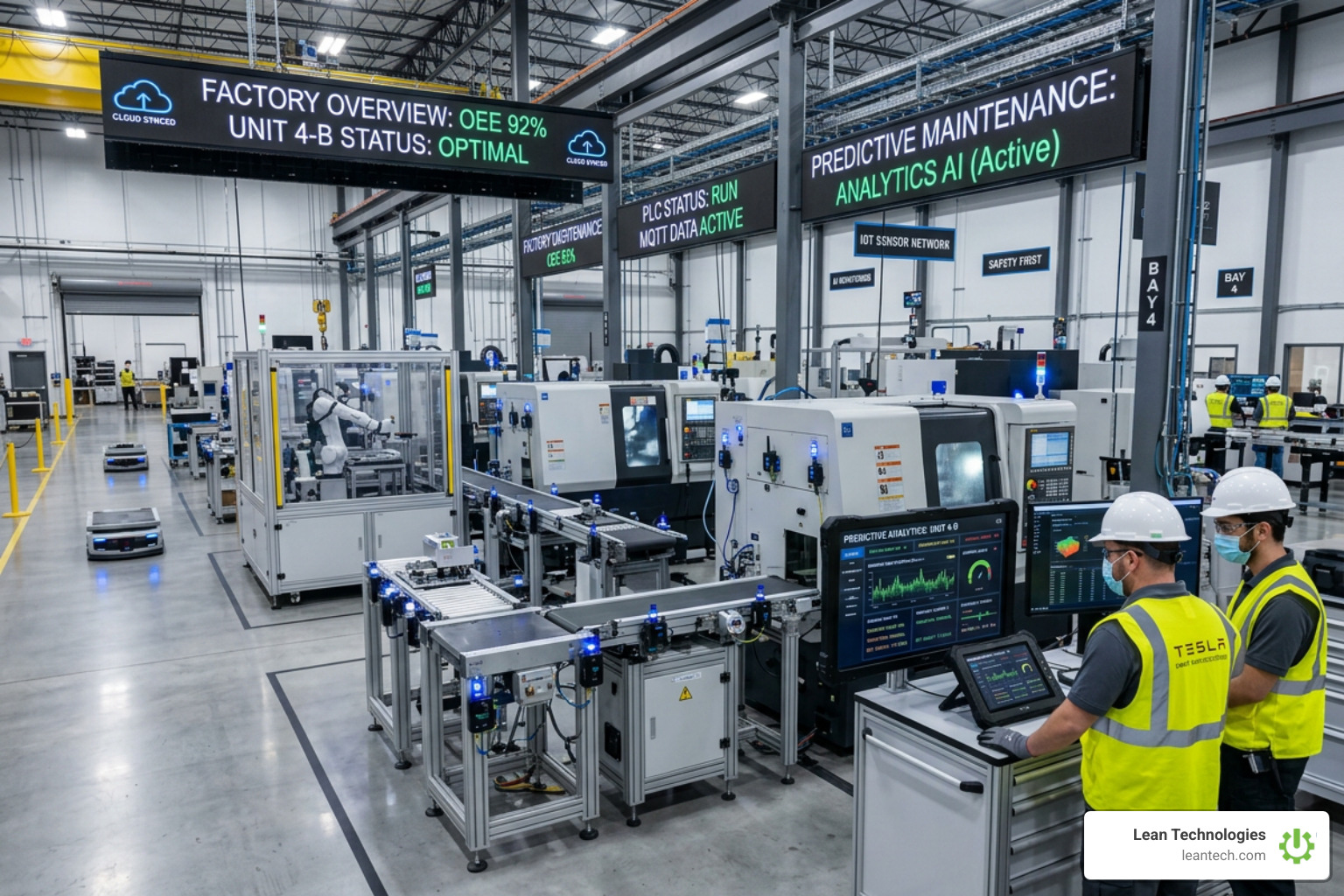
Industry 4.0 Maintenance is the Crystal Ball Your Factory Needs
The $50 Billion Problem Sitting on Your Shop Floor
Industry 4.0 maintenance is the practice of using connected technologies -- IoT sensors, AI, big data, and cloud computing -- to shift manufacturing maintenance from reactive firefighting to intelligent, predictive action.
Here's the quick version of what it means and why it matters:
What it is: Using real-time data from machines and systems to predict failures before they happen
Why it matters: Unplanned downtime costs industrial manufacturers an estimated $50 billion every year -- roughly $125,000 per hour across industries
How it works: Sensors collect machine data -> AI analyzes it -> maintenance is triggered before failure occurs
What you gain: Up to 40% reduction in unplanned downtime, 30% lower maintenance costs, and longer asset life
Where to start: Pilot on one critical asset, prove value, then scale
Most plants are still stuck in a pattern that looks something like this: something breaks, someone reacts, production stops, everyone scrambles. Rinse and repeat.
It's exhausting. And expensive.
The problem isn't effort -- your maintenance team is working hard. The problem is when they find out. By the time a fault shows up as a breakdown, you've already lost production time, parts, and probably some goodwill from the floor.
Poor maintenance strategies don't just cause headaches. Research shows they can reduce a plant's overall productive capacity by 5 to 20 percent. That's not a rounding error. That's a serious drag on output, margin, and competitiveness.
Industry 4.0 changes the equation. Instead of waiting for failure, smart factories let machines signal trouble before it becomes a crisis. That's the core promise -- and it's no longer a futuristic concept reserved for billion-dollar operations. It's being deployed right now by manufacturers of all sizes.
The Evolution: From Reactive Fixes to Industry 4.0 Maintenance
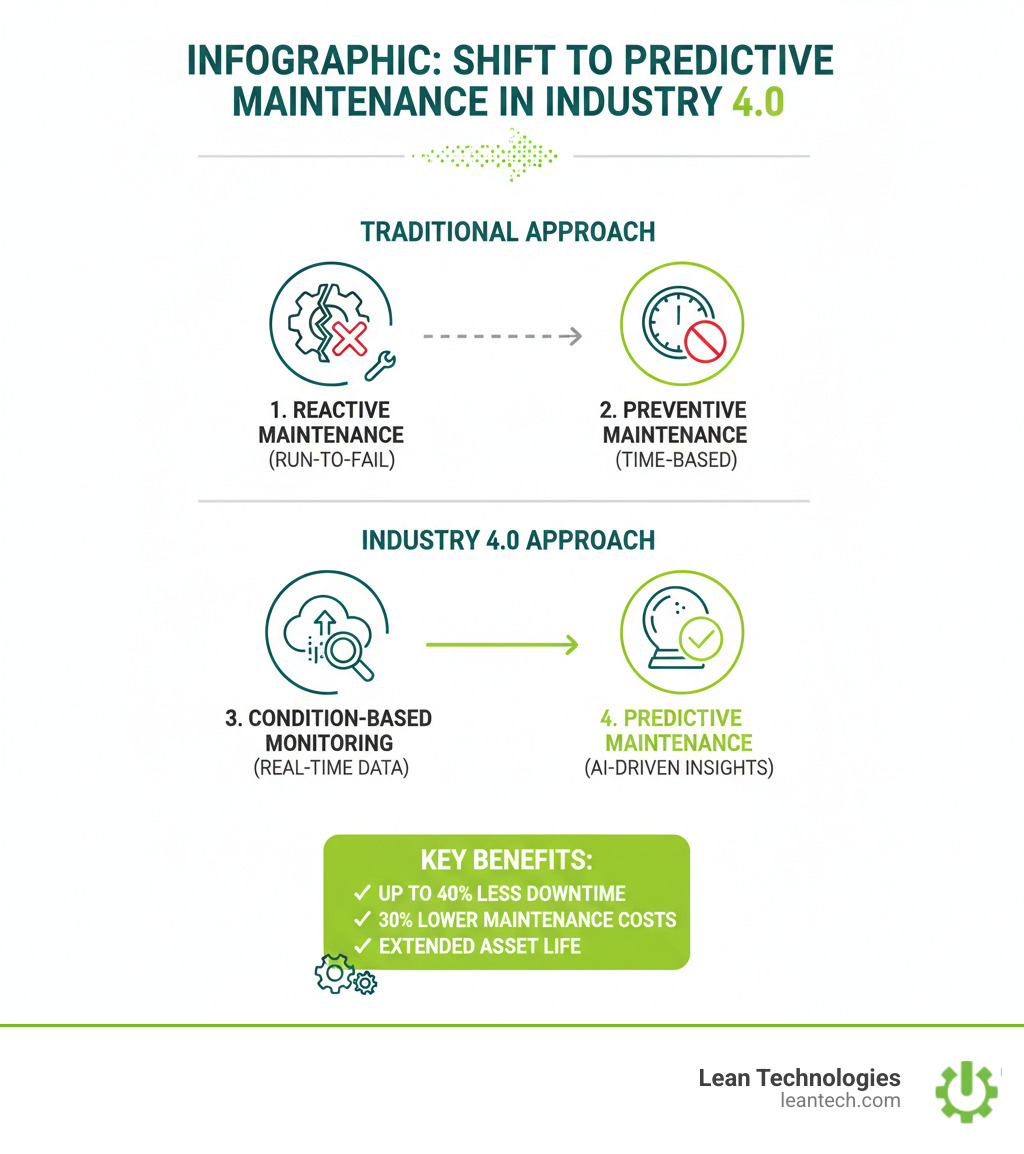
For decades, Maintenance has been viewed as a "necessary evil"—a cost center that only gets attention when things go wrong. To understand why industry 4.0 maintenance is such a game-changer, we have to look at the strategies that came before it.
Reactive Maintenance (Run-to-Fail): This is the "Whack-a-Mole" strategy. You use the machine until it stops. While it requires low initial investment, the trade-offs are brutal: high repair costs, secondary damage to equipment, and catastrophic unplanned downtime.
Preventive Maintenance (Scheduled): Think of this like an oil change for your car. You perform Planned Maintenance based on time or cycles (e.g., every 500 hours). It’s a step up, but it’s often wasteful. Research suggests that as much as half of all manually scheduled machine maintenance is actually futile, taking up resources for parts that didn't need replacing yet.
Proactive Maintenance: This focuses on the root cause. Instead of just fixing a failed bearing, you ask why it failed (e.g., misalignment or poor lubrication) and fix the underlying issue. It’s a more scientific approach to maintenance, but it still lacks real-time foresight.
Predictive Maintenance (PdM): This is the gold standard of Industry 4.0. By using sensors and data, we monitor the actual condition of the asset. We don't fix it because the calendar says so; we fix it because the data shows a failure is imminent.
The shift to industry 4.0 maintenance breaks the traditional trade-offs between cost and reliability. You no longer have to choose between "over-maintaining" (wasting money) and "under-maintaining" (risking downtime).
The Tech Stack: Powering the Physical-Digital-Physical Loop
At the heart of industry 4.0 maintenance is the "physical-digital-physical" loop. A machine starts showing signs of trouble. That signal becomes usable data. Then the team takes action before the issue turns into downtime.
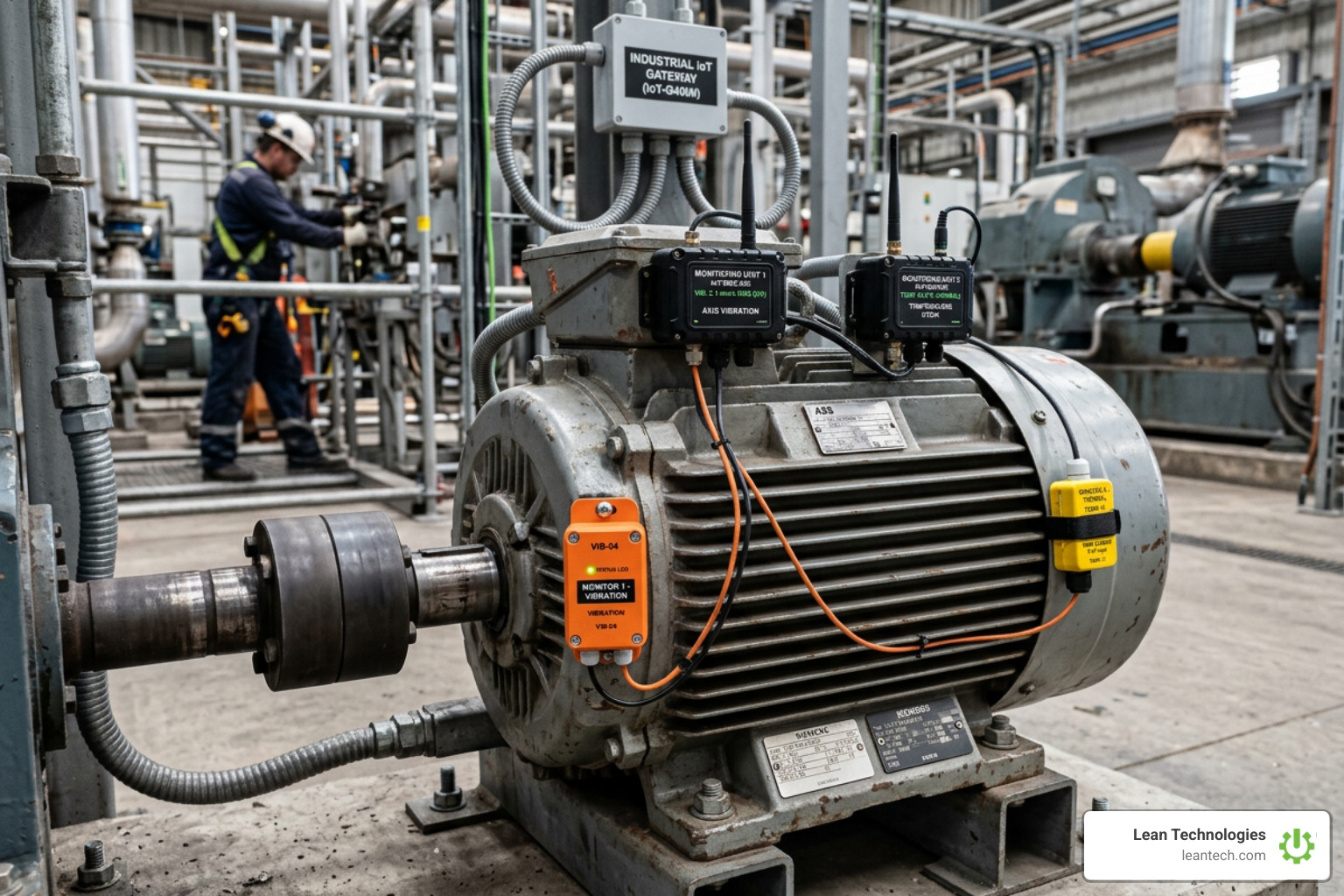
This loop depends on a stack of technologies that turns raw machine behavior into decisions the shop floor can actually use:
IoT Sensors: These are the "eyes and ears" of the factory. They translate physical variables like temperature, vibration, and conductivity into digital signals.
Big Data & Cloud Computing: Manufacturers generate massive amounts of data. The cloud provides the storage and processing power to handle this volume without crashing local servers.
Edge Computing: Sometimes, there is no time to wait for data to travel to the cloud and back. Edge devices process data right at the machine, allowing for split-second alerts.
AI and Machine Learning: This is where pattern recognition happens. AI sifts through Work Order History and real-time streams to find patterns that humans would miss. Over time, these algorithms get smarter, refining failure thresholds to become more accurate.
When these technologies work together, IoT slashes downtime by giving maintenance teams a head start.
What are the core technologies behind industry 4.0 maintenance?
Beyond the basics, several advanced tools are making the shop floor more intelligent:
Machine Learning: This allows systems to learn from previous failures. If a pump failed last time after three days of high vibration, the ML model remembers that and flags it even earlier next time.
Cyber-Physical Systems (CPS): These are integrations of computation, networking, and physical processes. In a CPS environment, the machine can sometimes even adjust its own parameters to slow down degradation until a technician arrives.
Augmented Reality (AR): Using wearables or tablets, technicians can see "digital overlays" on physical machines, providing step-by-step repair instructions or real-time Equipment Asset Tracking data without looking away from the task.
How does industry 4.0 maintenance integrate with existing ERPs?
One of the biggest problems in most plants is the data silo. Maintenance data lives in one system, inventory in another, and production schedules somewhere else.
Industry 4.0 works best when those systems are connected. A modern CMMS should not sit on an island. When an AI model predicts a motor failure, the next steps should be structured and fast:
Trigger a work order in the CMMS.
Check the ERP for spare parts.
Initiate Parts Management protocols to order what's missing.
Adjust the production schedule to minimize the impact of the repair.
That kind of handoff matters. It means the technician shows up with the right part, the right tool, and a time slot that does not blow up the schedule.
For teams using Thrive, this is an important distinction: Thrive is not the sensor layer, and it is not an ERP or MES replacement. It is the digital toolbox that helps teams log issues, assign follow-up, track actions, and create real-time visibility once data is entered at the source. That is how machine insight turns into accountable execution on the floor.
Real-World Gains: ROI, Uptime, and the $50B Problem
The numbers behind industry 4.0 maintenance aren't just theoretical; they are transformative. Unplanned downtime is a $50 billion annual drain on the industry, with the median cost across sectors sitting at $125,000 per hour.
When companies move to predictive models, the results are immediate:
30% Reduction in Maintenance Costs: By only fixing what needs fixing and avoiding emergency "rush" shipping for parts.
40% Reduction in Unplanned Downtime: Machines stay running, and repairs happen during scheduled gaps.
20-50% Less Planning Time: Automated insights mean managers spend less time guessing and more time executing.
Take Trenitalia, the Italian train operator, as an example. By installing sensors on locomotives and using predictive analytics, they decreased downtime by 5-8% and reduced their annual maintenance spend by 8-10%, saving an estimated $100 million per year.
For smaller manufacturers, the gains show up in the PM Gap Report, identifying exactly where maintenance is falling behind before it impacts quality. This is how smart companies achieve top-quartile performance -- by treating maintenance as a strategic asset rather than a cost of doing business.
A Practical Roadmap: How to Start Your PdM Pilot
You don't need to digitize your entire factory on Monday morning. In fact, trying to "boil the ocean" is the fastest way to fail. The most successful implementations follow a "start small, scale fast" approach.
Identify Critical Assets: Which machine, if it broke right now, would stop your entire line? Start there.
Assess Your Readiness: Do you have the data foundation? Are your technicians ready for mobile tools? Use a Work Request Queue to see where your current bottlenecks are.
Run a Pilot: Install sensors on one or two high-value assets. Collect data for a few months to build a baseline.
Bridge the Skills Gap: Industry 4.0 requires new skills. Involve your frontline team early. If they don't trust the data, they won't use the system.
Feature Traditional Maintenance Industry 4.0 Maintenance Triggers Calendar or Breakdown Real-time Asset Condition Data Source Manual Logs / Spreadsheets IoT Sensors / Automated Data Cost Model High O&M / Emergency Fixes Strategic Investment / ROI Outcome Reactive Firefighting Proactive Future-Proofing
Frequently Asked Questions about Smart Manufacturing
What is the main benefit of predictive maintenance?
The primary benefit is the drastic reduction in unplanned downtime. By knowing exactly when a part will fail, you can schedule repairs during natural production breaks. This leads to higher ROI, better asset health, and ensures that precision tools remain accurate through regular Gage Calibration.
Is Industry 4.0 maintenance suitable for small manufacturers?
Absolutely. Scalability is a core feature of Industry 4.0. Small manufacturers can start with low-cost vibration sensors on a single critical pump. Using mobile-first tools allows small teams to gain a competitive advantage without the massive IT overhead of traditional systems.
How does AI improve maintenance scheduling?
AI identifies patterns in historical and real-time data to predict exactly when a failure will occur. This allows for "automated workflows" where the system optimizes resources—assigning the right technician to the right machine at the exact moment maintenance is needed, rather than following a generic, often futile schedule.
In Summary
Industry 4.0 maintenance is not just about smarter machines. It is about faster decisions, fewer surprises, and better follow-through when something starts going wrong.
The next step for most manufacturers is not to chase every new technology at once. It is to build a process the team will actually use. Start with one critical asset. Make sure issues are captured at the source. Build a clean workflow for work orders, parts, follow-up, and accountability.
That is where many plants still get stuck. The sensor may detect the problem, but the response is buried in paper, spreadsheets, texts, or end-of-shift updates. Real-time beats real-late.
Thrive was built for that gap. It does not replace ERP or MES systems, and it does not collect sensor data or run predictive alerts. It helps small to midsize manufacturers structure the work around maintenance, downtime, quality, safety, and continuous improvement so teams can see problems sooner and act on them faster.
Stop managing your shop floor through spreadsheets and wishful thinking. Let the team run lean with a digital toolbox that drives action, accountability, and uptime. If industry 4.0 maintenance is the goal, structured real-time execution is what makes it work.