
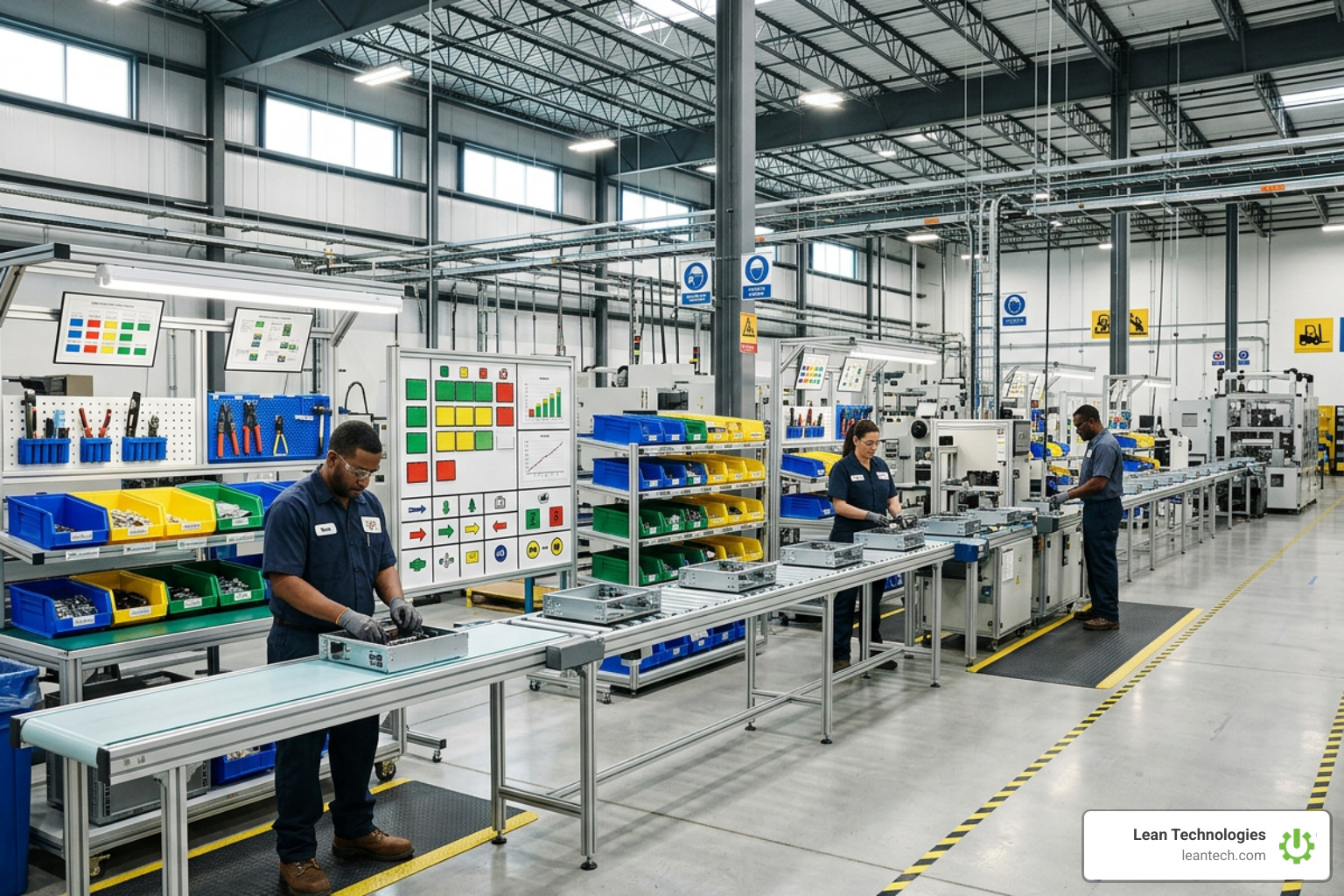
The Ultimate Guide to Lean Manufacturing Solutions for Modern Plants
Why Waste Is Costing Your Plant More Than You Think
Lean manufacturing solutions are tools, systems, and strategies that help manufacturers eliminate waste, reduce costs, and improve productivity across every stage of production.
Here are the most effective lean manufacturing solutions modern plants use today:
Solution Primary Waste Targeted Key Benefit Automated Storage & Retrieval (AS/RS) Motion, Transportation Up to 85% space savings, 99.9% pick accuracy Real-Time Location Systems (RTLS) Motion, Waiting 20-30% downtime reduction SMED (Single-Minute Exchange of Die) Waiting, Overproduction Changeover times reduced to under 10 minutes Digital Lean Platforms (CMMS, SIM) All 8 wastes 3-5% OEE improvement in 90 days Pull Systems & Kanban Overproduction, Inventory Demand-driven, just-in-time production Visual Management Tools Defects, Motion Faster issue identification on the shop floor 5Ms Root Cause Analysis Defects, Overprocessing Structured problem-solving, fewer recurring failures Production Monitoring & Carbon Reporting Waste, Overprocessing Efficiency gains + environmental compliance
Most plant managers know something is wrong before they can prove it. Orders are late. Inventory is piling up. Machines are sitting idle. The team is busy — but the numbers don't show it.
That gap between activity and results is where waste lives.
In manufacturing, waste isn't just scrap on the floor. It's the 65% of a picker's shift spent walking. It's the $8,000-per-minute hit every time a line goes down unexpectedly. It's the great improvement idea that died in a spreadsheet before anyone acted on it.
Lean manufacturing was built to close that gap. But here's the problem: the tools that worked in simpler factories are struggling to keep up with modern complexity. Higher product mixes, tighter margins, and more regulatory pressure mean the old whiteboard-and-clipboard approach just doesn't cut it anymore.
This guide covers the full picture — from foundational lean principles and the 8 wastes of manufacturing, to hardware solutions like AS/RS and RTLS, to digital platforms that give operations managers real-time visibility across every line, shift, and site. Whether you're just starting a lean journey or looking to take an existing program to the next level, you'll find practical strategies here that work on real shop floors.
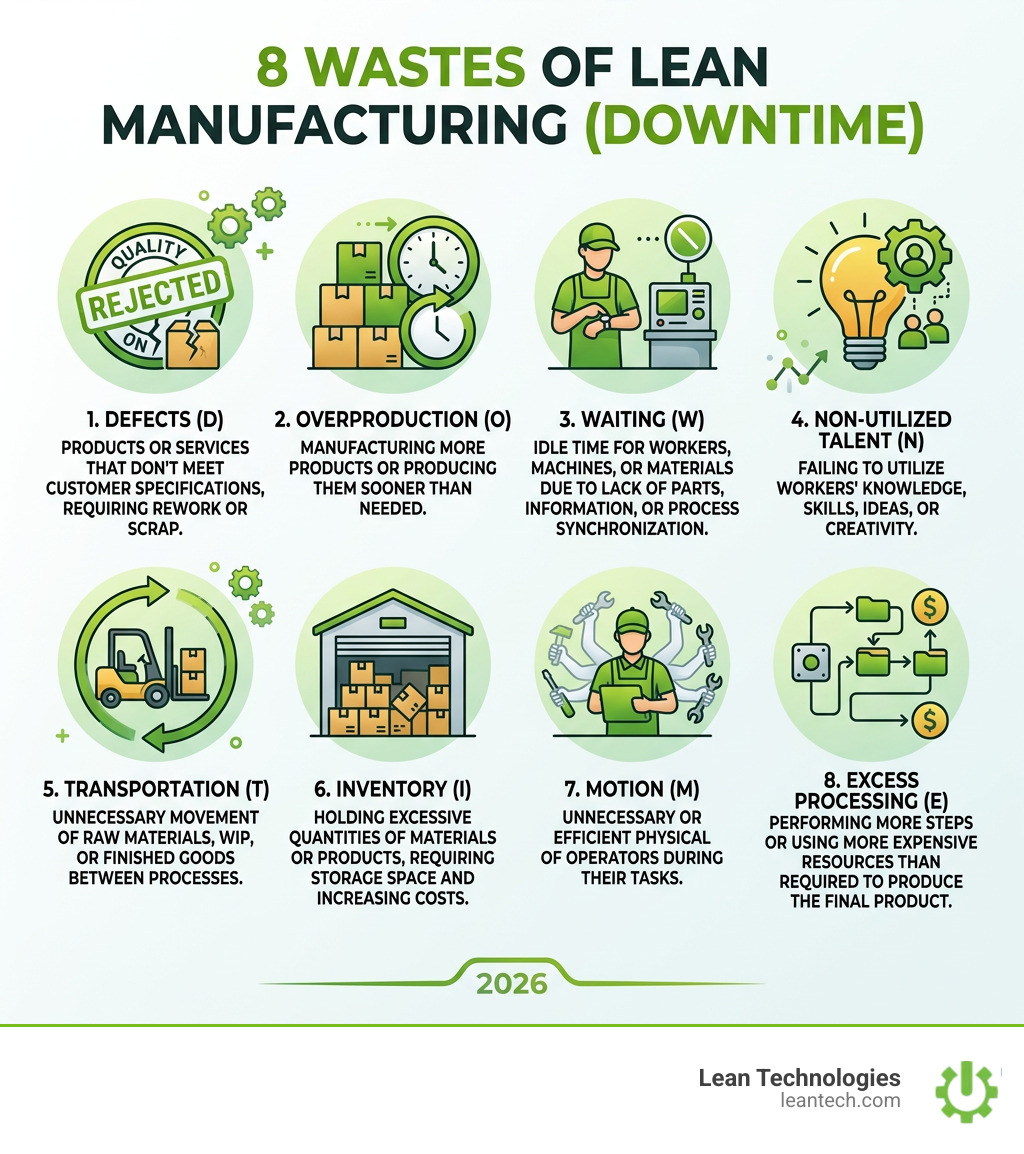
Lean Manufacturing Solutions for Modern Waste Elimination
Modern lean manufacturing solutions aren't just about tidying up the shop floor with a broom and some floor tape. They are about creating a culture of continuous improvement where every operator and manager is empowered to hunt down waste.
At its core, lean is defined by the pursuit of value from the customer's perspective. Anything that doesn't add value is waste (or Muda). While traditional lean focused on the "7 deadly wastes," modern practitioners have added an eighth: Non-Utilized Talent. This happens when we hire people for their hands but ignore their heads—failing to involve frontline workers in problem-solving.
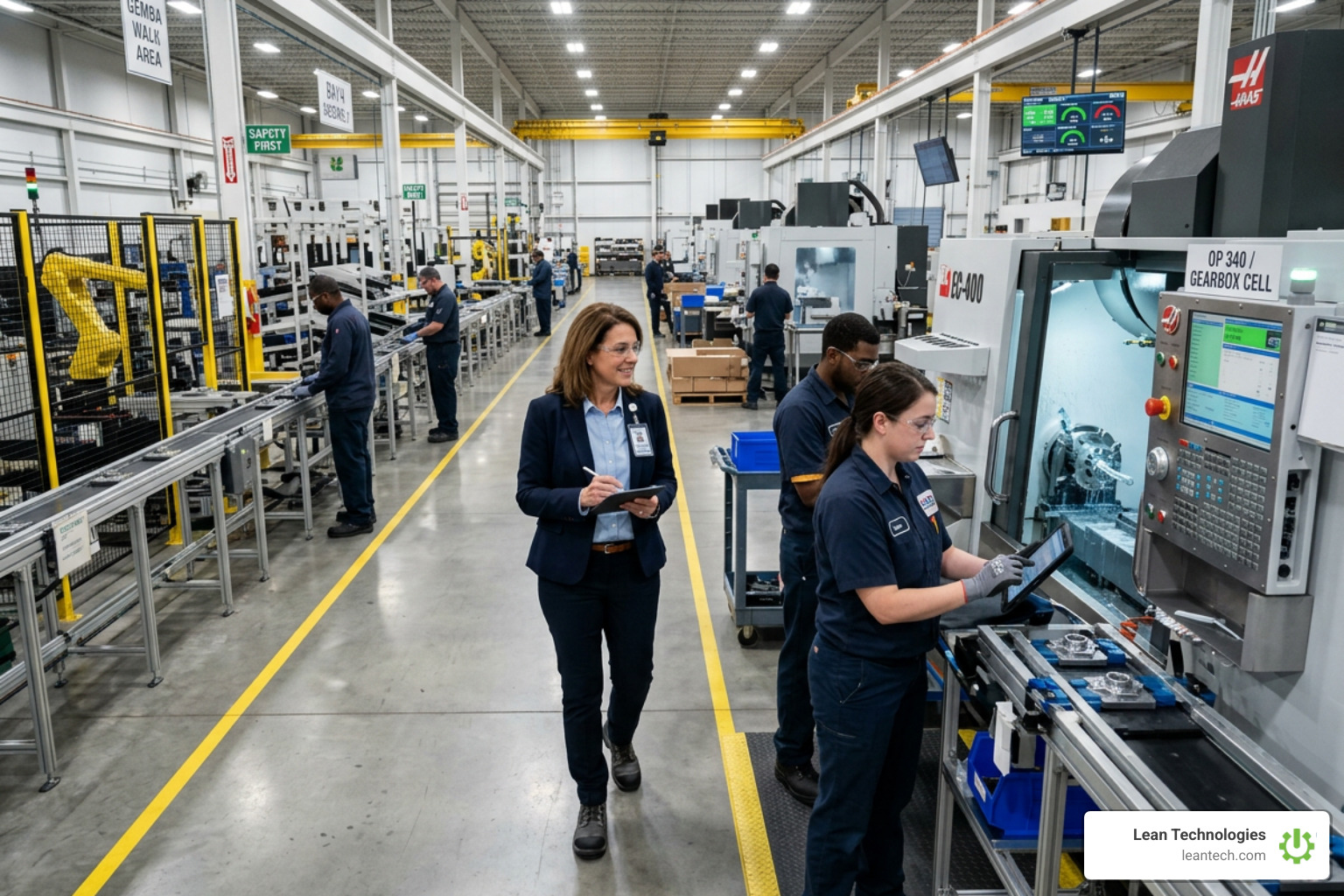
To truly "see" waste, many leaders use Gemba walks. This involves getting out of the office and onto the shop floor to observe processes where they actually happen. It’s not about micromanaging; it’s about understanding the reality of production. For those looking to dive deeper into the history and theory, Lean manufacturing - Wikipedia offers a great foundation.
However, once you find the waste, you need a way to fix it. This is where maintenance solutions play a critical role. If your machines aren't reliable, your lean efforts will always be undermined by unplanned downtime.
Applying the 5Ms Framework within Lean Manufacturing Solutions
When a problem occurs—like a packaging line going down for four hours—most teams just fix the immediate symptom and move on. Lean thinkers use the 5Ms Framework to conduct a proper root cause analysis (RCA).
The 5Ms stand for:
Manpower: Does the team have the right training? Are they following the SOP?
Machine: Is the equipment maintained? Is there a mechanical failure?
Materials: Is the raw material out of spec? Is there a shortage?
Methods: Is the process flawed? Are the instructions clear?
Measurement: Are the gauges calibrated? Is the data accurate?
By using a Fishbone diagram (Ishikawa), teams can brainstorm causes under each of these headers to find the real "why" behind a failure.
Framework Categories Best Use Case 5Ms Manpower, Machine, Materials, Methods, Measurement Rapid shop floor problem-solving and huddles. 8Ms Adds Management, Maintenance, and Mother Nature (Environment) Complex, high-level engineering or environmental issues.
Identifying Hidden Waste in Modern Factory Complexity
Traditional lean tools often struggle with the complexity of today’s plants. In the past, you might have produced one product on one line. Today, you likely have a high-mix, low-volume environment with complex routings and frequent changeovers.
This complexity creates "hidden" waste. For example, if your Work Order History isn't digitized, you might be repeating the same "quick fixes" every month without realizing a larger trend. Digital lean manufacturing solutions allow you to track these patterns in real-time, moving away from "gut feel" to data-driven decisions.
High-Tech Hardware: AS/RS and RTLS for Shop Floor Efficiency
If your workers are spending 65% of their shift just walking to find parts, you don't have a productivity problem—you have a motion waste problem. This is where hardware-based lean manufacturing solutions like Automated Storage and Retrieval Systems (AS/RS) come in.
Vertical Lift Modules (VLMs) and carousels are game-changers for space and accuracy. Instead of 120 bays of traditional shelving, you can condense that inventory into a single vertical lift. That’s an 85% space savings. Furthermore, by using light-directed picking, these systems can achieve 99.9% picking accuracy. This directly eliminates the "Defects" waste caused by wrong parts reaching the assembly line.
Implementing these high-tech systems also requires a focus on safety. Using digital Safety Audits ensures that as you automate, you aren't introducing new risks to your team.
How RTLS and AS/RS Act as Lean Manufacturing Solutions
Real-Time Location Systems (RTLS) take visibility to the next level. By tagging assets, WIP (Work-in-Progress), or even personnel, you can generate "spaghetti charts" automatically.
In a manual environment, an industrial engineer might spend a week with a stopwatch and a clipboard doing a time study. RTLS does this 24/7. It identifies:
Motion Waste: Workers taking inefficient paths.
Transportation Waste: Forklifts moving empty or pallets sitting in the wrong zone.
Waiting Waste: WIP sitting idle between stations for too long.
Data from RTLS can lead to a 20-30% reduction in downtime by providing predictive insights—knowing exactly where a bottleneck is forming before the line actually stops.
Digital Platforms as Scalable Lean Manufacturing Solutions
Hardware is only half the battle. You need a "digital twin" of your operations to make sense of the data. A unified digital thread connects your CMMS (Computerized Maintenance Management System) with your production data.
This allows for Short Interval Management (SIM). Instead of looking at a report at the end of the week, managers can see OEE (Overall Equipment Effectiveness) in real-time. If a machine's performance dips, an alert is triggered, and a task is assigned. This "closed-loop" approach is how some plants see a 3-5% OEE improvement in as little as 90 days. For larger initiatives, robust Project Management tools ensure that continuous improvement tasks don't fall through the cracks.
Strategic Flow: SMED, Pull Systems, and Kanban Execution
Flow is the heart of lean. If production stops, money vanishes. In modern manufacturing, downtime can cost upwards of $8,000 per minute. One of the biggest culprits of downtime is the changeover—switching a line from Product A to Product B.
SMED (Single-Minute Exchange of Die) is a systematic method to reduce changeover times to "single digits" (under 10 minutes). The secret is separating Internal Setup (tasks that must be done while the machine is stopped) from External Setup (tasks that can be done while the machine is still running). By pre-heating molds or gathering tools ahead of time, you can slash downtime and improve flexibility.
Transitioning from Push to Pull Production
Most traditional plants run on a "Push" system. They look at a forecast, guess what customers want, and "push" products through the factory. This leads to the "Just-in-Case" mentality, resulting in massive inventory waste.
Lean plants use a Pull system. Production is only triggered by actual customer demand. This is often managed via a Kanban Board Tool.
Just-in-Time (JIT): You only make what is needed, when it is needed.
WIP Limits: You cap the amount of work-in-progress to prevent bottlenecks.
Signals: An empty bin or a digital signal triggers the previous station to produce more.
This shift drastically reduces inventory costs and frees up cash flow that was previously tied up in "safety stock."
Visual Management and Line Performance Optimization
You shouldn't have to ask a supervisor how the shift is going. The shop floor should tell you. Visual management tools—like Performance Goal Boards—provide instant feedback to the team.
Optimization also involves the physical layout. Using components like Flowtubes allows you to build custom, ergonomic workstations. By placing frequently used items in the "Golden Zone" (between the waist and shoulders), you reduce reaching and straining. Combined with light-directed systems that show an operator exactly which part to grab next, you eliminate search time and errors simultaneously.
Sustainable Lean: Production Monitoring and Carbon Reporting
The "green" movement and the "lean" movement are essentially the same thing: the elimination of waste. In a modern context, lean manufacturing solutions must also address environmental impact.
Production monitoring isn't just for OEE; it’s for monitoring energy consumption and scrap rates. High scrap doesn't just hurt your bottom line; it increases your carbon footprint. By integrating Materials Compliance into your digital lean platform, you can track emissions and ensure you are meeting environmental regulations without adding a mountain of paperwork.
Sustainable lean means using real-time data to pinpoint energy-hungry processes and optimizing them for both profit and the planet.
Overcoming Implementation Resistance and Calculating ROI
The biggest hurdle to lean isn't the technology—it’s the "we've always done it this way" mindset. Change management is critical.
To get buy-in, you need to show results fast. Digital lean platforms often deliver a 300% ROI within six months. This comes from:
30% reduction in meeting time: No more manual data entry for Tier meetings.
40% faster root-cause resolution: AI and digital tracking ensure problems are solved, not just patched.
Lower Labor Costs: Reducing walking and search time allows the same team to produce more.
Using Leader Standard Work ensures that management stays disciplined in their new digital habits, preventing the plant from sliding back into old, wasteful routines.
Frequently Asked Questions about Lean Manufacturing
How do I start a lean transformation in my plant?
Start with an assessment and a Value Stream Map (VSM) to identify where your biggest bottlenecks are. Don't try to boil the ocean—launch a pilot program on a single line. With modern digital platforms, you can often complete onboarding and see initial results in just 4 weeks. Use Training Program Tracking to ensure your team is up to speed on the new tools.
What is the difference between internal and external setup in SMED?
Internal setup tasks require the machine to be completely stopped (e.g., physically mounting a new die). External setup tasks can be performed while the machine is running Product A (e.g., cleaning the tools for Product B, pre-heating materials). The goal of SMED is to convert as much internal setup to external as possible.
Why is a Pull system better than a Push system for lean?
A Push system relies on forecasts, which are often wrong, leading to overproduction and high inventory costs. A Pull system is demand-driven; it only uses resources when there is a confirmed need. This extends asset lifespan, reduces waste, and makes the plant much more responsive to customer changes.
Stop Managing Your Shop Floor Through Spreadsheets
If your "lean system" consists of whiteboards that aren't updated and spreadsheets that are a week old, you aren't running lean—you’re running on lag.
Lean Technologies offers Thrive, an all-in-one, customizable shopfloor software built by manufacturing experts who have actually walked your floors. Thrive doesn't replace your ERP; it fills the "visibility gap" between your high-level planning and the reality of the shop floor.
With Thrive, you get real-time visibility into downtime, quality, and safety. You empower your frontline teams to log issues instantly and give your managers the data they need to drive true continuous improvement.
Stop managing through wishful thinking. Get started with a digital lean manufacturing roadmap and turn your shop floor into a real-time engine of productivity.