

From Chaos to Control: Implementing a Seamless Manufacturing Operations System
Still Running Your Shop Floor on Spreadsheets and Sticky Notes?
Manufacturing operations management is the framework manufacturers use to control and optimize every step of production—from supply chain and planning through production, quality control, maintenance, inventory, and logistics. It aims to reduce waste, improve quality, boost efficiency, and increase profitability by connecting people, processes, and systems into one coordinated operation.
Quick Answer: What is Manufacturing Operations Management?
Definition: A holistic approach to managing end-to-end manufacturing processes for operational excellence
Core Components: Production planning, quality management, inventory control, maintenance, supply chain coordination
Primary Goals: Reduce costs by up to 15%, increase OEE by up to 20%, improve on-time delivery by 10-25%
Key Difference from MES: MOM is the broader strategy; MES is the shop floor execution tool that sits within it
If you're a plant operations manager, you know the pain.
Production delays no one saw coming.
End-of-shift data entry that's already too late to matter.
Inventory numbers that never match reality.
Blame games instead of problem-solving.
You're firefighting every day because you don't have real-time visibility into what's actually happening on your shop floor.
And you're tired of managing with spreadsheets, sticky notes, and wishful thinking.
Manufacturing operations management is how you move from chaos to control.
It's not about buying one massive software system.
It's about creating structured, repeatable processes your team can actually execute—and giving them the visibility to solve problems before they snowball.
The global MOM market is projected to hit $27.5 billion by 2030, and by 2027, 70% of manufacturers will have implemented a MOM system.
Why?
Because companies that get this right see a 15% reduction in production costs, a 20% increase in overall equipment effectiveness, and up to 25% improvement in on-time delivery.
Those aren't just numbers.
They're the difference between running a profitable operation and barely keeping the lights on.
I'm Jamie Gyloai, Vice President at Lean Technologies, and I've spent over 20 years in manufacturing operations—from the shop floor to supply chain leadership—helping teams implement practical manufacturing operations management systems that actually work. In this guide, we'll walk you through exactly how to move from firefighting to structured problem-solving.
What Is Manufacturing Operations Management (And Why Should You Care?)
Manufacturing operations management (MOM) is the "art of orchestrating people and processes on the shop floor" for efficient, profitable, and safe production.
It’s a holistic approach to managing your end-to-end manufacturing processes.
Think of it as the brain of your factory, connecting everything from incoming raw materials to outgoing finished goods.
MOM isn't just a buzzword; it's a critical framework for survival and growth in today's demanding market.
Its primary goals are clear: drive operational excellence, boost efficiency, and improve profitability.
How does it do this?
By reducing waste, lowering production costs, and significantly increasing overall equipment effectiveness (OEE).
Companies that effectively implement MOM can see a reduction in production costs by up to 15% and an increase in OEE by up to 20%.
Furthermore, the adoption of MOM solutions can lead to a 10-25% improvement in on-time delivery rates.
This isn't just about making things faster; it's about making them better, smarter, and more reliably.
MOM provides the structure to ensure quality products that are safe to consume and use.
It ensures that every step, from design to delivery, is optimized, controlled, and visible.
This comprehensive approach helps manufacturers steer unprecedented challenges like supply chain and workplace disruptions.
It transforms operations end-to-end, pushing you toward a more agile and demand-driven business model.
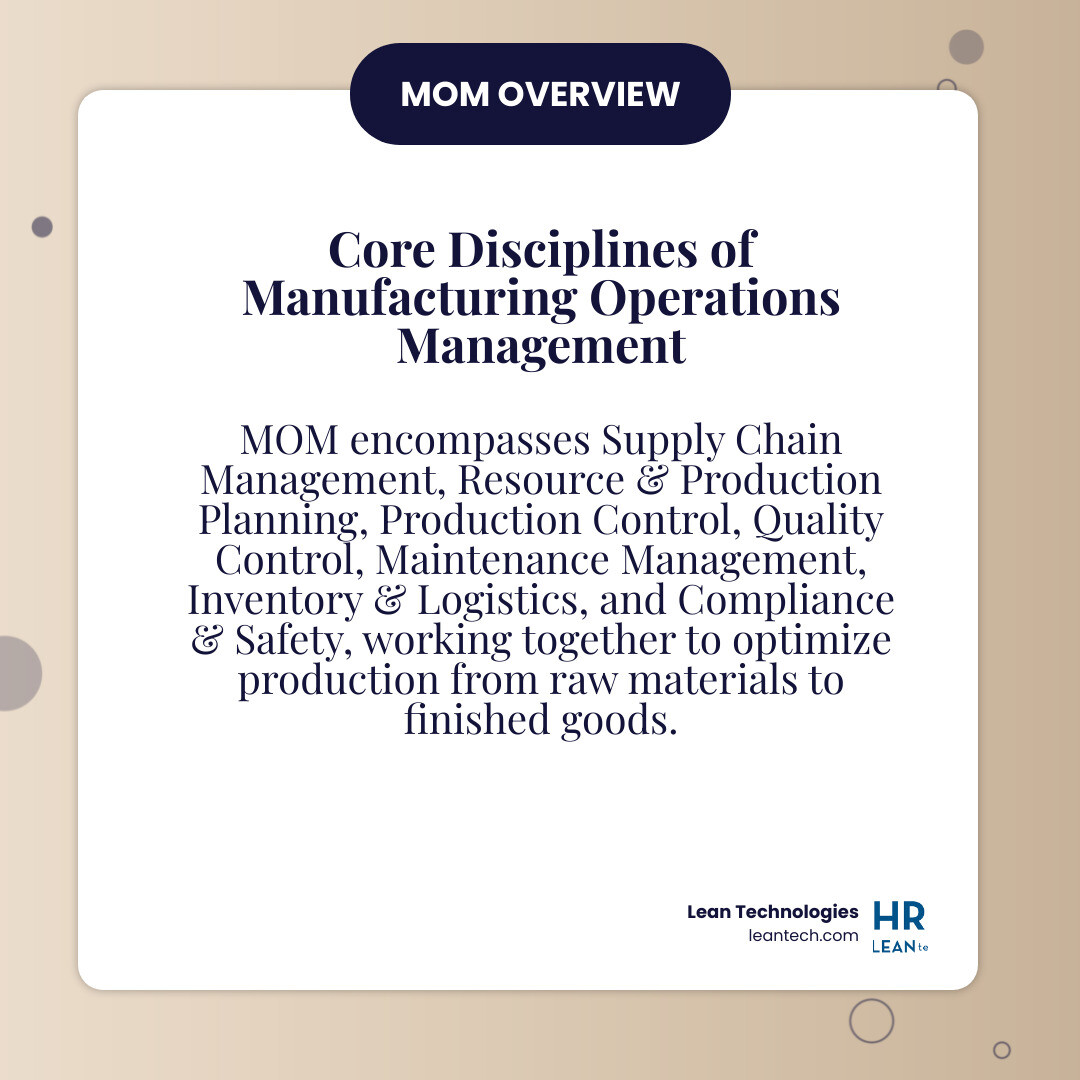
The Core Disciplines of Manufacturing Operations Management
Manufacturing operations management covers a broad spectrum of activities, ensuring every cog in the manufacturing machine is turning smoothly and efficiently.
Let’s break down the key areas:
Supply Chain Management (SCM): This is about managing the entire flow of resources, from raw materials coming in to finished products going out. It includes inventory optimization, vendor management, shipping, distribution, and delivery. Effective SCM ensures you have the right materials, at the right time, at the right cost.
Resource & Production Planning: This discipline focuses on balancing demand with your available capacity. It involves detailed scheduling, ensuring raw materials, machinery, and labor are available when needed. Advanced Planning and Scheduling (APS) systems help reduce inventory, shorten production cycles, and improve customer service levels.
Production Control: This is the real-time management of your production processes on the shop floor. It involves tracking jobs, collecting data, and managing work orders to keep production flowing efficiently. It ensures that what's planned actually gets executed.
Quality Control (QC): This area is crucial for ensuring your products meet specified standards and customer expectations. It involves inspecting products throughout production, identifying defects, and implementing corrective actions. A robust Quality Management System (QMS) helps achieve quality and compliance objectives, potentially reducing quality-related costs by 10-30%. A Quality Management System (QMS) for achieving quality and compliance objectives
Maintenance Management: Keeping your machinery and equipment in prime working condition is vital to avoid costly downtime. This involves implementing planned, preventive, and even predictive maintenance strategies. A Computerized Maintenance Management System (CMMS) can automate scheduling and track asset performance.
Inventory & Logistics: This covers managing materials, work-in-progress, and finished goods within and outside the plant. Accurate inventory management prevents stockouts and overstocking, while efficient logistics ensure timely transportation and storage.
Compliance & Safety: Manufacturing goods often requires strict adherence to state and federal regulations (e.g., OSHA, environmental laws) and industry standards (e.g., ISO). MOM systems help document processes, track compliance, and maintain a safe working environment. Environmental laws, OSHA mandates
Our platform, Thrive, helps teams digitize lean work processes in real time, bringing clarity to your quality, maintenance, and safety efforts. Learn more about how Thrive helps with quality, maintenance, and safety.
MOM vs. MES: What’s the Real Difference?
This is where it gets a little murky for many manufacturers.
The terms Manufacturing Operations Management (MOM) and Manufacturing Execution Systems (MES) are often used interchangeably, but there's a crucial distinction.
Think of it this way:
MOM is the broad strategic umbrella, the entire playbook for managing your manufacturing enterprise.
MES is a critical tool within that umbrella, focused specifically on the shop floor execution.
Feature Manufacturing Operations Management (MOM) Manufacturing Execution System (MES) Scope Broader, holistic approach covering the entire manufacturing lifecycle, from planning to delivery. Focused on real-time control and monitoring of production processes on the shop floor. Goal Optimize overall efficiency, profitability, and quality across the entire operation. Execute production orders, track work-in-progress, collect production data, and manage resources on the factory floor. Components Includes MES, QMS, APS, EMI, SCM, Maintenance, Quality, Inventory, Labor Management, etc. Typically includes production dispatching, resource management, data collection, quality management (shop floor level), maintenance management (shop floor level). Integration Level Connects ERP (business planning) to the shop floor (MES) and other operational systems, providing a coordinated view. Connects to lower-level control systems (SCADA, PLC) and feeds data up to MOM/ERP. Perspective Strategic and tactical: "What should we be doing across all operations?" Operational: "How are we doing on this specific production order right now?"
Simply put, MES sits inside MOM.
MOM looks across the full operation, connecting planning, execution, and quality.
MES stays focused on the shop floor, tracking jobs, collecting data, and managing work orders.
Your Enterprise Resource Planning (ERP) system handles the business layer: finance, planning, and materials.
It sits on top, depending on MOM and MES for real-time production data.
MOM acts as the crucial layer that connects your business-level systems (like ERP) to the real-time activities on your shop floor.
This connection ensures that business decisions are based on accurate, up-to-the-minute operational data, creating one single source of truth for your entire manufacturing process.
Your Playbook for Implementing Effective Manufacturing Operations Management
Ready to move from chaos to control?
Implementing an effective Manufacturing operations management system isn't a flip of a switch; it's a journey.
But it doesn't have to be overwhelming.

Here's our playbook:
Start small—pilot a process. Don't try to digitize your entire factory overnight. Pick one underperforming product line or a single process. This allows you to understand core characteristics, identify what data truly matters, and establish a basic management framework without disrupting everything.
Involve your frontline team. The people doing the work are your greatest asset. Let them define what "good" looks like for workflows. Their input is crucial for adoption. Most failed rollouts don't die because of software; they die when the floor team doesn't trust it.
Standardize your processes. Before you digitize, standardize. Document your Standard Operating Procedures (SOPs) and ensure everyone follows them. This creates consistency and makes it easier to identify deviations.
Define your KPIs. What gets measured, gets managed. Identify the key performance indicators (KPIs) that truly reflect the health of your operations. These should be visible, actionable, and tied to your business goals. KPI standards in manufacturing operations management from the International Standards Organization
Focus on data quality. Garbage in, garbage out. Ensure the data you're collecting is accurate, timely, and relevant. This means making data entry easy and intuitive for your team.
Empower the workforce. Give your operators and supervisors the tools and information they need to make real-time decisions. When they see their input shape workflows, adoption soars.
Improve collaboration. MOM systems break down silos between departments (production, quality, maintenance). Improved communication means faster problem-solving and better coordination.
Tackle implementation challenges head-on. Integration with existing equipment, scaling across sites, security, and compliance are all real concerns. Plan for these early, involving IT and Quality from the beginning.
Change management is key. This is less about technology and more about people. Communicate the "why," provide training, and celebrate small wins. Rolling out MOM isn't a one-time project; it's an ongoing adjustment.
Best Practices for a Seamless Rollout
We've seen countless manufacturers succeed (and sometimes stumble) on their MOM journey.
Here's what the best of them do:
Collect data in real time: This means moving away from paper and spreadsheets. Use tablets, mobile devices, or desktop interfaces on the shop floor to capture data as it happens. Real-time beats real-late.
Make decisions based on metrics: Don't rely on gut feelings. Use manufacturing intelligence software to analyze how your processes are working and evaluate machine and people performance. This transforms big data into actionable intelligence.
Use visual dashboards: Make your KPIs visible across the organization. Dashboards provide a quick, intuitive overview of performance, helping everyone understand where things stand and where improvements are needed.
Standardize procedures: This isn't just about documenting; it's about active adherence. Develop Standard Operating Procedures (SOPs) and use digital work instructions to ensure consistency.
Empower operators to own the data: When operators are responsible for entering data at the source and see its immediate impact, they become invested. This improves data accuracy and fosters a culture of ownership.
Foster continuous improvement: MOM is a continuous journey, not a destination. Implement lean manufacturing principles like Kaizen. Regularly review your processes, analyze data, and make iterative improvements.
Our Thrive platform is designed to help teams quickly digitize lean work processes, track actions, and drive continuous improvement. It's how you get faster problem-solving with better visibility. Explore how Thrive supports project management and CI.
The Future is Now: Using Tech to Boost Your Operations
The manufacturing industry is in the midst of Industry 4.0, a digital change fueled by advanced technologies.
Manufacturing operations management is at the heart of this evolution, shifting from rigid, fixed systems to flexible, adaptive backbones.

Here are the emerging trends and future capabilities that are revolutionizing MOM:
Digital work instructions and checklists: Replace paper-based instructions with interactive, digital guides. This ensures consistency, reduces errors, and makes training easier.
Real-time data capture at the source (tablets, mobile, desktop): This is non-negotiable for modern MOM. When data is captured directly on the shop floor, it's accurate, timely, and immediately available for analysis.
Cloud platforms for scalability: Cloud-based MOM solutions simplify scaling, central oversight, and enable collaboration tools across multiple sites. They offer flexibility and reduce the burden on your internal IT infrastructure.
Real-time visibility: This is the holy grail. By connecting machines, tools, and sensors, MOM systems provide an immediate, accurate picture of production status, quality, and maintenance needs. This helps predict and solve issues before they escalate.
Data analytics for decision-making: Changing raw data into actionable intelligence is key. AI-guided analytics and self-service reporting empower teams to make faster, more informed decisions.
Moving from reactive to proactive: MOM systems integrate signals from machines, quality checks, and operators. This helps spot drift before it becomes a stop, enabling predictive maintenance and proactive quality control.
Seamless integration with your existing systems: Modern MOM solutions are designed to connect with your ERP and other enterprise systems. This creates a unified operational view without requiring you to rip out and replace your entire tech stack.
By 2025, 80% of manufacturers will be using AI in their MOM strategies to optimize production and improve decision-making.
This isn't about replacing people; it's about empowering them with better tools and insights.
Our Thrive platform is specifically designed to bring real-time visibility to your team, helping you digitize lean work processes without replacing your existing ERPs or MES systems. See how Thrive brings real-time visibility to your team.
Frequently Asked Questions about Manufacturing Operations Management
What’s the real difference between MOM and MES?
Manufacturing Operations Management (MOM) is the overall strategy and comprehensive set of systems used to manage and optimize the entire manufacturing process, from planning to delivery. It encompasses a wide range of functions including supply chain, quality, maintenance, and production planning.
Manufacturing Execution System (MES), on the other hand, is a specific software system focused on executing and monitoring work on the shop floor in real time. It manages production orders, tracks work-in-progress, and collects production data.
Think of MOM as the strategic playbook for your entire manufacturing enterprise, and MES as one of the key players or a critical tool within that playbook, specifically focused on direct shop floor operations. MES feeds crucial real-time data up to the broader MOM system.
Can I implement MOM if I have old equipment?
Absolutely, yes!
Manufacturing operations management is process-driven first, technology second. While integrating with modern sensors and IoT devices can improve MOM, it's not a prerequisite for getting started.
You can begin by digitizing manual logs, checklists, and work instructions using tablets, mobile devices, or desktop interfaces on your shop floor. This approach allows you to capture real-time data from operators without needing expensive sensors on every single machine.
The key is to establish structured processes and collect accurate data at the source, regardless of the age of your equipment. This helps organize and drive action from your machine data, even if it's entered manually by your team.
How does MOM help with regulatory compliance?
MOM systems are powerful tools for ensuring and demonstrating regulatory compliance.
They create a robust digital audit trail for every step of your manufacturing process.
By standardizing work instructions and embedding quality checks directly into digital workflows, MOM ensures that processes are followed consistently, every single time.
This means you have clear, documented proof of adherence to standards like ISO, FDA regulations, or OSHA mandates.
Real-time tracking of production, quality, and maintenance activities provides irrefutable evidence for audits, helping you identify and address non-compliance issues proactively rather than reactively.
This not only reduces the likelihood of fines but also streamlines the auditing process significantly.
Your Next Move: Stop Managing with Spreadsheets
Manufacturing operations management isn’t about buying a single, massive piece of software.
It’s about creating structured, repeatable processes your team can actually execute.
It’s about giving your people real-time visibility so they can solve problems faster.
You’re tired of managing with spreadsheets, sticky notes, and wishful thinking.
You need to stop managing your shop floor through guesswork and start with visibility.
Thrive gives you a flexible digital toolbox to log issues, track actions, and drive continuous improvement—without ripping out your current systems.
Let your team run lean—with real-time visibility and fewer workarounds.
Learn how to implement digital lean manufacturing with Thrive.