
Why Your Manufacturing Order Management Needs a Serious Upgrade
When Your Orders Are Running the Shop Floor Instead of You
Manufacturing order management is the system that controls how production orders move from customer request to finished product — covering order capture, scheduling, material planning, shop floor execution, and delivery.
Here's what it includes at a glance:
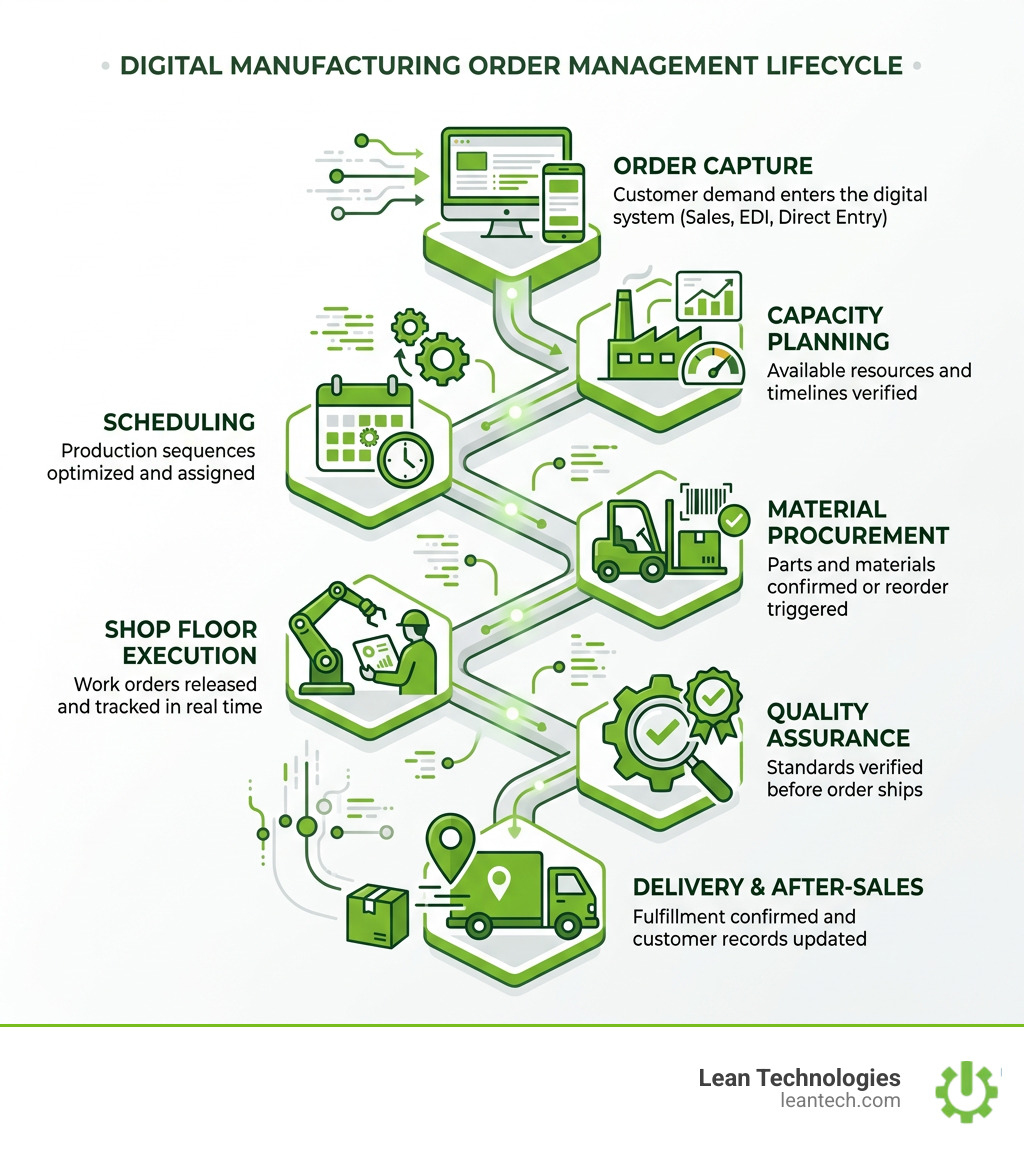
Stage What Happens Order Capture Customer demand enters the system via sales, EDI, or direct entry Capacity Planning Available resources and timelines are verified Scheduling Production sequences are optimized and assigned Material Procurement Parts and materials are confirmed or triggered for reorder Shop Floor Execution Work orders are released and tracked in real time Quality Assurance Standards are verified before the order ships Delivery & After-Sales Fulfillment is confirmed and customer records updated
Here's what most operations managers already know but rarely say out loud: the order management process isn't broken because people aren't working hard enough. It's broken because the data is always late.
Paper logs filled out at end of shift. Spreadsheets emailed between departments. Supervisors chasing status updates on the floor instead of solving problems. By the time the numbers hit your desk, the damage is already done — a missed ship date, a production bottleneck that ran for hours, an inventory gap that stopped the line cold.
The gap between when something happens and when you know about it is costing you real money. Research shows that digitizing manufacturing order management can cut fulfillment time by 30-50% and push order accuracy from 85% to 98%. Those aren't marginal gains — they're the difference between a shop floor you're running and one that's running you.
This guide is for operations managers who are done managing through guesswork. It breaks down what modern manufacturing order management actually looks like, where most teams are losing time and money, and what a practical upgrade path looks like — without ripping out your ERP.
What is Manufacturing Order Management and Why It’s the Backbone of Your Operations
At its core, manufacturing order management is the systematic planning, control, and monitoring of production orders. It is the bridge between a customer’s "I want this" and the shop floor’s "we made this." Without a robust framework, a factory is just a collection of machines and people working in silos, hoping everything aligns by the shipping deadline.
In the broader context of order management in SCM, this process ensures that demand is synchronized with production capacity. It isn’t just about taking an order; it’s about resource allocation—ensuring the right people, materials, and machines are available at the exact moment they are needed.
When you get this right, you achieve a smooth order-to-cash cycle. When you get it wrong, you end up with "firefighting" mode: expedited shipping costs, overtime labor, and stressed-out supervisors. Adopting a guide to digital lean manufacturing mindset helps transition from reactive chaos to proactive control by focusing on value-added steps and eliminating the waste of waiting for information.
The High Cost of "Real-Late" Data: Common Challenges in Manufacturing Order Management
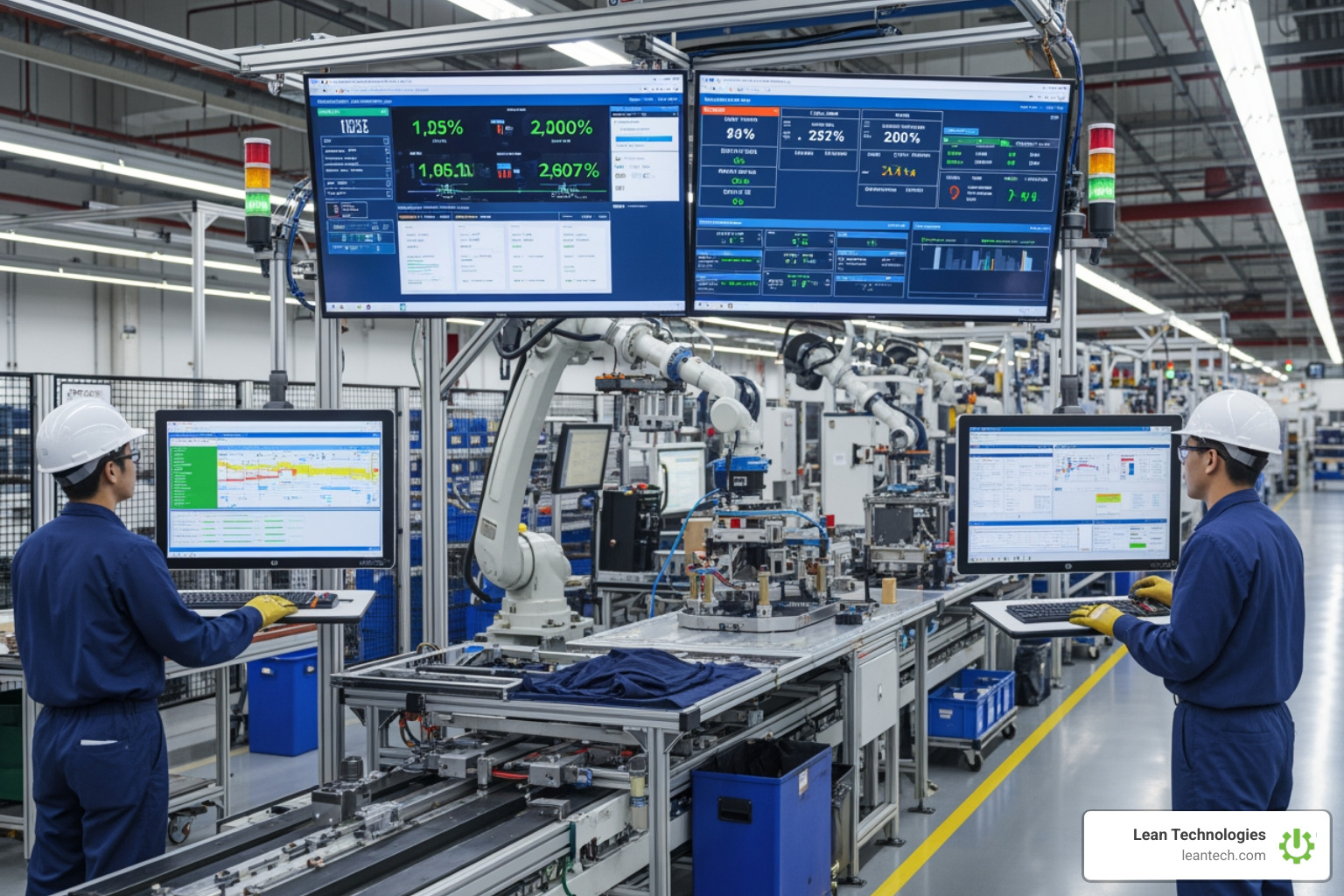
The biggest enemy on your shop floor isn't a broken machine; it's "real-late" data. If an operator records a defect on a paper log at 10:00 AM, but the Quality Manager doesn't see that log until the end-of-shift review at 4:00 PM, you’ve just spent six hours producing scrap.
Common challenges include:
Manual Data Entry Errors: Humans make mistakes. Moving data from a paper traveler to an Excel sheet or an ERP results in an average order accuracy of only 85% in manual environments.
Data Silos: Sales knows what the customer wants, but Production doesn't know if the materials are in stock. This lack of communication leads to missed deadlines.
Inaccurate Inventory: Without real-time updates, you might schedule a job only to find the "available" raw materials were used for a different order yesterday.
Production Bottlenecks: Without visibility, you can't see where work-in-progress (WIP) is stacking up until the line physically stops.
By implementing defect and scrap tracking, teams can identify quality issues the moment they happen, rather than days later during a post-mortem meeting.
Key Components and Stages of a Modern Order Control Framework
A modern manufacturing order management system moves beyond simple spreadsheets. It functions as a control framework that integrates several moving parts into a single, visible flow.
Order Capture & Validation: Ensuring the order is technically feasible and the pricing is accurate.
Capacity & Resource Planning: Checking if the shop floor actually has the "bandwidth" to take on the work without bumping existing high-priority orders.
Material Requirement Planning (MRP): Verifying that every nut, bolt, and raw component is staged or on its way.
Real-Time Scheduling: Assigning the order to a specific line and shift based on optimized sequences.
Quality Assurance (QA): Integrating checkpoints throughout the build, not just at the end.
Effective workflow tracking allows every stakeholder—from the plant manager to the customer service rep—to see exactly where an order sits in this framework at any given second.
Streamlining the Manufacturing Order Management Process
Streamlining isn't just about moving faster; it's about removing friction. Workflow automation handles the repetitive tasks that eat up a supervisor's day. Instead of manually checking if a part is ready for the next station, the system triggers a notification the moment the previous step is logged as "complete."
Using a kanban board tool provides a visual representation of the shop floor. It allows managers to see the "flow" of orders and identifies where work is stalling. This visual management, combined with sequence optimization, ensures that the most urgent tasks are always at the front of the line.
Integrating Manufacturing Order Management with ERP and CRM Systems
A common misconception is that you need to replace your ERP to get better shop floor visibility. In reality, the most effective setups involve a "single source of truth" where your order management layer talks to your ERP via API integration.
While your ERP handles the "back office" (billing, high-level inventory, HR), your digital shop floor tool handles the "front line." This integration between OMS and ERP ensures that when a sales rep enters a demand in the CRM, the production team sees it instantly. This connectivity is vital for project management, allowing teams to track complex, multi-stage custom builds without losing the thread in a sea of emails.
The Digital Edge: How Automation and AI Transform Fulfillment
The transition from manual to digital isn't just a "nice to have"—it’s a competitive necessity. Statistics show that digitization reduces order fulfillment time by 30-50% and shipping time by 10-20%.
When you move to a digital system, you unlock:
90% Reduction in Errors: AI-powered validation ensures that orders aren't processed with missing specs or impossible deadlines.
Predictive Analytics: Systems can flag potential delays before they happen by analyzing historical production speeds and current machine health.
Real-Time Tracking: Technicians use mobile tablets to log progress at the source. This means "real-time" actually means now, not tonight.
Using performance goal boards that update automatically based on this live data keeps the entire team aligned on daily targets, boosting morale and accountability.
Best Practices for Transitioning to Digital Order Control
Moving away from paper can feel daunting, but it doesn't have to happen all at once. The most successful manufacturers follow a structured transition plan:
Standardize Before You Digitize: If your manual process is a mess, digitizing it will just give you a "digital mess." Map out your workflows and simplify them first.
Appoint "Digital Champions": Identify tech-savvy operators on each shift who can help train their peers and advocate for the new system.
Focus on Mobile Accessibility: If an operator has to walk 50 feet to a desktop computer to log a part, they won't do it in real time. Put tablets in their hands.
Implement Leader Standard Work: Use leader standard work to ensure supervisors are using the digital dashboards to drive their daily huddles and floor walks.
Frequently Asked Questions about Manufacturing Order Management
How does digitization reduce order fulfillment time?
Digitization eliminates the "paper trail lag." Instead of waiting for a physical folder to move from the front office to the production manager's desk, and then to the shop floor, the information moves at the speed of light. It reduces order entry time from 30 minutes to 5 minutes and production scheduling from 4 hours to just 1 hour.
What is the difference between a work order and a production order?
A production order is a high-level document that specifies what needs to be made, the quantity, and the deadline. A work order is the "how-to" instruction for the shop floor—it details the specific tasks, labor requirements, and maintenance steps needed to complete that production order.
Can I upgrade my order management without replacing my ERP?
Absolutely. Most modern manufacturers use a "layered" approach. They keep their existing ERP for financial and high-level planning but add a flexible digital layer like Thrive to manage the real-time shop floor execution. This provides the visibility you need without the multi-million dollar cost of a full ERP overhaul.
Stop Managing Through Spreadsheets and Wishful Thinking
If you are still using whiteboards and spreadsheets to track your orders, you are leaving money on the table. You’re also likely burning out your best people by forcing them to act as human data-transfer machines.
Lean Technologies built Thrive to solve exactly this problem. We don’t want to replace your systems; we want to make them work better by giving you real-time shop floor visibility. When your team logs data at the source, you get the accountability and insights needed for true continuous improvement.
Stop guessing when an order will ship. Start knowing. Start tracking your work order history today and take control of your manufacturing order management.