

How to Enforce Safety Protocols and Automate Audits with Modern Tools
The Real Cost of Getting Risk Assessment Wrong on the Shop Floor
Manufacturing risk assessment tools are the structured methods and software platforms teams use to identify, evaluate, and control hazards before they turn into incidents, downtime, or regulatory headaches.
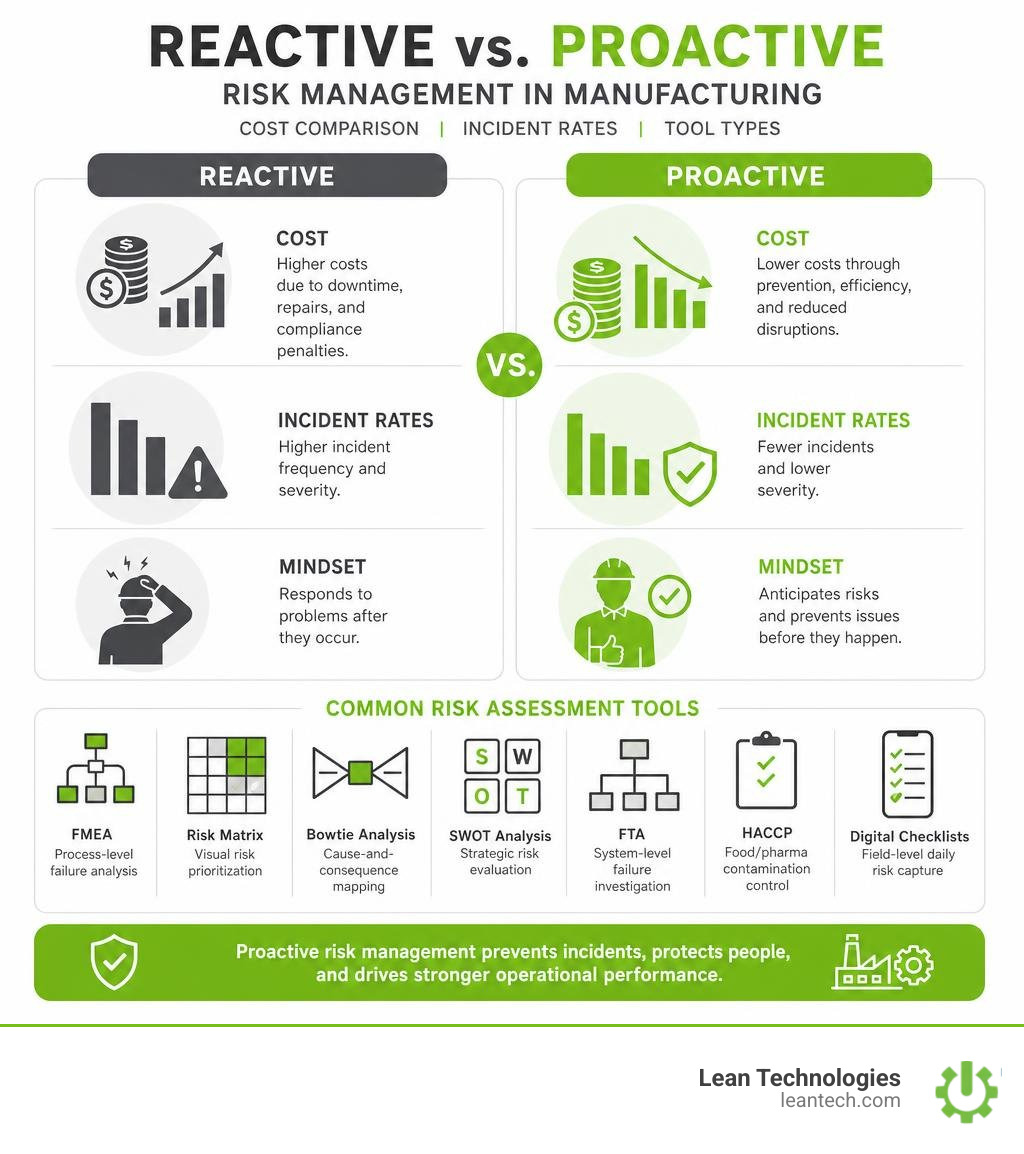
If you're comparing options, here are the most widely used tools in manufacturing today:
Tool Best For Approach FMEA Process-level failure analysis Bottom-up, quantitative RPN scoring Risk Matrix Visual risk prioritization Likelihood vs. severity grid Bowtie Analysis Hazard visualization with controls Cause-and-consequence mapping SWOT Analysis Strategic risk evaluation Internal/external factor review FTA (Fault Tree Analysis) System-level failure investigation Top-down deductive logic HACCP Food/pharma contamination control Science-based hazard prevention Digital Checklists Field-level daily risk capture Mobile, real-time, structured
Here's the hard truth: most manufacturing plants aren't failing because of unknown risks. They're failing because known risks aren't being tracked, acted on, or closed out in time.
Paper checklists get lost. Excel spreadsheets are out of date before the shift ends. And by the time someone compiles last week's audit data into a report, the hazard has already become an incident — or worse, a regulatory finding.
The numbers back this up. Manufacturers using digital risk assessment platforms report up to 30% less unplanned downtime and a 25% improvement in overall equipment effectiveness (OEE). Companies running structured risk programs see 40% fewer workplace incidents and regulatory non-conformities. That's not a marginal gain — that's the difference between a plant that reacts and one that prevents.
The shift from reactive to proactive risk management isn't just about safety culture. It's about visibility. When your team can log a hazard from the shop floor in real time, tie it to a corrective action, and track that action to closure — you've built a system that actually works.
This article breaks down the top manufacturing risk assessment tools, compares the leading methodologies, and shows how modern digital platforms are replacing the clipboards and spreadsheets that slow your team down.
What is Manufacturing Risk Assessment and Why It Matters
A manufacturing risk assessment is a structured process used to identify, evaluate, and control safety, operational, and compliance hazards within a production facility. It is not a check-the-box exercise to satisfy corporate auditors. It is a vital operational safeguard.
In high-stakes production environments, hazards are everywhere. They range from mechanical dangers on an assembly line to chemical exposure in a mixing bay, repetitive strain injuries at packaging stations, and sudden supply chain disruptions.
When a team fails to systematically evaluate these threats, the consequences are immediate and severe:
Operational Risks: A single bearing failure on a critical line can cascade into weeks of downtime and thousands of dollars in lost revenue.
Compliance Risks: Failing to comply with environmental, safety, or quality standards leads to costly regulatory fines, legal liabilities, and devastating reputational damage.
Strategic Risks: Unresolved operational bottlenecks and safety issues slowly erode a company’s market share and competitive edge.
To manage these threats, safety and operations managers rely on formal Risk Assessment workflows and routine Safety Audits. These processes ensure that the shop floor remains safe, compliant, and productive.
For a deeper dive into establishing these fundamental practices, you can consult the Manufacturing Risk Assessment Guide - Westfield Insurance.
Core Methodologies Behind Manufacturing Risk Assessment Tools
To build an effective risk management program, manufacturers use several core methodologies. Each approach offers a different lens through which to view and mitigate shop floor risks:
Failure Mode and Effects Analysis (FMEA): A quantitative, bottom-up approach that evaluates potential failure modes within a process. It calculates a Risk Priority Number (RPN) based on Severity, Likelihood of Occurrence, and Detectability. This helps teams prioritize high-impact issues. The Pareto principle applies heavily here: roughly 80% of manufacturing defects are caused by 20% of the failure modes, making FMEA highly effective for targeted mitigation.
SWOT Analysis: A high-level strategic tool used to evaluate internal Strengths and Weaknesses alongside external Opportunities and Threats.
Risk Matrices: A visual, easy-to-understand 5x5 grid that plots the probability of an event against its potential severity, instantly highlighting the most critical hazards.
Bowtie Analysis: A highly visual risk mapping tool. The hazard sits at the center, with potential causes on the left (preventive controls) and consequences on the right (mitigative controls).
Fault Tree Analysis (FTA): A top-down, deductive logical analysis that starts with an undesired system-level event and traces it back to its basic component failures.
Hazard Analysis Critical Control Point (HACCP): A science-based, systematic approach focused on identifying and controlling biological, chemical, and physical contamination risks.
For quality assurance and operations leaders looking to deepen their technical toolkit, understanding how these methods integrate with quality management systems is essential. Standardizing these processes across multiple facilities helps larger enterprises maintain consistency, reduce defects, and ensure compliance.
Methodology Best Applied To Key Strengths Limitations FMEA Equipment design, complex production processes, and quality assurance Highly quantitative; calculates RPN to objectively rank failure modes Can be time-consuming to set up and maintain Bowtie Analysis Major accident hazards, chemical containment, and safety-critical systems Excellent visual communication of preventive and mitigative controls Less effective for analyzing complex, interconnected failures Risk Matrix Daily shop floor hazard assessments and routine task planning Simple to use; provides instant visual prioritization for field teams Highly subjective without clear, standardized scoring definitions
Choosing the Right Manufacturing Risk Assessment Tools for Your Plant
Selecting the right methodology depends entirely on your plant's operational context, regulatory requirements, and organizational maturity. A medical device manufacturer governed by strict ISO standards needs highly structured tools like FMEA and FTA. Meanwhile, a high-volume assembly plant might focus on rapid, field-level risk matrices and digital checklists.
The key to successful risk management is scalability and user adoption. If a tool is too complex, shop floor operators will bypass it. If it is too simple, it won't yield actionable data.
Modern plants are moving away from isolated, complex software systems and toward integrated digital checklists and action-tracking platforms. By embedding risk assessments directly into daily operator routines, companies ensure that risk management becomes a living, continuous process rather than a static document.
Step-by-Step: How to Conduct an Effective Risk Assessment
Executing a reliable risk assessment on the shop floor requires a structured, repeatable approach. Following these five core steps ensures no hazard goes unnoticed:
Identify the Hazards: Walk the shop floor, consult operators, and review historical incident logs. Look for mechanical, chemical, electrical, ergonomic, and organizational hazards.
Evaluate the Risks: Assess the likelihood and potential severity of each hazard. Use a standardized risk matrix to assign a clear risk level.
Implement Control Measures: Apply the hierarchy of controls to address identified risks.
Record and Communicate Findings: Document every hazard, assessment, and control measure. Share these findings with the entire team to ensure alignment.
Monitor and Review Regularly: Risk management is never finished. Reassess your processes annually, after any workplace incident, or whenever new equipment or procedures are introduced.
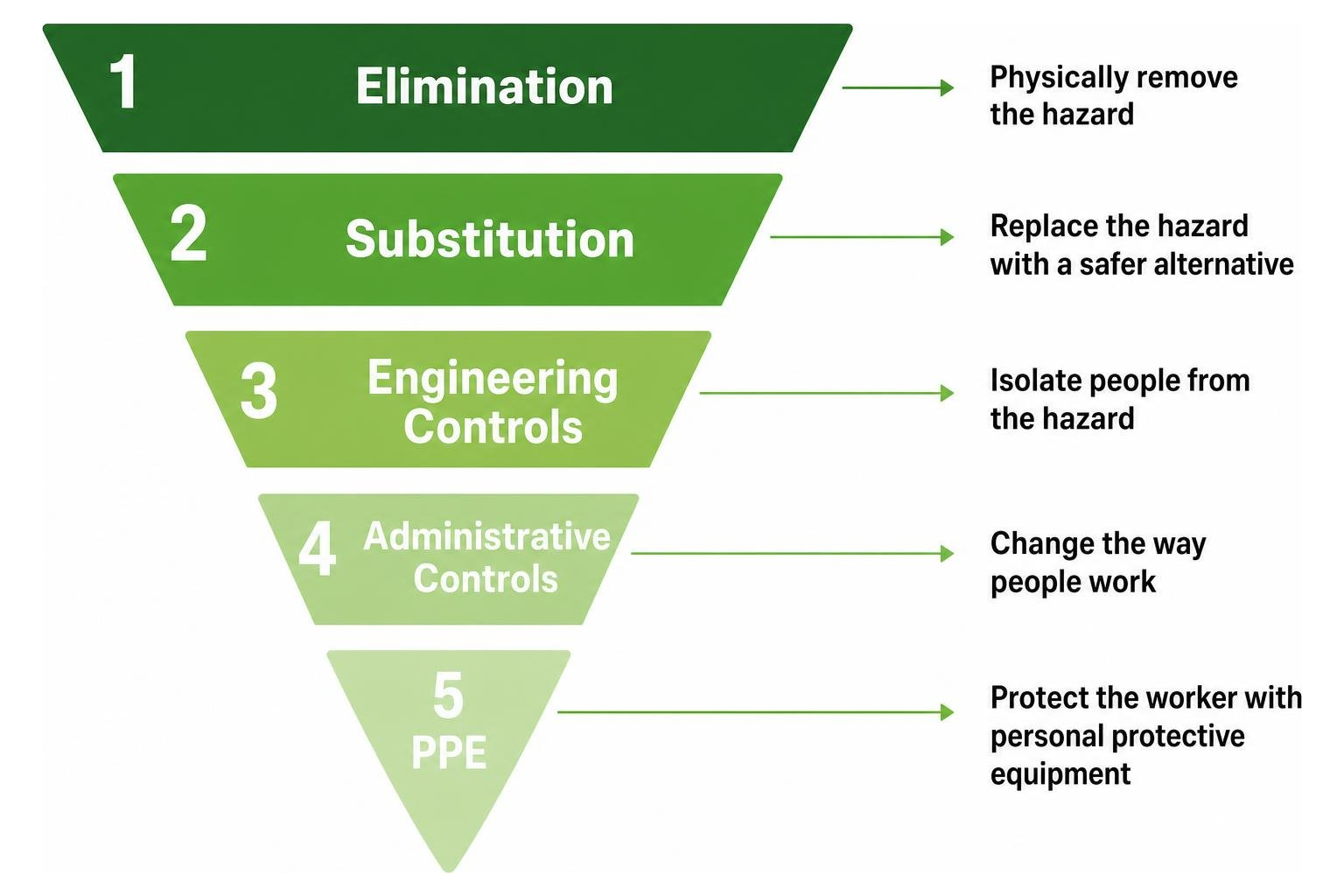
When establishing controls, always follow the Hierarchy of Controls:
Elimination: Physically remove the hazard (the most effective control).
Substitution: Replace the hazard with a safer alternative.
Engineering Controls: Isolate people from the hazard (e.g., machine guards, ventilation systems).
Administrative Controls: Change the way people work through training, procedures, and Safety Audits.
PPE: Protect the worker with Personal Protective Equipment (the last line of defense).
When hazards bypass these controls and cause quality issues, teams must log them immediately using Nonconformance workflows and track them using Defect Scrap Tracking to prevent recurrences.
How Digital Manufacturing Risk Assessment Tools Prevent Downtime
Traditional paper-based risk assessments are static. They are filled out on a clipboard, filed in a cabinet, and rarely looked at again until an auditor visits. If an operator identifies a worn-out machine guard on Tuesday, but the safety manager doesn't review the paper checklists until Friday, that is three days of unnecessary risk exposure.
Digital manufacturing risk assessment tools solve this problem by enabling real-time monitoring and instant communication.
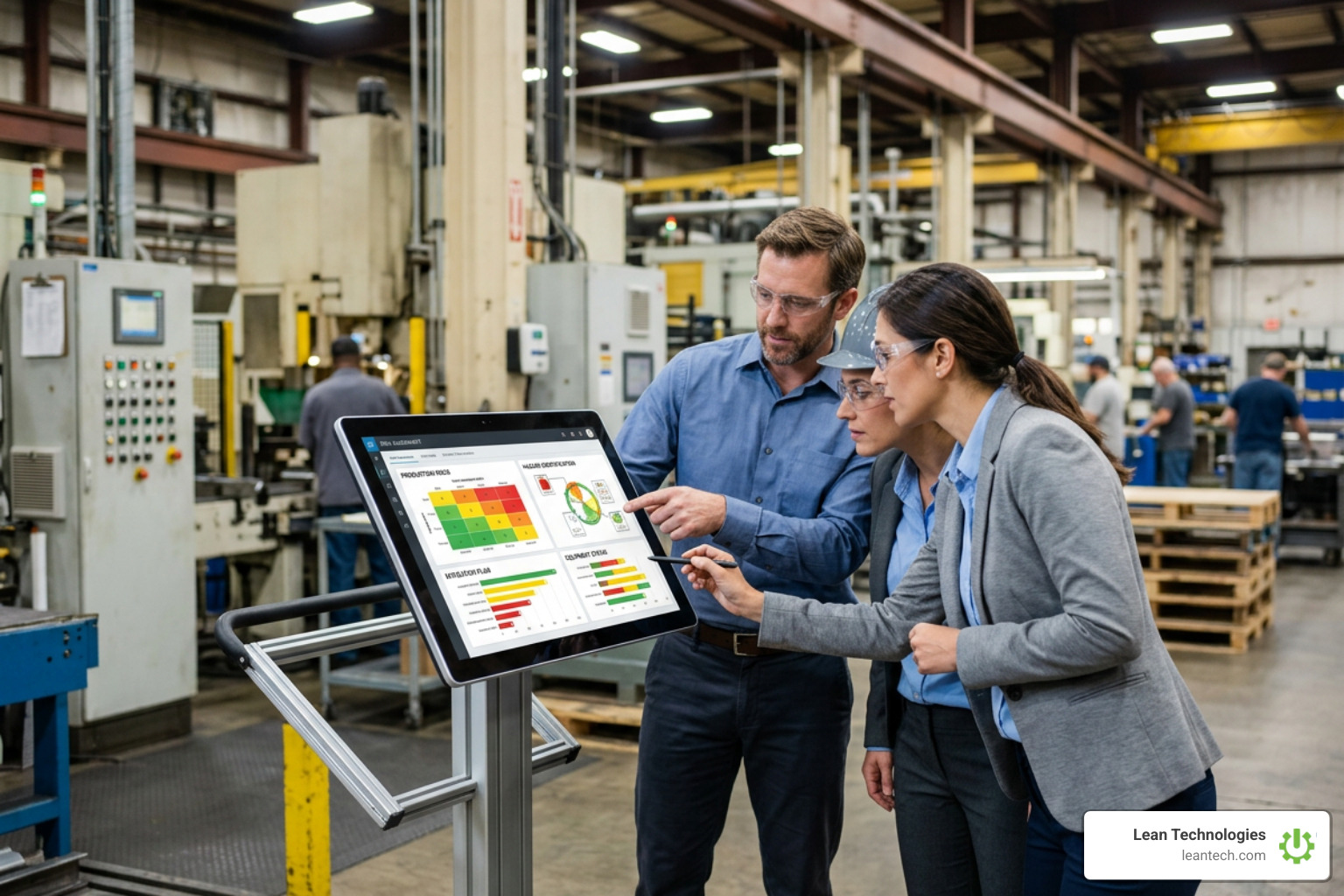
When operators use mobile checklists on tablets or phones:
Instant Alerts: If an operator flags a critical hazard during a pre-shift check, the system instantly routes an alert to the maintenance and safety teams.
Structured Workflows: Identified risks automatically trigger corrective and preventive action (CAPA) workflows, assigning tasks to specific owners with clear due dates.
Unified Data: Quality, maintenance, and safety data live in one place, allowing managers to see how minor machine issues correlate with safety risks and defect rates.
By digitizing these frontline workflows, plants transition from a reactive state of "firefighting" to a proactive state of continuous improvement. To see how this fits into a broader operational strategy, read the Guide to Digital Lean Manufacturing.
Evolving Trends: Resilience, Sustainability, and Process Closure
Modern manufacturing risks extend far beyond physical shop floor hazards. Today’s operations must also navigate complex supply chain disruptions, environmental, social, and governance (ESG) mandates, and advanced contamination challenges.
To address these vulnerabilities, organizations are turning to specialized resilience tools. For instance, the Pacific Northwest National Laboratory developed the STIR | Screening Tool for Industrial Resilience, which helps small and medium-sized manufacturers evaluate their resilience posture against energy, water, and supply chain disruptions.
For teams looking to understand the underlying math and logic of these resilience assessments, The Screening Tool for Industrial Resilience Technical Report provides a comprehensive look at how vulnerability and likelihood are calculated to drive proactive risk mitigation.
At the same time, the push for sustainability and ESG reporting is forcing manufacturers to evaluate environmental risks — such as energy waste, water consumption, and chemical disposal — with the same rigor they apply to machine safety. This requires digital standard operating procedures that keep compliance and risk-tracking closely aligned.
Modernizing Contamination Control and Resilience on the Shop Floor
In highly regulated sectors like life sciences, biopharmaceuticals, and food manufacturing, risk assessment practices are evolving rapidly. Over 70% of life sciences manufacturers now use advanced risk assessment tools as part of their Contamination Control Strategy (CCS) and Quality Risk Management (QRM) programs.
One of the most significant shifts in these industries is the move toward process closure. By using closed, self-contained processing equipment, manufacturers can eliminate the need for traditional, high-maintenance cleanrooms. This approach transfers the burden of contamination control from the surrounding environment directly to the equipment itself.
Engineering and safety teams must carefully coordinate these complex machinery modifications. Ensuring that any changes to guarding, automation, or process containment are fully documented and compliant with international standards like ISO 12100 and ISO 13849 is critical for maintaining a safe, compliant shop floor.
Frequently Asked Questions about Manufacturing Risk Assessment
What are the most common risks in a modern manufacturing facility?
Modern manufacturing facilities face five primary categories of risk:
Mechanical Hazards: Moving machine parts, unguarded crush points, and entanglement risks.
Chemical Exposure: Inhaling toxic fumes, skin contact with corrosive substances, or accidental chemical spills.
Ergonomic Strain: Repetitive lifting, awkward working postures, and poorly designed workstations.
Electrical Dangers: Exposed wiring, ungrounded equipment, and failure to follow proper Lockout/Tagout (LOTO) procedures.
Slips, Trips, and Falls: Wet floors, cluttered walkways, and unprotected work at heights.
How often should a manufacturing risk assessment be updated?
A manufacturing risk assessment should be treated as a living document. At a minimum, teams should review and update assessments:
Annually: To verify that existing controls remain effective.
When Modifications Occur: Whenever equipment, tooling, or plant layouts are altered.
During Process Changes: If new chemicals, raw materials, or operating procedures are introduced.
Post-Incident: Immediately following any near-miss, injury, or quality nonconformance to identify gaps in existing controls.
Why do spreadsheets fail as manufacturing risk assessment tools?
While Excel is a common starting point, spreadsheets fail to support modern manufacturing operations for several reasons:
Static Data: Spreadsheets do not update in real time, meaning managers are always looking at historical data.
No Version Control: Multiple copies of the same spreadsheet quickly lead to confusion and outdated risk ratings.
Siloed Information: Spreadsheet data is disconnected from daily maintenance logs, quality audits, and safety checklists.
No Action Tracking: Excel cannot automatically assign tasks, send reminders, or track corrective actions to closure, allowing critical hazards to slip through the cracks.
What to Do Next: Build a Culture of Safety and Action
Identifying risks is only half the battle. The real challenge is closing the loop — ensuring that when a hazard is found, it is quickly resolved and documented.
This is where Thrive by Lean Technologies comes in. Thrive is an all-in-one, customizable shopfloor software platform built by manufacturing experts to streamline operations, boost productivity, and drive continuous improvement.
Unlike rigid ERP or MES systems, Thrive provides a flexible digital toolbox that lets your frontline operators log safety hazards, complete digital checklists, and track corrective actions in real time.
By digitizing your daily risk workflows with Thrive, you can:
Replace slow, paper-based checklists with fast, mobile audits.
Ensure complete accountability with automated task assignments and progress tracking.
Gain real-time visibility into shop floor safety, quality, and maintenance risks before they cause downtime.
Stop managing your shop floor through paper workarounds and spreadsheets. Implement structured, digital workflows that keep your team safe and your lines running.
To learn more about modernizing your shop floor operations, explore our Guide to Digital Lean Manufacturing, master the art of operational transitions with our guide to Change Management, or discover how to streamline your plant safety program at Thrive Safety Solutions.