
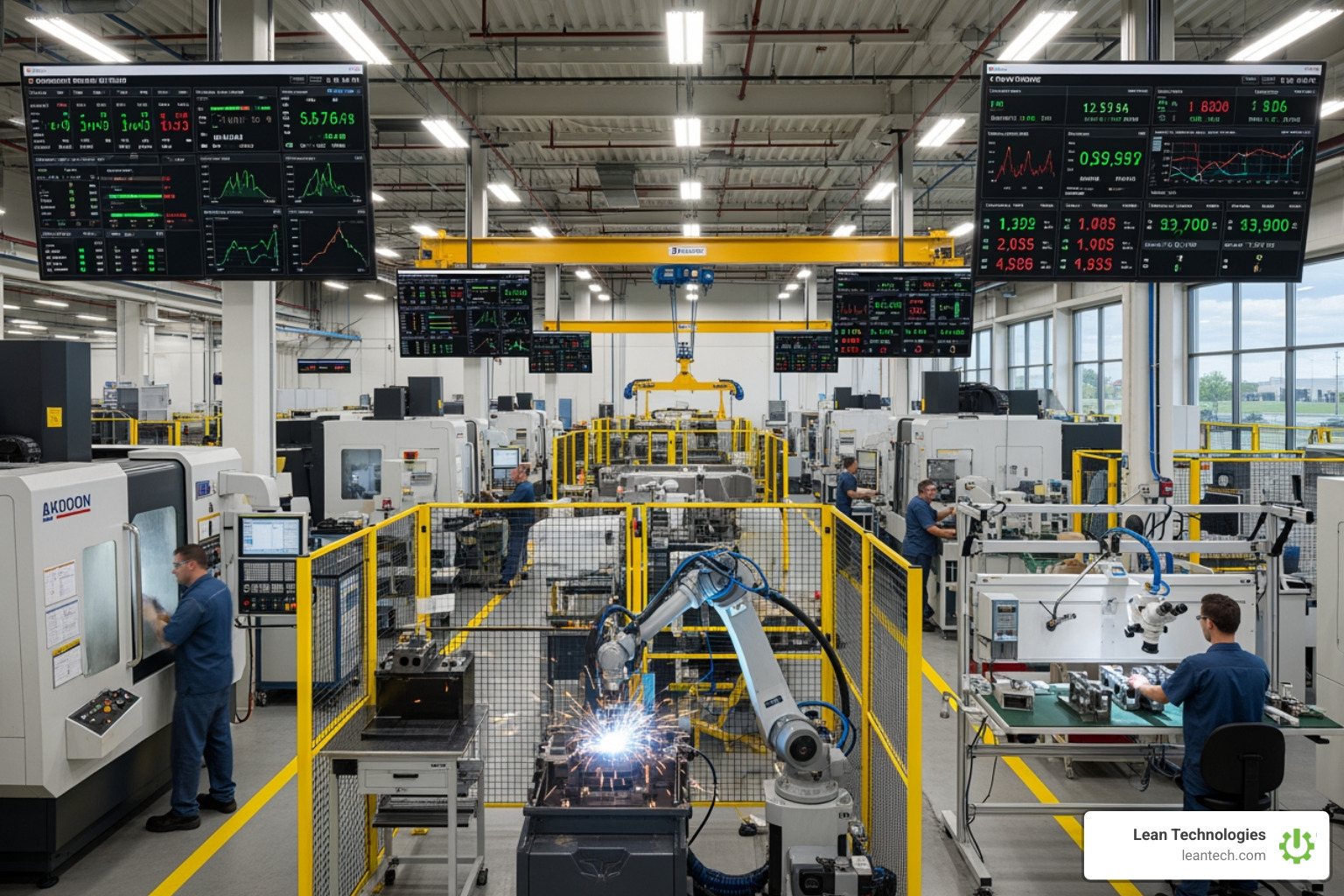
The Definitive Guide to Manufacturing Shop Floor Data Collection
Your Shop Floor is Leaking Profits. Here's How to Plug the Holes.
Manufacturing shop floor data collection is the process of capturing real-time information about what's happening on your production floor—production counts, downtime reasons, quality issues, and labor hours. It's the difference between running your plant on gut-feel and running it on facts.
What you need to know right now:
Without real data, you're blind. Manual logs and end-of-shift reports mean you're always reacting, never preventing.
The average facility loses $25,000 per hour during unplanned downtime. For larger plants, that number jumps past $500,000.
Real-time beats real-late. If your team logs data on paper and enters it hours later, problems have already cost you money.
You don't need to replace your ERP. Modern shop floor data tools work alongside your existing systems to fill the real-time gap.
Operators are the key. The best data comes from the people closest to the work—when you make it easy for them to capture it.
Here's the brutal truth: Your shop floor is probably leaking profits right now. Not because your team isn't working hard. But because you're managing by spreadsheets, sticky notes, and end-of-shift memory dumps.
When downtime happens, how long before you know about it? Minutes? Hours? End of shift?
When scrap rates spike, can you trace it back to the exact moment things went sideways?
When a bottleneck slows your entire line, do you have the data to prove what's really causing it?
If you're like most operations managers we talk to, the answer is no. And that's costing you—in efficiency, quality, delivery performance, and straight-up cash.
The good news? Manufacturing shop floor data collection isn't about expensive sensors or ripping out your ERP. It's about giving your team a simple, digital way to capture what's happening as it happens. And then using that data to drive real action.
This guide breaks down exactly how to do it—what to track, which methods work, how to get your team on board, and how to turn data into decisions that move the needle.
What is Shop Floor Data Collection & Why It’s More Than Just Numbers
Let's cut to the chase: manufacturing shop floor data collection is the systematic process of gathering information directly from your production environment. Think of it as taking the pulse of your factory in real-time. This isn't just about counting finished products; it's about understanding everything that impacts that count.
It's crucial for manufacturers because it provides three non-negotiable benefits:
Visibility: You can't fix what you can't see. Real-time data collection illuminates every corner of your shop floor, showing you exactly what's happening, when, and where. Production managers gain instant insight into machine status, work order progress, and potential roadblocks.
Accountability: When data is collected at the source, it becomes clear who, what, and why. This isn't about blame; it's about empowering teams to own their processes and identify areas for improvement. Human Resources managers can track labor utilization accurately, while Safety Managers can log incidents precisely.
Problem-solving: With accurate, timely data, you move from guessing games to data-driven solutions. Continuous Improvement Managers can quickly identify root causes of inefficiencies, rather than chasing symptoms.
The real power of shop floor data collection isn't in hoarding numbers; it's in changing raw data into actionable insights that drive improvement. As McKinsey points out, "High uncertainty and low growth have already forced manufacturers to squeeze every asset for maximum value. The next target is their own data." McKinsey highlights how data unlocks productivity and profitability.
Key metrics you should be focusing on include:
Overall Equipment Effectiveness (OEE): A golden standard, measuring how well your manufacturing operation is used compared to its full potential.
Downtime: Not just that a machine is down, but why and for how long.
Scrap Rate: The percentage of produced goods that don't meet quality standards.
Cycle Time: The time it takes to complete one unit or operation.
Labor Utilization: How effectively your workforce is being deployed.
For Operations Managers and Production Managers, this means moving beyond gut feelings. Instead, you're making decisions based on solid facts, understanding the true capacity of your lines, and pinpointing exactly where your team needs support. Quality Assurance Managers can track defect rates in real-time, enabling immediate corrective action, rather than finding a batch of faulty products after the fact.
The Real-World Payoff: How Good Data Drives Real Results

So, you're collecting data. Great. But what's the tangible return? Why should you invest time and resources into perfecting your manufacturing shop floor data collection? Because good data isn't just a nice-to-have; it's a strategic weapon that impacts your bottom line.
Here’s why it matters:
Improved Efficiency: With real-time visibility, you can spot bottlenecks and inefficiencies the moment they arise. This isn't theoretical; automated data collection has been shown to increase output by 50% for a product line. By understanding exactly where work is piling up or slowing down, Continuous Improvement Managers can optimize workflows, reallocate resources, and significantly boost overall productivity. One manufacturer even reported increasing their uptime by 15% and efficiency by 20% by leveraging production data. That's a serious competitive edge.
Reduced Downtime: Unplanned downtime is a killer. It's not just frustrating; it's incredibly expensive. The average manufacturing facility loses around $25,000 for every hour of unplanned downtime. For larger organizations, this figure can exceed $500,000 per hour. In automotive manufacturing, unplanned downtime can cost up to $2.3 million per hour. By collecting data on machine performance and downtime reasons, Maintenance Managers can transition from reactive firefighting to proactive, preventive, and even predictive maintenance. When shifting from reactive to preventive maintenance, companies can reduce overall downtime by up to 32% on average. This means fewer unexpected stoppages and more consistent production.
Better Quality: Quality isn't just about inspection at the end of the line; it's about preventing defects throughout the process. With real-time data, Quality Assurance Managers can track quality metrics like defect rates and inspection results as they happen. This enables immediate intervention when a process starts to drift, significantly reducing scrap and rework. Comprehensive data also supports robust traceability, providing a "digital passport" for every part assembled, which is invaluable for audits and root cause analysis. This helps you maintain high standards and meet stringent compliance requirements.
Smarter Decisions: When you have accurate data flowing from the shop floor, you replace speculation with facts. This empowers Production Managers and Project Managers to make data-driven choices, leading to more accurate quoting, better production planning, and more reliable forecasting. As SAS states, "Big data analytics examines large amounts of data to uncover hidden patterns, correlations, and other insights. With today’s technology, it’s possible to analyze your data and get answers from it almost immediately." This immediate insight means you can adjust production schedules, assign tasks effectively, and make informed decisions about resource allocation, directly impacting profitability.
For Operations Managers, this means a clearer path to operational excellence. For Maintenance Managers, it's about optimizing asset utilization and lifecycle management, with industries implementing asset performance management seeing asset utilization improvements on the order of 20%. For Quality Engineers, it's about embedding quality into every step of the process. For Continuous Improvement Leaders, it’s the fuel for every initiative, helping to uncover "hidden bottlenecks or unprofitable production lines" that McKinsey highlights as previously impenetrable problems.
How to Master Manufacturing Shop Floor Data Collection: Techniques & Tech
To truly harness the power of manufacturing shop floor data collection, you need to understand the methods available. And frankly, some methods are simply better than others.

The Old Way: Manual Data Collection (and Why It’s Holding You Back)
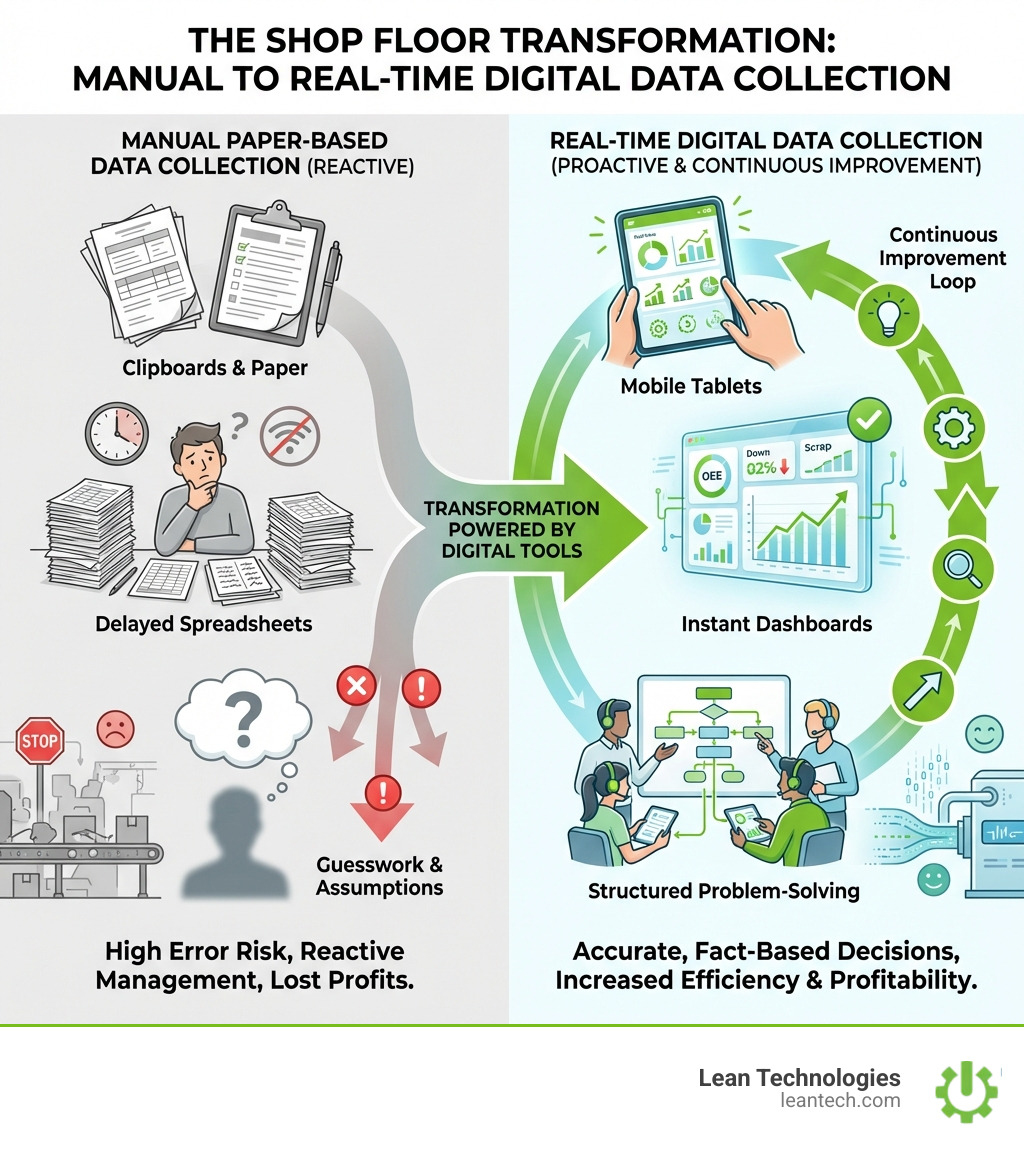
We've all been there. The clipboards, the paper forms, the sprawling spreadsheets, the end-of-shift scramble to transcribe notes. This is manual data collection, and while it might feel familiar, it's a productivity killer.
Common methods include:
Paper logs: Operators jotting down machine readings, stop reasons, production counts, or quality checks on physical forms.
Spreadsheets: Data entered into Excel at the end of a shift, or even the next day.
Whiteboards and sticky notes: Informal tracking that often gets lost or overlooked.
The problems with this approach are glaring:
Human Error: Omission, bias, misreading, transposition—these are constant companions of manual data entry. Whether it's a tired operator at the end of a long shift or a supervisor rushing to compile reports, inaccuracies creep in.
Data Silos: Information captured on paper or in individual spreadsheets rarely integrates seamlessly with other systems. This creates isolated pockets of data that are hard to analyze holistically. Maintenance Managers might have their logs, Production Managers theirs, and Quality Assurance still another.
Delays: Data isn't real-time; it's "real-late." If a machine goes down at 10 AM, but the downtime reason isn't logged until 2 PM, and then entered into a system at 5 PM, you've lost hours of opportunity to intervene. This impacts invoicing and inventory management, as ERP data can often be delayed by one or two days.
Inaccurate Info: Because of errors and delays, the data you eventually get might not reflect the true state of your shop floor. This leads to poor decision-making and a lack of trust in the numbers.
No Real-Time View: You can't react to problems as they happen if your data is hours or days old. You're always playing catch-up.
For Operations Managers, this means making decisions based on incomplete or outdated information. For Continuous Improvement Leaders, it means struggling to pinpoint root causes because the data is fragmented and unreliable. For Safety Managers, inaccurate incident logs can hinder effective analysis and prevention.
The Smart Way: Digitized Operator Input
The modern solution involves moving beyond paper and directly digitizing data capture at the source. This is where the power of operators, equipped with the right tools, truly shines. It's about empowering your team with mobile-first solutions that make data entry intuitive and efficient.
Methods for digitized operator input include:
Tablets or workstations with digital forms: Operators use a simple interface to log production counts, downtime reasons, quality checks, or maintenance requests directly as they occur.
Barcode scanning: Quickly record material movements, labor transactions, or finished goods by scanning barcodes, eliminating manual typing errors.
Structured checklists and workflows: Guide operators through processes, ensuring consistency and capturing necessary data points at each step.
The benefits are immediate and profound:
Real-Time Input from the Source: Data is captured instantly, precisely when and where the event happens. This means Production Managers have an up-to-the-minute view of their lines, and Maintenance Managers can respond to issues immediately.
Structured, Actionable Data: Digital forms ensure consistency, requiring specific information and reducing free-form entry. This makes data clean, organized, and ready for analysis.
Operator Context (Not Just Numbers): Operators can add notes, categorize downtime reasons, or attach images to provide crucial context that raw machine data often lacks. This human element is vital for true problem-solving.
Lower Barrier to Entry than Full Automation: While IoT sensors and PLCs offer highly automated data collection, a digitized operator input system can be implemented quickly and cost-effectively, providing significant gains without a massive infrastructure overhaul. It focuses on the data that matters most, the data that drives action.
This approach is the cornerstone of digital lean manufacturing, enabling manufacturers to streamline operations and boost productivity by empowering their frontline teams.
Why Thrive’s Approach Works
At Thrive, we understand the shop floor. We know you need solutions that fit seamlessly into your existing operations, not another complex system that adds to the headache. Our approach to manufacturing shop floor data collection is built for real-world manufacturing, focusing on simplicity, effectiveness, and immediate value.
Built for operators and supervisors: Thrive isn't designed for IT specialists; it's built for the people doing the work. Our intuitive, mobile-first interface makes data entry fast, simple, and painless. Operators can quickly log issues, track actions, and contribute to continuous improvement without feeling bogged down.
No need for expensive sensors or machine integrations: We don't believe you need to rip out your existing infrastructure or invest in costly new hardware to get valuable data. Thrive organizes and drives action from data entered by your team or imported from other systems. This means you leverage the knowledge and experience of your operators directly, capturing the human context that automated sensors often miss.
Real-time visibility: The moment an operator logs an event—whether it's a machine stop, a quality check, or a completed task—that data is instantly visible. No more waiting for end-of-shift reports. No more "real-late" data. You see issues as they happen, enabling immediate intervention and proactive problem-solving.
Integrates with your ERP: We know your ERP is the backbone of your business. Thrive isn't here to replace it. Instead, Thrive fills the real-time operational data gap, providing granular, minute-by-minute insights from the shop floor that your ERP can then leverage for broader business planning. It's a powerful complement, not a competitor.
The Biggest Problems in Data Collection (And How to Jump Them)
Implementing a robust manufacturing shop floor data collection system isn't always smooth sailing. There are common problems manufacturers face, but with the right strategy, you can jump them.
Operator Pushback & Lack of Trust: This is perhaps the most critical challenge. Operators might view data collection as a tool for micromanagement or blame. To overcome this, you must:
Track the process, not the person: Clearly communicate that the goal is to improve processes, identify systemic issues, and make everyone's job easier, not to monitor individual performance for punitive reasons.
Show what’s in it for them: Highlight how better data leads to fewer machine breakdowns, smoother shifts, less rework, and a less stressful work environment. When operators see the data helps solve real problems, they become advocates.
Make it easy: If the system is clunky or time-consuming, operators won't use it. An intuitive, mobile-friendly interface is non-negotiable.
Data Silos & ERP Integration: Many manufacturers find their data scattered across disparate systems—manual logs, legacy software, and various departmental spreadsheets. This creates "data silos" where information doesn't flow freely.
Use tools with open APIs: Look for solutions that can integrate with your existing ERP, MES, or other enterprise systems. This ensures that shop floor data can enrich your broader business intelligence.
Connect data to action, not just storage: The goal isn't just to collect data, but to use it to drive workflows, trigger alerts, and inform decision-making across departments. Integrating shop floor data into an ERP system, for example, connects it with accounting, inventory, and sales, providing real-time visibility across the entire operation.
“Analysis Paralysis”: With the potential to collect vast amounts of data, it's easy to get overwhelmed and not know where to start or what to focus on.
Start with one problem: Don't try to solve everything at once. Focus on a single, high-impact problem area.
Focus on a few key metrics: Identify the 2-3 most critical KPIs that directly relate to your chosen problem.
Use visual dashboards: Present data in clear, concise, visual formats that make trends and issues immediately apparent, rather than drowning in spreadsheets.
The National Institute of Standards and Technology (NIST) provides valuable guidance, emphasizing the importance of collecting, curating, and re-using manufacturing data. Their recommendations for managing manufacturing data underscore the need for a structured approach to avoid these common pitfalls.
Your Game Plan: A 5-Step Guide to Getting Started
Ready to stop the profit leaks and start gaining real control? Here’s a practical, 5-step game plan for implementing effective manufacturing shop floor data collection. This isn't about a massive overhaul; it's about strategic, impactful steps.
Step 1: Start with Your Biggest Pain Point
Don't try to digitalize your entire factory overnight. That's a recipe for overwhelm and failure. Instead, identify the single most frustrating or costly problem area on your shop floor. This could be:
A persistent machine bottleneck that slows down your entire line.
A specific product with an unacceptably high scrap rate.
A piece of equipment that experiences frequent, unpredictable downtime.
An area where quality issues consistently arise.
As Forbes advises, "Manufacturers getting the most value from analytics start with a solid business case first, based on a known problem they’ve been trying to solve either in their supply chains, production or fulfillment operations." Forbes: Analytics projects succeed when they start with a known problem. Starting with a clear, defined business case ensures you're solving a real problem and can demonstrate quick value. This helps Operations Managers get buy-in and show tangible ROI.
Step 2: Define What to Track (and What to Ignore)
Once you've identified your pain point, narrow down the data you need to collect. Resist the urge to track everything. Focus on 2-3 critical metrics that directly shed light on your chosen problem.
If your problem is downtime: Track machine status (running/stopped), downtime reasons (breakdown, changeover, material shortage), and duration.
If your problem is scrap: Track good parts vs. scrap, scrap reasons, and the specific operation where scrap occurred.
If your problem is a bottleneck: Track cycle time, queue times, and operator activity at that specific workstation.
The goal is to get enough data to understand the problem, not to drown in information. Continuous Improvement Managers should lead this effort, ensuring the selected metrics are actionable and relevant.
Step 3: Choose Your Tool
This is where the right technology makes all the difference. You need a system that's powerful enough to deliver insights but simple enough for your team to use every day. Look for a solution with these key features:
Operator-friendly interface: Intuitive, mobile-ready (tablets are ideal), and requires minimal training. This is crucial for getting buy-in from your frontline team.
Real-time feedback and dashboards: Visual dashboards that display key metrics instantly, allowing supervisors and operators to see performance at a glance and react quickly.
Reporting capabilities: Generate clear, customizable reports that help you analyze trends, track progress, and communicate results to stakeholders.
Easy integration with your ERP: The system should complement, not compete with, your ERP. It should be able to push or pull data to enrich your existing business systems without complex IT projects.
For IT Managers, ease of integration and a robust, scalable platform are key. For Production Managers, user adoption and immediate visibility are paramount.
Step 4: Run a Pilot Project
Before rolling out to your entire facility, conduct a pilot project on a single line, cell, or even just one machine.
Start small, get a quick win: This allows you to test the system in a controlled environment, gather feedback, and demonstrate value quickly.
Involve the team: Select a small, enthusiastic group of operators and supervisors to participate in the pilot. Their input is invaluable for refining the system and building champions.
Build momentum: A successful pilot provides concrete evidence of the system's benefits, making it easier to gain broader adoption and secure further investment. Project Managers can use this phase to refine implementation strategies.
Step 5: Review, Refine, and Expand
Once your pilot is complete and you've achieved a quick win, the work isn't over—it's just beginning.
Use the data to drive change: Analyze the data collected during the pilot. What insights did you gain? What processes can be improved? Implement those changes.
Show the value: Quantify the improvements from your pilot (e.g., "We reduced downtime on Machine X by 20%"). Share these successes widely to build enthusiasm.
Get team feedback: Continuously solicit input from your operators and supervisors. What's working? What could be better? Their practical experience is essential for ongoing refinement.
Roll out to other areas: Once you've refined your process and demonstrated success, expand the system to other relevant areas of your shop floor, following a similar phased approach.
This iterative process is fundamental to continuous improvement. To dive deeper into managing these phases effectively, explore project management in manufacturing.
Frequently Asked Questions about Shop Floor Data Collection
How does real-time data actually help make better decisions?
Real-time data gives you instant visibility into problems as they happen. Instead of waiting for an end-of-shift report, you see issues in minutes. If a machine stops, you know immediately, not hours later. This lets supervisors and operators act fast, solve problems at their source, and prevent small issues from becoming big ones. For Production Managers, this means adjusting schedules on the fly. For Maintenance Managers, it's about dispatching technicians to the right place at the right time.
Do I need to replace my ERP to collect shop floor data?
No. Thrive is designed to work alongside your ERP, not replace it. Your ERP is excellent for business planning, financials, and high-level inventory. Thrive fills the real-time operational data gap, giving you second-by-second shop floor control and detailed production insights, while your ERP handles broader business functions. It's about enhancing your existing systems, not ripping them out.
What’s the best way to get operators on board with a new data collection system?
Involve them from the start. Ask what data matters to them, what problems they face daily, and how the system could make their work easier. Make it clear the goal is to improve the process, not micromanage individual performance. Highlight the benefits for them: less paperwork, faster problem resolution, and a smoother workday. When operators see the data helps solve their real problems and makes their lives easier, they become the system’s biggest fans.
What to Do Next: Stop Guessing, Start Winning
Manufacturing shop floor data collection is the fastest way to move from chaos to control. Ditch the paper logs and spreadsheet headaches that are costing you time, money, and sanity. Give your team a tool built for the shop floor—one that delivers real-time visibility and drives continuous improvement.
Stop managing through spreadsheets and wishful thinking. Let your team run lean—with real-time visibility and fewer workarounds. Want faster problem-solving? It starts with better visibility.
Thrive is the digital lean toolbox for manufacturers who want to run lean, solve problems faster, and build a culture of accountability.
See how Thrive helps you build a culture of continuous improvement.