

Master Your Tools' Longevity Essential Steps for Preventive Maintenance
Why Your Tools and Equipment Need a Better Strategy Than "Run Until They Break"
Perform preventive maintenance of tools and equipment and you'll reduce downtime by up to 80%, cut maintenance costs by up to 40%, and extend the life of your assets by 20–40%. Here's what that actually means:
Quick Answer: How to Perform Preventive Maintenance
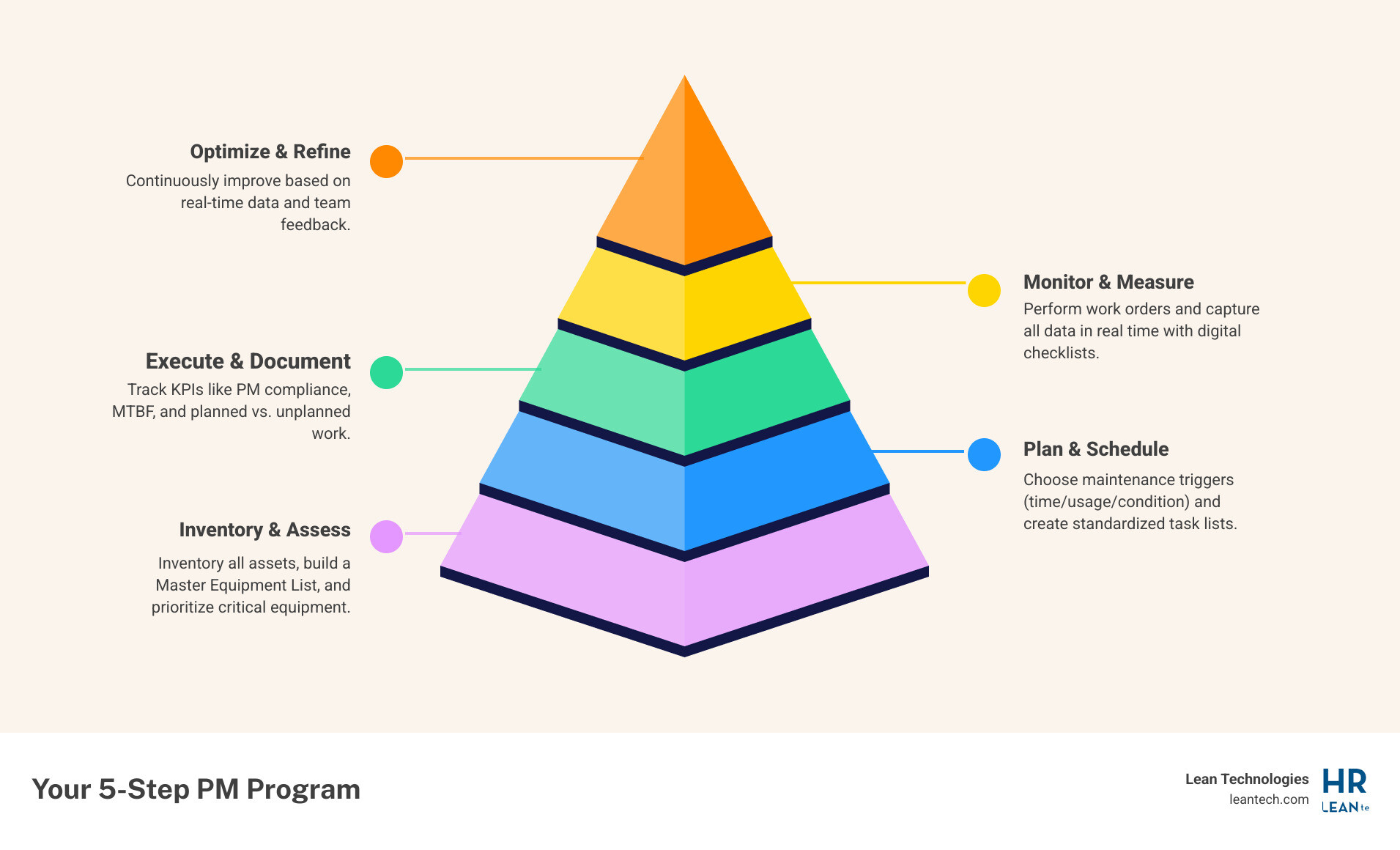
Inventory your assets – Know what you have, where it is, and its current condition
Prioritize critical equipment – Focus on machines where failure halts production or creates safety risks
Set maintenance triggers – Use time-based (monthly), usage-based (every 200 hours), or condition-based (when vibration spikes) schedules
Create clear task lists – Document what to inspect, clean, lubricate, or replace
Execute and document – Use digital checklists to capture data at the source in real time
Track KPIs – Monitor PM compliance, MTBF, and planned vs. unplanned work ratios
Adjust based on data – Refine your program as you learn what actually prevents failures
Most maintenance teams live in firefighting mode.
A machine breaks. Production stops. Everyone scrambles. Rush orders for parts. Overtime to get it running again.
Then it happens again next week—on a different machine.
This is reactive maintenance, and it's expensive, unpredictable, and demoralizing.
The alternative? A structured approach that catches problems before they become emergencies.
That's what preventive maintenance does.
It shifts you from constant firefighting to predictable, proactive care—so your equipment runs longer, your team works safer, and your costs stay under control.
But here's the catch: most PM programs fail because they're built on paper, Excel, or vague checklists that nobody follows consistently.
Real-time beats real-late. If your team is logging maintenance data at the end of the shift or week, you've already lost visibility when it matters most.
I'm Jamie Gyolai, Vice President at Lean Technologies, and I've spent over 20 years in manufacturing operations—from the assembly line to supply chain leadership. I've seen how the right systems to perform preventive maintenance of tools and equipment can transform a shop floor from chaos to control. In this guide, I'll show you exactly how to build a PM program that actually works.
What is Preventive Maintenance (and Why “Run-to-Fail” is Draining Your Shop)
We've all been there. A machine screams to a halt. Production stops. The clock starts ticking, costing us time, money, and sanity. This is the reality of reactive maintenance, where we wait for failure to happen before we act.
But there's a better way. It's called preventive maintenance (PM).
PM is about being proactive. It’s the systematic care and protection of our tools, equipment, and machines. We inspect, service, and maintain them regularly to keep them in safe, usable condition.
This approach limits unplanned downtime, extends productivity, and protects our investments.
Think of it like this: your equipment has a failure curve, often called the P-F curve. This curve shows a point (P) where a potential failure can be detected, and a later point (F) where functional failure occurs. Reactive maintenance means waiting until F. Preventive maintenance aims to detect issues at P, or even earlier, to prevent F from ever happening.
Organizations that rely on reactive maintenance face significant costs. Manufacturers can lose an average of $125,000 per hour during unplanned downtime. That's a staggering figure.
The good news? Organizations that prioritize preventive and predictive maintenance can experience 52.7% less unplanned downtime compared to their reactive-heavy peers. This translates directly to massive savings and smoother operations.
A well-executed PM program can reduce overall maintenance costs by up to 40% and increase equipment life by 20 to 40%. It’s not just about fixing things; it’s about making them last longer and perform better.
Beyond the numbers, PM is crucial for safety. All tools, equipment, and vehicles must be properly maintained so that workers are not endangered. Poor maintenance is a leading cause of incidents and injuries.
While some failures are age-related (about 11%), a vast 89% occur randomly or due to external factors. This means we can't just rely on equipment getting old to predict failure. We need a systematic approach that catches these random issues before they become catastrophic.
This commitment to preventive maintenance is a hallmark of a mature maintenance program. We want to move beyond being constantly reactive, through planned and optimized stages, towards a predictive and ultimately, a world-class maintenance operation.
Why You Must Perform Preventive Maintenance of Tools and Equipment
Let’s be honest: a shop floor stuck in constant reactive mode creates a firefighting culture.
It's a high-stress environment where every day is an emergency. This drains resources, budgets, and, most importantly, kills team morale. Technicians are always scrambling, never quite getting ahead.
But when we accept preventive maintenance, we flip the script.
We get predictable costs instead of five-figure surprise invoices (think a $15,000 HVAC repair). We achieve higher equipment reliability, meaning fewer breakdowns and more consistent output.
We also ensure lower safety risks. Maintenance tasks themselves can be hazardous, but a well-structured PM program controls these risks and keeps our team safe. This also ensures regulatory compliance, as many industries require documented inspections and maintenance.
Here’s a powerful truth: a $1 spent on preventive care can save $4-$5 in deferred failure or rehabilitation costs. That’s a return on investment we can't ignore. It’s not a cost center; it’s a profit protector.
Preventive vs. Corrective (Reactive) Maintenance
Let’s clarify the difference between these two approaches. It's about choosing between chaos and control.
Preventive Maintenance is a proactive strategy. We perform scheduled tasks and routine checks at defined intervals (time-based, usage-based, or condition-based) to spot issues early and prevent them from becoming major problems. It's about staying ahead.
Corrective (Reactive) Maintenance is, well, reactive. It's the unplanned repairs and emergency work we do after something has already broken. This leads to constant firefighting, unexpected downtime, and inflated costs.
Here’s a quick comparison:
Feature Preventive Maintenance Corrective (Reactive) Maintenance Approach Proactive, scheduled, systematic Reactive, unplanned, emergency-driven Cost Predictable, lower long-term, $1 saves $4–$5 Unpredictable, higher long-term, rush orders, overtime Downtime Minimized, planned, predictable Maximized, unplanned, disruptive Safety Improved, reduced hazards, controlled risks Increased risks, potential for accidents during emergencies Planning High level of planning, optimized resource allocation Little to no planning, resource scrambling Team Morale Higher, less stress, empowered technicians Lower, constant stress, firefighting culture Equipment Life Extended, maintained at peak condition Shortened, accelerated wear and tear
The Core Components of a Winning PM Program
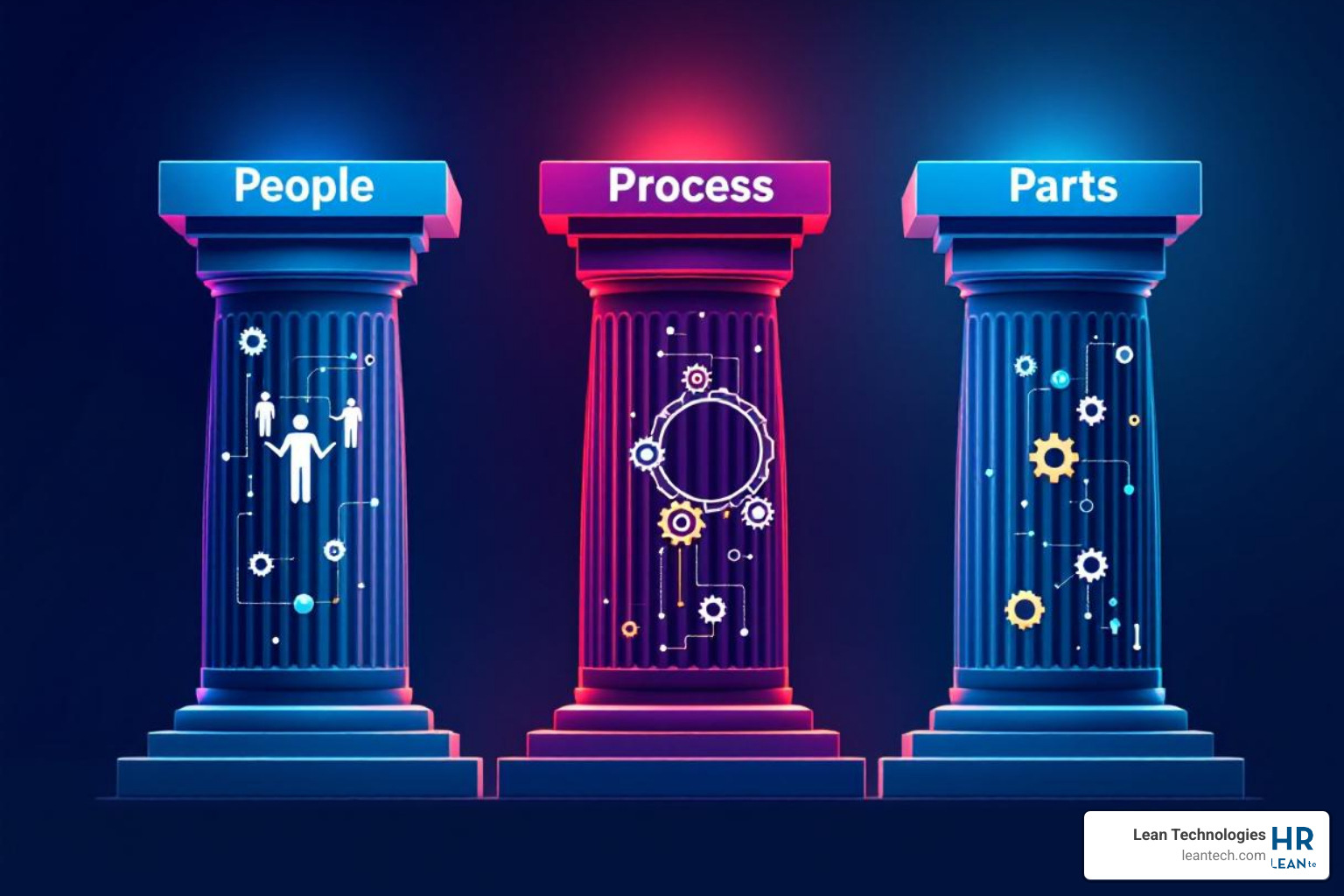
A real PM program isn’t just a checklist—it’s a system built on three pillars: People, Process, and Parts.
Pillar 1: People and Training
Your maintenance program is only as good as the team executing it.
We need competent teams who understand the equipment, the procedures, and the importance of their work. This starts with clear responsibility. Everyone needs to know their role in the maintenance cycle.
Operator involvement is critical. The people who use the equipment daily are often the first to notice subtle changes in sound, vibration, or performance. Empowering them to report issues immediately and participate in daily checks provides invaluable early detection.
Skill development through continuous training ensures our technicians are up-to-date on the latest equipment, tools, and maintenance techniques. This includes fundamental safety procedures like Lockout-Tagout (LOTO). LOTO is a non-negotiable safety procedure designed to prevent equipment from being energized during servicing, protecting our team from serious injury.
Well-trained personnel are foundational to a successful preventive maintenance program. They ensure they understand the latest procedures, best practices, safe handling, and troubleshooting techniques for specific equipment.
Want to learn more about keeping your team safe? Check out our guide on safety processes.
Pillar 2: Process and Scheduling
This pillar is the backbone of operational stability.
It dictates when, how, and why work gets done. We start with manufacturer recommendations as a baseline, but we don't stop there.
A comprehensive asset inventory is the foundation. We need a detailed list of all machinery and equipment, including their current condition, maintenance history, and frequency of use. This helps us build a Master Equipment List (MEL).
Next, we perform a criticality analysis. Not all equipment is created equal. We prioritize assets based on their impact on production, safety risks, and repair costs. This ensures we focus our efforts where they matter most.
Standardized inspections are crucial for consistency. These procedures, whether visual checks, performance tests, or diagnostic tools, help identify potential issues early.
We then develop detailed task lists for each piece of equipment. These aren't vague instructions like "check motor." They're specific: "check motor temperature with IR gun and compare to baseline."
Finally, we establish a scheduling frequency. This could be time-based (e.g., monthly), usage-based (e.g., every 200 operating hours), or condition-based (e.g., when vibration levels exceed a threshold).
Effective documentation is the glue that holds it all together. It ensures we track what was done, when, by whom, and what was found.
Pillar 3: Parts and Resources
You can have the best plan and the best people, but without the right parts and tools, your PM program will grind to a halt.
Effective inventory management is key to avoiding shortages. We need to know what spare parts are on hand, their locations, and reorder points. Nothing derails a planned maintenance task faster than a missing filter or a specialized tool.
Ensuring technicians have the right tools for the job, along with the necessary materials management, prevents delays and frustration. This proactive approach to resources means we can execute PM tasks efficiently and on schedule, without constant scrambling for supplies.
How to Perform Preventive Maintenance of Tools and Equipment: A Step-by-Step Guide
This is where it gets real. Follow these steps to build a program that actually works.

Step 1: Assess Your Equipment and Define Goals
Before we can fix anything, we need to know what we're working with.
First, inventory your assets. This means creating a complete list of every piece of equipment, its make, model, serial number, location, and key specifications. This forms your Master Equipment List (MEL). It's the backbone of your maintenance program.
Next, we check the current condition of each asset. What’s working well? What’s showing signs of wear? What needs immediate attention?
We also review maintenance history. Past failures, repairs, and scheduled tasks provide valuable data for future planning.
Finally, we set clear goals. These should be specific and measurable. Do we want to reduce unplanned downtime by 20%? Extend the lifespan of our CNC machines by 15%? These goals will guide our entire program.
Step 2: Choose Your Strategy and Build the Schedule
Now that we know our assets and goals, it’s time to decide how we’ll maintain them.
We have several strategies for maintenance triggers:
Time-based maintenance (TBM): This is the simplest. We schedule tasks at fixed calendar intervals, regardless of usage. Think changing HVAC filters every three months.
Usage-based maintenance (UBM): Here, maintenance is triggered by equipment usage, like operating hours, cycles, or mileage. For example, servicing a forklift every 200 operating hours.
Condition-based maintenance (CBM): This is more advanced. We monitor the real-time condition of equipment using sensors (e.g., for vibration, temperature, oil analysis) and schedule maintenance only when anomalies indicate a potential problem. Replacing a motor bearing when vibration levels spike is a CBM example.
The best programs often use a mix of these strategies, custom to the criticality of each asset.
Once the strategy is chosen, we start building our PM calendar. This means assigning specific tasks to specific assets at specific frequencies. We also define assigning responsibilities so everyone knows who is accountable for each task.
Ready to get started? You can build your own preventive maintenance schedule with our templates.
Step 3: Execute and Document with Precision
This is where the rubber meets the road. Execution and documentation are critical for success.
We implement work order management to track every task. Each PM activity should have a clear work order detailing what needs to be done, by whom, and by when.
This is also where digital tools shine. Using digital checklists on mobile devices allows technicians to capture data at the source. No more paper forms, no more transcribing data at the end of the shift. This provides real-time updates on task completion and equipment status.
When an issue is found, we can record issues immediately, often with photos or videos, and trigger follow-up actions. We also track parts used for each task, which feeds directly into our inventory management.
This precision in execution and documentation isn't just about accountability; it’s about collecting the data we need to continuously improve. For more on how digital tools can transform your operations, explore our insights on digital manufacturing.
Measure What Matters: Tracking PM Success and Avoiding Pitfalls
If you don’t measure it, you can’t improve it. Stop guessing—use data to refine your program.
Key Performance Indicators (KPIs) to Track
To truly understand if our preventive maintenance program is working, we need to track the right metrics.
Mean Time Between Failures (MTBF): This measures the average time a system or product operates before failing. A rising MTBF indicates increasing reliability.
PM Compliance Rate: This shows the percentage of scheduled PM tasks that were completed on time. A high compliance rate means we're sticking to our plan.
Planned vs. Unplanned Work Ratio: This compares the amount of time spent on scheduled, proactive maintenance versus reactive, emergency repairs. We want this ratio to heavily favor planned work.
Overall Equipment Effectiveness (OEE): A critical metric in manufacturing, OEE measures how efficiently equipment is operating, taking into account availability, performance, and quality. Improved PM should boost your OEE.
Maintenance Backlog: This tracks the amount of uncompleted maintenance work. A growing backlog can signal resource issues or unrealistic scheduling.
Total Maintenance Cost: This covers all expenses related to maintenance, including labor, parts, and contractors. We want to see this decrease over time as PM reduces reactive costs.
By monitoring these KPIs, we gain real-time visibility into our program's effectiveness and can make data-driven decisions to optimize our efforts.
Common Pitfalls and How to Avoid Them
Even with the best intentions, PM programs can stumble. Here are some common traps and how to steer clear of them:
Vague checklists: Instructions like "Inspect motor" leave too much room for interpretation. Be specific: "Check motor temperature with IR gun and compare to baseline."
No team buy-in: If technicians don't understand why PM is important, or if their feedback is ignored, compliance will suffer. Involve them in the planning and continuous improvement.
Weak training: Untrained personnel can damage equipment or miss critical issues. Invest in skill development.
Ignoring data: Don't just collect data; use it. Analyze trends, identify recurring failures, and adjust your plan accordingly.
Over-maintenance: Performing PM too frequently or replacing parts unnecessarily can waste resources and even induce failures. Only 11% of failures are age-related.
Inconsistent execution: If PM tasks are skipped or performed differently by various technicians, the program loses its effectiveness. Standardize procedures.
Not adjusting the plan: A PM program is not static. It needs continuous monitoring, evaluation, and refinement based on new data and changing operational needs.
Real-World PM: Checklists and Tech for the Modern Shop Floor
Let’s make this practical. Here are examples and the tech that pulls it all together.
Practical Examples and Checklists
Preventive maintenance tasks vary widely depending on the equipment, but the principles remain the same.
CNC Machines:
Daily: Clean work area, inspect cutting tools, check lubrication levels, quick visual inspection for loose parts or unusual sounds.
Weekly: Clean motion components (rails, screws), inspect belts/chains/couplings, check coolant/dust collection systems.
Monthly: Verify machine calibration, inspect electrical components, review fasteners.
Quarterly/Semi-annually: Replace wear components (belts, bearings), perform software/control maintenance.
Forklifts (Powered Industrial Trucks):
Daily Pre-Op: Check hydraulic fluid, engine oil, coolant, transmission fluid. Inspect tires, brakes, steering, lights, horn, safety seat. Verify propane tank, hose, and connections (if applicable). Check overhead guard, mast assembly, forks, lift chains for damage or leaks.
OSHA provides Sample Daily Checklists for Powered Industrial Trucks that are excellent resources.
HVAC Systems:
Monthly (DIY): Inspect, clean, or change air filters.
Spring (Contractor): Clean evaporator and condenser coils, check refrigerant levels, clean/adjust blower components.
Fall (Contractor): Inspect gas/oil connections, gas pressure, burner combustion, and heat exchanger.
Landscape Equipment (e.g., Lawn Mowers, Trimmers):
Before Each Use: Check engine oil (4-cycle), inspect blades/chains, check tire pressure.
Seasonal/Annual: Change engine oil, clean/replace air filters, sharpen blades, check spark plugs, winterize fuel system (especially important with ethanol fuels).
How Thrive Helps You Perform Preventive Maintenance of Tools and Equipment
Paper checklists and spreadsheets are slow. They create delays, scatter data, and make it impossible to get real-time visibility.
Thrive changes that.
Our platform provides digital checklists that technicians can access on tablets or mobile devices, right at the point of work. This means they can capture data at the source, ensuring accuracy and timeliness.
This gives you real-time visibility into every maintenance task. You see what's being done, what's found, and what needs follow-up, all as it happens.
Thrive centralizes all your maintenance data, creating a single source of truth. This makes automated scheduling of recurring PM tasks simple, ensures nothing falls through the cracks, and helps you identify trends faster.
With mobile access for technicians, they have all the information they need—and can input new data—wherever they are on the shop floor.
No more waiting for end-of-shift reports. No more paper or spreadsheets slowing you down.
Thrive gives your team the digital tools to execute PM right at the source—so nothing falls through the cracks. It's how you move from reactive chaos to proactive control.
Frequently Asked Questions about Preventive Maintenance
How often should I perform preventive maintenance?
It depends on the asset. We recommend starting with the manufacturer’s guidelines. Then, adjust based on factors like equipment criticality, actual usage, operating environment, and your own historical failure data. Some tasks might be daily, others weekly, monthly, or even annually.
Is replacing parts on a schedule wasteful?
It can be. Only 11% of failures are purely age-related, while the vast majority (89%) occur randomly or due to other factors. This means blindly replacing parts just because a calendar says so can be wasteful. The best approach is to use inspection data, condition monitoring, and failure analysis to replace parts when they show actual signs of wear, not just because the calendar says so.
What’s the difference between preventive and predictive maintenance?
Preventive maintenance is scheduled based on fixed intervals (time-based, like every month) or usage (usage-based, like every 200 hours). It's proactive but doesn't necessarily react to the actual condition of the equipment. Predictive maintenance is more advanced. It uses real-time data from sensors (e.g., vibration, temperature, oil analysis) to monitor equipment condition, predict when a failure is likely to occur, and then schedule maintenance just-in-time, only when needed.
What to Do Next: From Firefighting to Flawless
A solid plan to perform preventive maintenance of tools and equipment turns your shop from chaos to control. It means less downtime, lower costs, and a safer, more productive team.
Stop managing your floor with spreadsheets and hope. You deserve better.
Give your team the digital tools to execute—right at the source. Thrive gives you a simple, powerful way to digitize checklists, track work in real time, and close the loop on every maintenance task.
Ready to build a world-class maintenance program? Visit https://leantech.com/maintenance to learn how Thrive can help your team.