
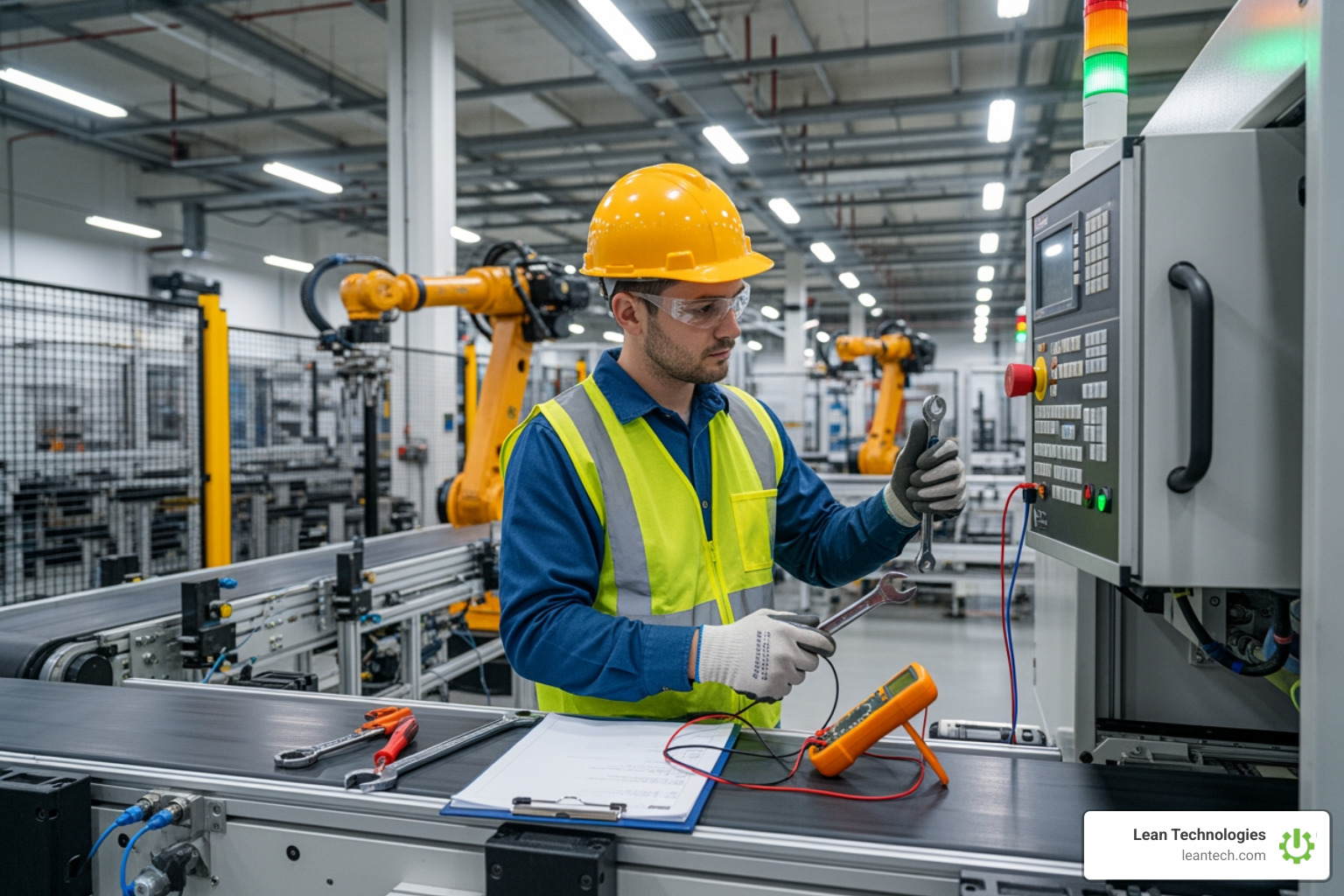
Stop the Shop Floor Drama with Planned Maintenance
What is Planned Maintenance TPM and Why Does It Matter?
Unplanned downtime isn't just a line item on a P&L it’s a $25,000-per-hour heart attack for your operations. When a critical asset goes down, the ripple effect hits everything: missed shipments, overtime costs, and a stressed-out crew. This is the "shop floor drama" that kills productivity. Planned maintenance TPM is the antidote.
In Total Productive Maintenance, the Japanese term for this pillar is Keikaku Hozen. While it translates to "planned maintenance," it represents a deep commitment to asset reliability. Developed by the Japan Institute of Plant Maintenance (JIPM), this methodology was championed by Seiichi Nakajima to transform how factories treat their machinery. It addresses the Six Big Losses—breakdowns, setup/adjustments, small stops, reduced speed, startup rejects, and production rejects—by ensuring equipment is always in peak condition.
The history of Total Productive Maintenance shows that it evolved from simple preventive maintenance into a holistic system where equipment health is everyone’s business. In a traditional "I operate, you fix" environment, the shop floor is a stage for constant drama. Planned maintenance TPM breaks that script. It moves the maintenance department from a "firefighting" unit to a strategic asset management team.
Feature Reactive Maintenance Planned Maintenance TPM Trigger Equipment fails or breaks down Scheduled intervals or condition alerts Cost High (emergency shipping, overtime) Controlled (budgeted parts and labor) Production Impact High (unplanned stops) Low (scheduled during downtime) Safety Risk High (unexpected failures) Low (controlled environment) Staff Morale Stressful "hero" culture Calm, disciplined execution
The Core Objectives of Planned Maintenance TPM
The ultimate goal is simple but bold: Zero breakdowns. By systematically eliminating the root causes of equipment failure, companies can extend the equipment lifecycle and significantly reduce the total cost of ownership. Instead of replacing an entire motor after it burns out, you replace a $50 seal during a scheduled window. This proactive approach is a cornerstone of modern maintenance management, ensuring that machines are available exactly when production needs them. It’s about moving from a culture of "fixing things" to a culture of "improving things."
How Planned Maintenance TPM Differs from Preventive and Predictive Strategies
People often use these terms interchangeably, but in a TPM framework, they are distinct tools in your kit:
Preventive Maintenance (PM): This is time-based or usage-based (e.g., change the oil every 500 hours). It’s like getting a 3,000-mile oil change for your car. It’s the baseline for any reliable operation.
Predictive Maintenance (PdM): This uses condition-based monitoring—like vibration analysis or thermography—to predict exactly when a part will fail. It’s like a warning light on your dashboard telling you your brake pads are at 10% life.
Planned Maintenance TPM: This is the system that organizes all the above. It uses historical failure data and component lifecycles to create a master schedule. It ensures that the right person, with the right parts, is at the right machine before the drama starts.
By following established Quality Definitions and OEE Standards, teams can ensure that maintenance isn't just about "fixing things" but about maintaining the precise standards required for perfect product quality. When you align your maintenance strategy with these standards, you stop guessing and start executing with precision.
The 6 Phases of Implementing a Planned Maintenance System
Transitioning to a planned maintenance TPM model doesn't happen overnight. It requires a phased approach to build capability and trust on the shop floor. If you try to skip steps, you’ll end up with a system that looks good on paper but fails in practice.
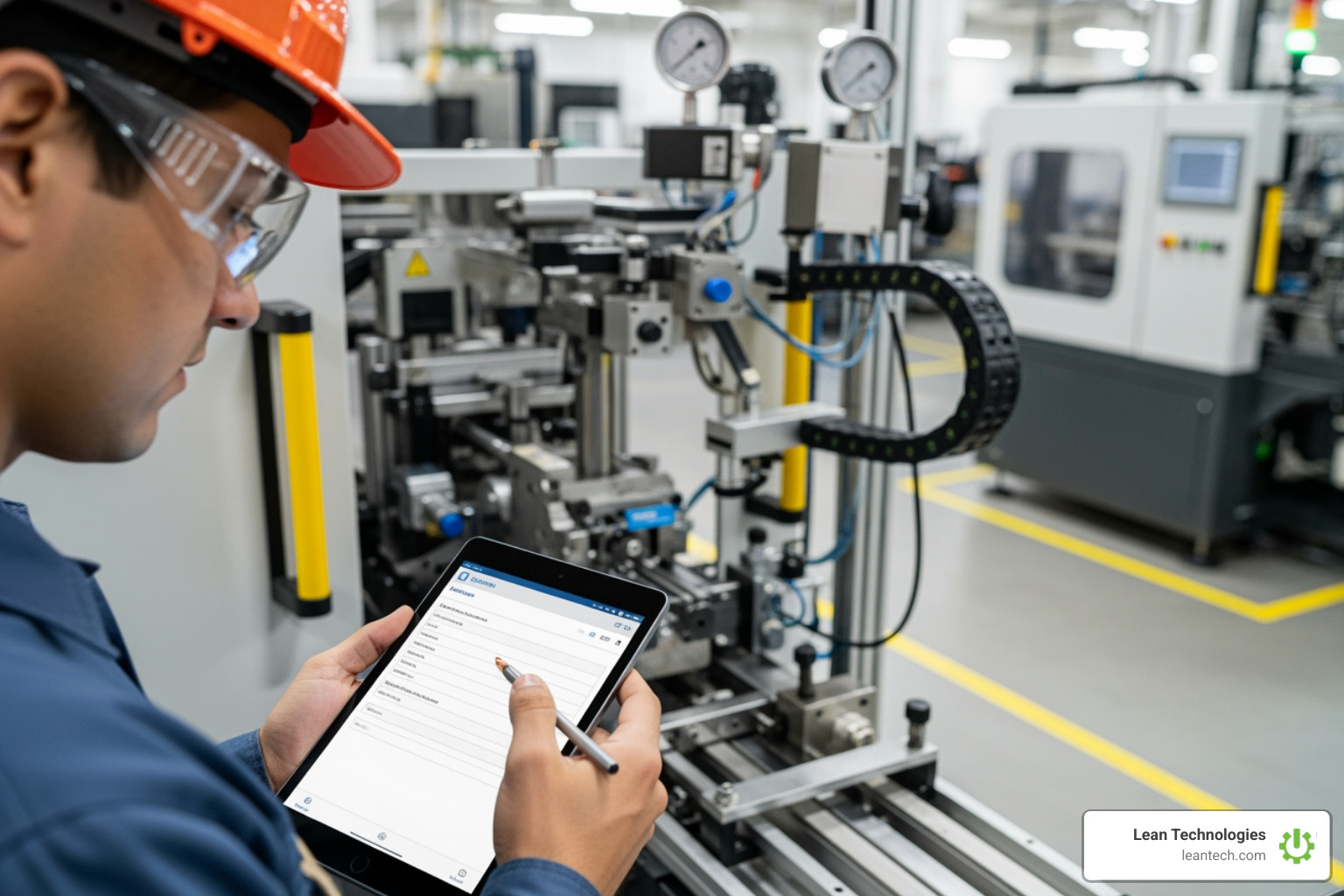
Equipment Evaluation and Data Collection: You can't manage what you don't measure. Start by creating a master equipment list and ranking assets by criticality. Use real-time data to understand which machines are your biggest bottlenecks. If you don't know which machine is costing you the most in downtime, you're just throwing darts in the dark.
Restoration of Deterioration: You can't maintain a machine that is already "broken." This phase involves "cleaning to inspect"—bringing equipment back to its original "as-new" condition. This is often the most labor-intensive phase, but it's non-negotiable for long-term reliability.
Information Management Systems: Move away from paper. If your maintenance logs are captured on paper and entered into a spreadsheet at the end of the week, your data is "real-late." Implement a digital system to track failure history, repair costs, and technical data in real-time. This is where digital lean manufacturing becomes your competitive advantage.
Periodic Maintenance System: Establish clear schedules for lubrication, inspections, and parts replacement. Define who does what and when. This phase focuses on preventing the "forced deterioration" caused by neglect or improper use.
Predictive Maintenance System: Introduce diagnostic technologies. Start small with high-criticality assets where sensors or manual condition checks can provide early warnings. The goal here is to move from "guessing" to "knowing" exactly when a component needs attention.
System Evaluation: Regularly audit the maintenance system. Are breakdowns decreasing? Is the cost per asset going down? Continuous improvement (Kaizen) never stops. You need to look at your MTBF and MTTR trends monthly to ensure the system is actually delivering the ROI you expected.
By moving through these phases, you build a foundation of data and discipline. You stop reacting to the loudest problem and start managing the most important ones.
Measuring Success: KPIs for Proactive Teams
If you want to stop the shop floor drama, you need to track the right numbers. World-class manufacturers don't guess; they use data to drive accountability. Without clear KPIs, your maintenance team will always be seen as a "cost center" rather than a value driver.
Mean Time Between Failures (MTBF): This measures reliability. You want this number to go up. It tells you how long, on average, a machine runs before it hits a snag. A rising MTBF is the ultimate proof that your planned maintenance TPM strategy is working.
Mean Time To Repair (MTTR): This measures maintainability. You want this number to go down. It tells you how quickly your team can get a machine back up after a stop. High MTTR often points to poor training, lack of spare parts, or disorganized tool stations.
Overall Equipment Effectiveness (OEE): The gold standard. It combines Availability, Performance, and Quality. While 60% is typical for many plants, TPM aim for 85% or higher. OEE is the single best metric for aligning production and maintenance goals.
Planned Maintenance Percentage (PMP): This tracks the ratio of planned work to total work. If your team is spending 60% of their time on emergency repairs, you don't have a maintenance plan; you have a firefighting squad.
Integrating Autonomous and Planned Maintenance TPM
Planned maintenance cannot succeed in a silo. It must be paired with Autonomous Maintenance (Jishu Hozen). This is where operators take ownership of basic tasks like cleaning, lubrication, and initial inspections.
When operators own the "daily care," it frees up skilled maintenance technicians to focus on the technical "Phase 4 and 5" tasks. This cross-functional approach elevates the skill level of the entire team and ensures that safety and compliance are baked into every shift. It shifts the mindset from "that's not my job" to "this is our machine."
Avoiding Common Pitfalls in Shop Floor Maintenance
Even the best-laid plans can fail if the foundation is shaky. Most TPM initiatives don't fail because the theory is wrong; they fail because the execution is inconsistent. Here are the most common traps:
Data Scarcity and "The Paper Trap": If you're relying on memory or end-of-week spreadsheets, your data is "real-late." Decisions based on bad data lead to over-maintenance (wasting money) or under-maintenance (causing breakdowns). Real-time visibility is the only way to drive true accountability.
Neglecting the 5S Foundation: You cannot have planned maintenance TPM in a filthy, disorganized shop. 5S (Sort, Set in Order, Shine, Standardize, Sustain) is a prerequisite. If a technician spends 20 minutes looking for a wrench, the "plan" is already failing. A clean machine also makes it much easier to spot leaks or cracks before they cause a failure.
Over-Maintenance Bias: Sometimes maintenance teams "over-service" equipment to feel safe. This drives up costs and takes machines out of production unnecessarily. Use Root Cause Analysis (RCA) to ensure you are doing the right maintenance, not just more maintenance. If a part is still in perfect condition at the scheduled replacement interval, investigate why.
Lack of Stakeholder Alignment: If production managers are incentivized only by "units out the door," they will fight maintenance schedules. Everyone must agree that a two-hour planned stop today is better than a two-day unplanned breakdown next week. This requires a culture shift where uptime is valued over short-term output.
IT vs. Manufacturing Misalignment: Often, maintenance software is chosen by IT because it fits the ERP, not because it helps the guy on the floor. If the software is too hard to use, the team will go back to paper, and your visibility will vanish. Choose tools built for the shop floor, not the back office.
Frequently Asked Questions about Planned Maintenance
What is the difference between planned and preventive maintenance?
Planned maintenance is the overarching strategy and system that includes scheduling, resource allocation, and data analysis. Preventive maintenance is a specific type of task within that system (like changing a filter every month). You can have a preventive task that isn't "planned" well (e.g., you have the task but no parts in stock), but you can't have effective planned maintenance TPM without preventive actions.
How do you calculate Planned Maintenance Percentage (PMP)?
The formula is: (Planned Maintenance Hours / Total Maintenance Hours) x 100. If your team worked 100 hours this week and 80 of those were on scheduled tasks while 20 were on emergency repairs, your PMP is 80%. World-class organizations aim for 85% to 95%. If your PMP is below 50%, you are in a reactive cycle that is costing you a fortune.
Why is OEE the gold standard for TPM success?
OEE doesn't let you hide. If your machines are running but producing scrap, your OEE drops. If they are running perfectly but at half speed, your OEE drops. It provides a single, honest metric that shows exactly how much "perfect production" you are actually achieving. It forces maintenance and production to work together toward the same goal.
How long does it take to see results from a TPM program?
While some "quick wins" like 5S and basic cleaning can show immediate results in morale and safety, a full planned maintenance TPM rollout typically takes 6 to 12 months to show significant impact on MTBF and OEE. It is a marathon, not a sprint, requiring consistent leadership support and operator buy-in.
Drive Action with Better Visibility
Stop managing your shop floor through spreadsheets and wishful thinking. The drama of unplanned breakdowns is a choice-a choice to remain reactive. When the work is tracked on paper and typed in later, there is no real-time truth. There is only guesswork, and guesswork is how reactive maintenance wins.
If the goal is world-class planned maintenance tpm, the missing ingredient is usually not effort. It is visibility + follow-through:
The team needs one place to log downtime, defects, and maintenance issues at the source.
Supervisors need a clean way to assign actions, set due dates, and see what is stuck.
CI leaders need history they can trust for RCA and PM optimization.
At Lean Technologies, Thrive is built to do exactly that. Thrive is not an ERP or MES. It is a customizable shop floor platform built by manufacturing people to help operators, maintenance, and leaders run structured processes in real time.
Thrive also does not replace predictive systems or collect sensor data by itself. Instead, it organizes and drives action from the data the team enters (or imports from other systems), right when the problem happens. That is how accountability gets real.
Real-time visibility means the team knows which assets are failing, what the failure modes look like, and whether the fix actually stuck. That is how planned work starts to beat emergency work. And that is how planned maintenance tpm stops being a poster and starts being the way the plant runs.
Want faster problem-solving? It starts with better visibility. Stop the shop floor drama and let the team run lean.
Internal linking opportunities:
Link to the Thrive product page on leantech.com
Link to a maintenance workflows or CMMS-lite overview page (if available)
Link to a downtime tracking or OEE reporting page (if available)