
A Comprehensive Guide to Preventive Maintenance in 2026
Tired of Chasing Breakdowns? Here's Why Preventive Maintenance Matters
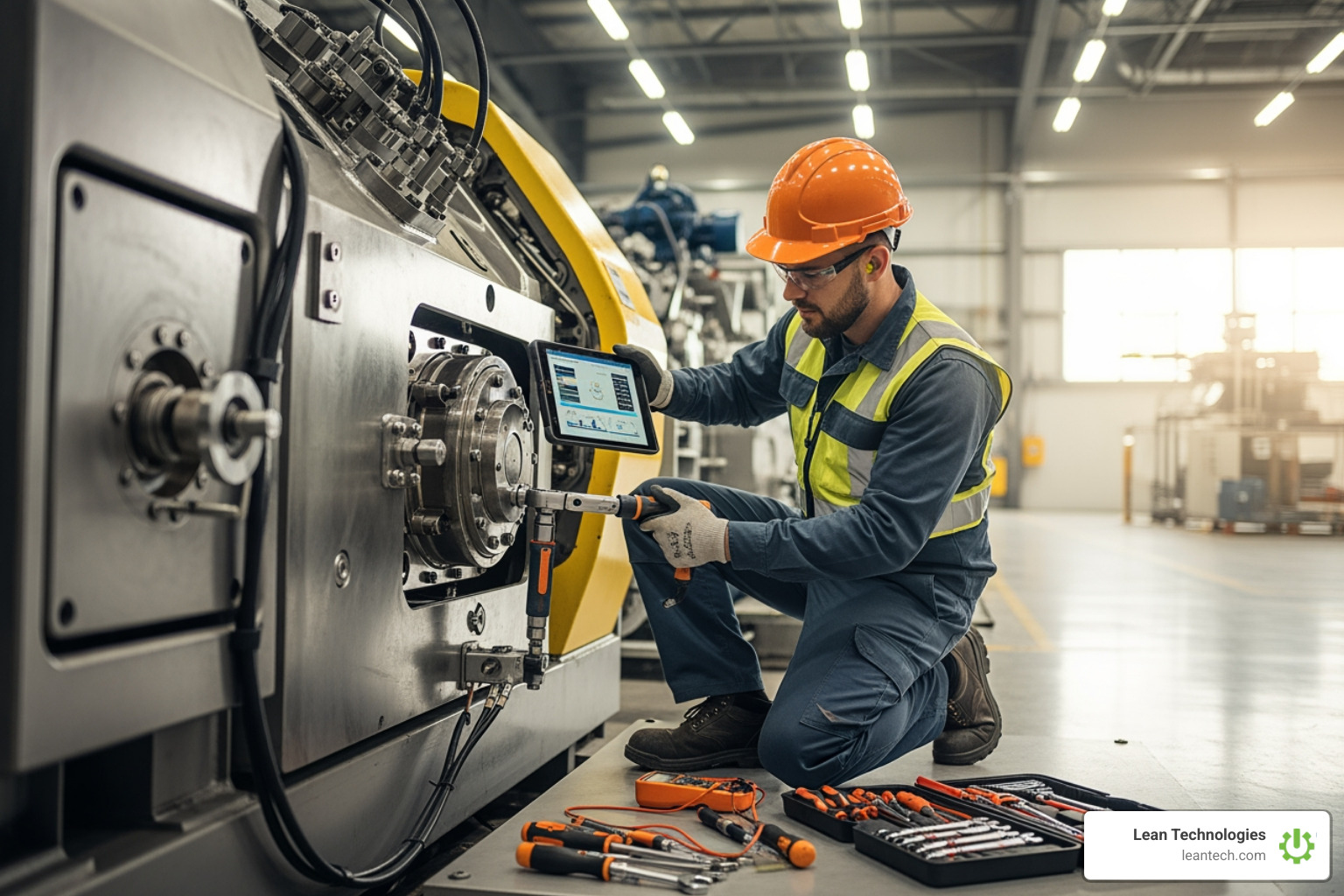
Preventive maintenance is the practice of regularly servicing equipment on a planned schedule to prevent unexpected failures and breakdowns. Instead of waiting for machines to fail, teams perform routine inspections, cleaning, lubrication, and parts replacements to keep assets running smoothly. The goal: control the chaos before it controls you.
Quick Overview:
What it is: Scheduled maintenance tasks performed before equipment fails
Why it matters: Reduces downtime, cuts repair costs, improves safety
How it works: Time-based schedules, usage triggers, or condition checks
Who benefits: Operations managers, maintenance teams, operators
Result: More uptime, fewer surprises, predictable production
Unplanned downtime doesn't just cost money—it kills momentum. Your team scrambles for parts. Operators stand idle. Production targets slip. Safety risks spike. If you're always in firefighting mode, you know the drill.
Here's the reality: only 11% of equipment failures are age-related. That means 89% of breakdowns happen randomly or because of external factors you can see coming—if you're looking. Preventive maintenance flips the script. It shifts your team from reactive chaos to proactive control.
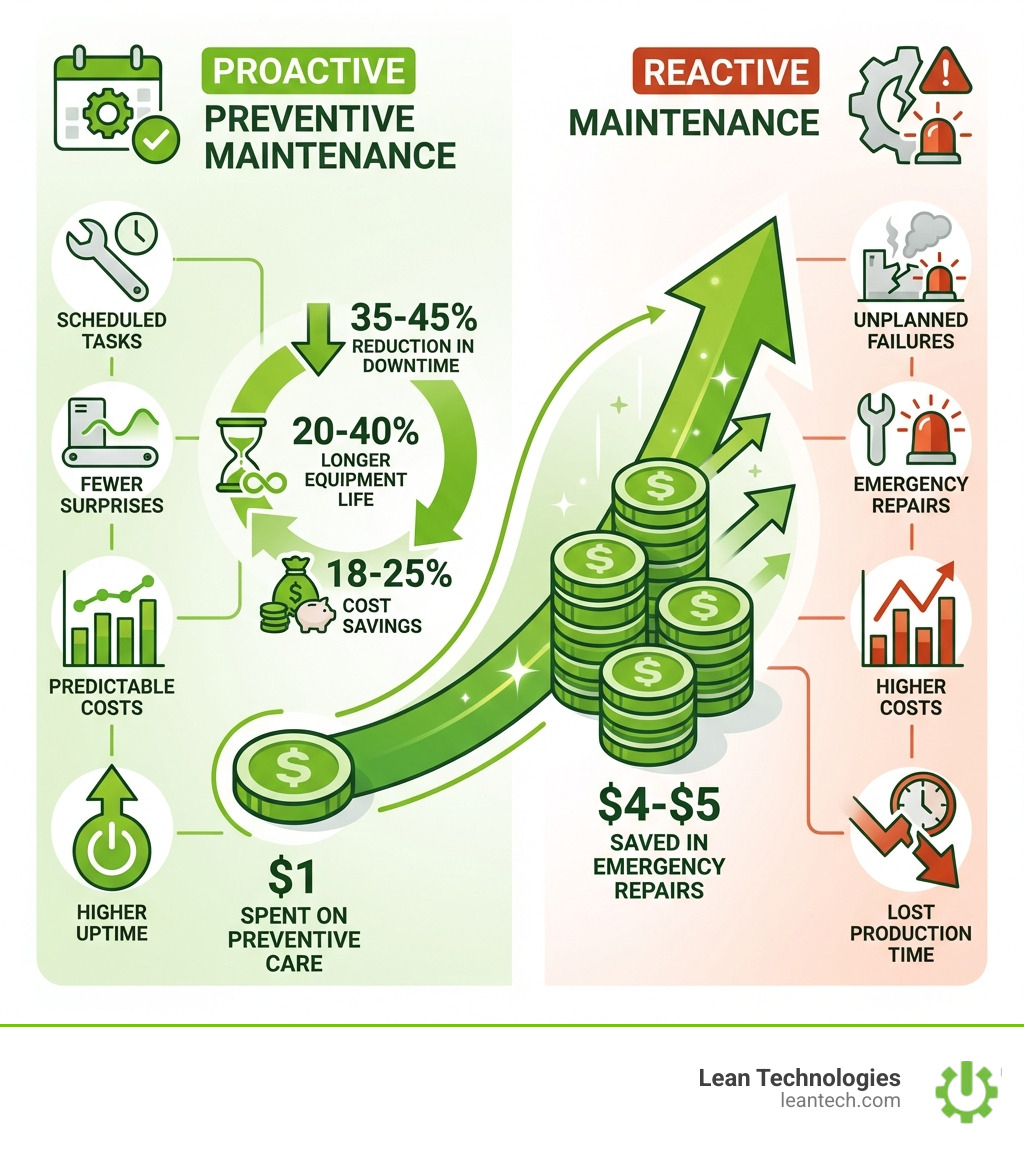
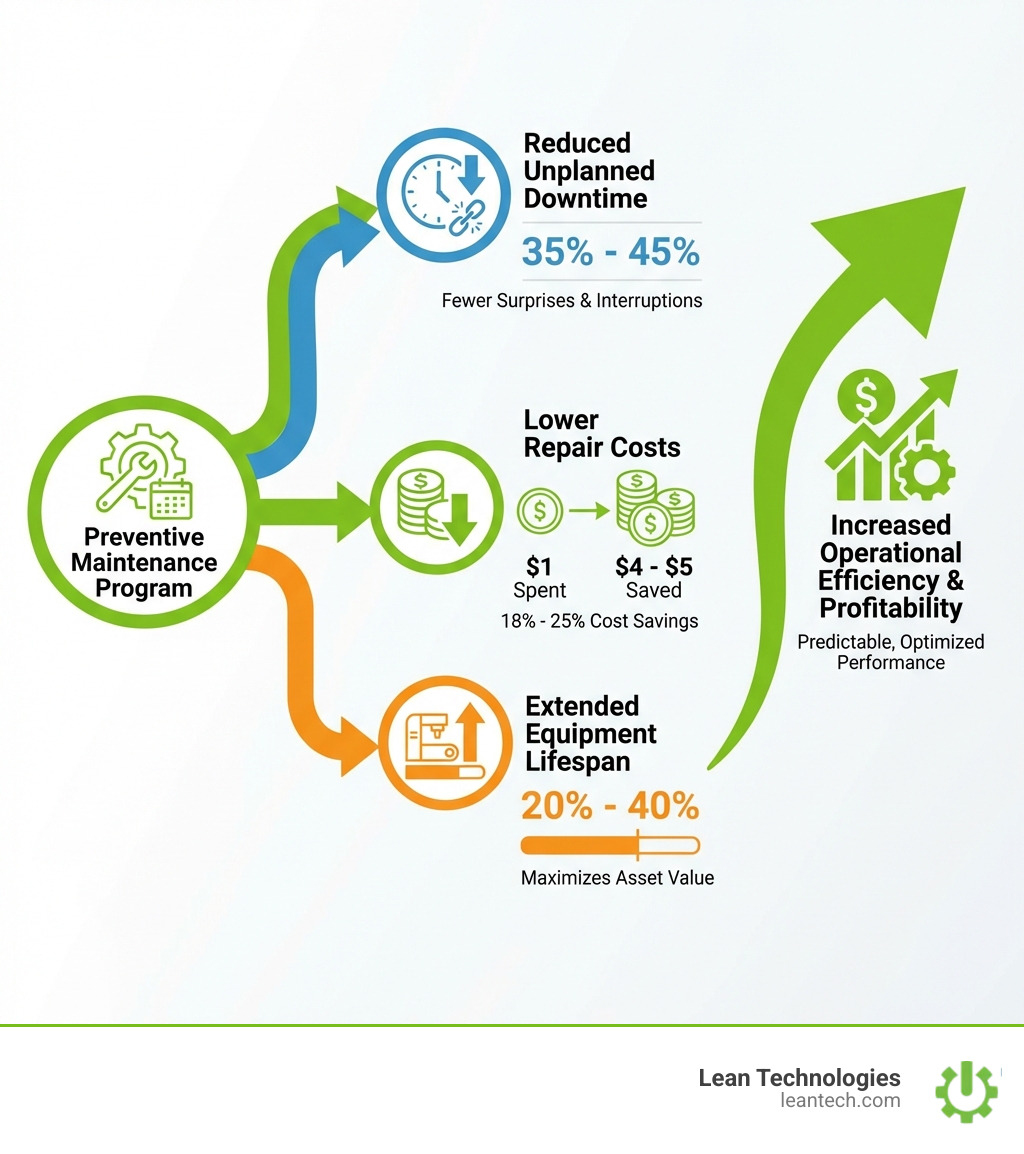
The numbers back it up. Every dollar spent on preventive care saves $4 to $5 in deferred failure or emergency repair costs. Companies that lean into preventive and predictive strategies see 18% to 25% cost savings and cut unplanned downtime by 35% to 45%. Manufacturers who get this right extend equipment life by 20% to 40%—and that's not even counting the safety wins.
But here's the catch: preventive maintenance only works if it's actually happening. If your team logs work on paper at the end of a shift, or updates spreadsheets once a week, you're already too late. Real-time beats real-late. When PMs are tracked digitally—at the machine, as they happen—you get visibility, accountability, and the ability to adjust before small issues become big problems.
This guide breaks down everything you need to know: the types of maintenance, how to build a program that fits your shop, the metrics that matter, and the pitfalls to avoid. Whether you're starting from scratch or fixing a broken system, you'll walk away with a clear path from chaos to control.
From Firefighting to Control: Preventive vs. Reactive Maintenance
The core difference between preventive maintenance and reactive maintenance boils down to one thing: timing. Reactive maintenance is the "run-it-till-it-breaks" approach. Something fails, and then your team scrambles to fix it. This creates a culture of chaos, where every day is a surprise.
Think about it like this: your car. If you ignore oil changes and tire rotations, you're eventually going to be stranded on the side of the road, facing a massive, unplanned repair bill. That's reactive maintenance in action. The costs of these unplanned events are always higher. Emergency repairs often mean expedited shipping for parts, overtime pay for technicians, and the crushing expense of lost production. Manufacturers, for instance, can face downtime costs of up to $125,000 per hour.
Preventive maintenance, on the other hand, is all about control. It's planned, scheduled work performed before a failure occurs. This proactive approach allows you to anticipate equipment issues and take corrective action on your terms, not the machine's. This leads to a more predictable production schedule, better resource allocation, and a calmer shop floor.
The impact isn't just financial. Reactive maintenance can lead to significant safety and environmental risks. Consider the Deepwater Horizon disaster, a catastrophic event where critical maintenance could have prevented immense loss of life and environmental damage. By shifting to a preventive mindset, you're not just saving money; you're safeguarding your team and your operations.
The Business Case: Why a PM Program Pays Off
Implementing a robust preventive maintenance program isn't just about ticking boxes; it's a strategic investment that delivers tangible returns. For operations managers, maintenance teams, and even the C-suite, the benefits are clear:
Lower repair costs over time: Research shows that for every dollar spent on preventive care, you can save $4 to $5 in deferred failure or rehabilitation costs. McKinsey & Company found that proactive strategies can lead to 18% to 25% cost savings. This means fewer five-figure invoices for surprise breakdowns, like that $15,000 HVAC repair.
Fewer safety incidents: When equipment is routinely inspected and maintained, potential hazards are identified and addressed before they can cause harm. Poorly maintained machinery can lead to dangerous situations, from gas buildup in ventilation systems to slip-and-fall hazards from leaks. OSHA even requires companies to have some form of preventive maintenance in place.
Longer equipment life: Regular upkeep—lubrication, cleaning, adjustments, and timely part replacements—reduces wear and tear, extending the useful lifespan of your assets by 20% to 40%. This defers costly capital expenditures and maximizes your existing investments.
More predictable production: Unplanned downtime is a killer for production schedules. Organizations relying on preventive maintenance see 52.7% less unplanned downtime compared to their reactive peers. This translates to smoother operations, consistent output, and happier customers.
Better resource planning: A well-designed preventive maintenance program aligns labor, inventory, and scheduling to minimize unplanned failures. You know what needs to be done, when, and what parts you'll need. This means less frantic scrambling and more efficient use of your team's time.
When you shift from seeing maintenance as a cost center to a lever for growth, you protect margins and boost productivity.
Types of Maintenance: Which One Fits Your Shop?
Not all preventive maintenance is created equal. There are different approaches, and the best strategy for your shop depends on your assets, their criticality, and your team's capabilities. The goal is always the same: keep things running, but the how varies.
Calendar and Usage-Based Maintenance: The Basics
These are the most common and foundational types of preventive maintenance:
Time-based Maintenance (TBM): This is maintenance scheduled at fixed, predetermined intervals, regardless of actual equipment usage. Think changing the air filters in your HVAC system every three months, or performing a general inspection every Monday morning. It's simple to schedule and ensures routine checks happen.
Usage-based Maintenance (UBM): This approach triggers maintenance tasks based on how much an asset has been used. This could be based on operating hours, cycles completed, miles driven, or units produced. For example, scheduling an oil change for a forklift every 200 operating hours, or servicing fleet vehicles every 5,000 miles. This method often aligns better with actual wear and tear than pure time-based schedules.
For both TBM and UBM, a great starting point is always the Original Equipment Manufacturer (OEM) recommendations. Their manuals provide baseline guidelines for maintenance tasks and frequencies. However, remember these are just starting points. Your specific operating conditions, environment, and historical data should inform how you adjust these schedules over time.
Condition-Based and Data-Driven Maintenance: Getting Smarter
As you mature your preventive maintenance program, you can move beyond fixed schedules to more intelligent approaches:
Condition-based Maintenance (CBM): This type of maintenance is triggered by observations from inspections or simple checks that indicate a change in an asset's condition. Instead of servicing an asset whether it needs it or not, CBM involves regular monitoring to detect early signs of potential failure. This could include visual inspections, listening for unusual noises, checking fluid levels, or noting temperature fluctuations. When an operator observes an anomaly and logs it, that's the trigger for a maintenance task.
Data-driven Maintenance: This is where you leverage the information you're already collecting. By systematically logging all maintenance activities, inspection results, and operator observations into a digital system, you build a rich history. This data allows you to spot trends, identify recurring issues, and understand failure patterns. For instance, if operator logs consistently show a specific machine running hot before a breakdown, you can adjust your PM schedule to include more frequent temperature checks or lubrication.
The beauty of CBM and data-driven approaches is that they lead to smarter scheduling. You're doing maintenance only when necessary, preventing both under-maintenance (leading to breakdowns) and over-maintenance (wasting time and resources). This means less downtime and more value from every preventive maintenance task.
Thrive is not about collecting sensor data or running predictive machine alerts. Instead, it organizes and drives action from machine data if it’s entered by the team or imported from other systems. This means your operators and technicians can log observations from their condition checks directly into Thrive, building that crucial data history that informs your smarter scheduling.
Type of Maintenance Trigger Cost (relative) Best For Time-based Calendar (e.g., monthly, quarterly) Low Routine tasks, regulatory compliance, non-critical assets where failure isn't catastrophic. Usage-based Usage (e.g., hours, cycles, mileage) Medium Assets with wear directly related to operation, like vehicles or machinery with clear cycle counts. Condition-based Observed condition (e.g., visual inspection) Medium Critical assets where early detection of degradation is important, but advanced sensors are not feasible or necessary. Data-driven Analysis of logged operator input & historical data Medium Optimizing PM schedules, identifying recurring issues, leveraging existing operational data for smarter decisions.
How to Build a Preventive Maintenance Program That Actually Works
Starting a preventive maintenance program can feel like a huge undertaking, especially if you're drowning in reactive work. But it doesn't have to be. The key is a structured approach, starting small, and leveraging the right tools.
Step 1: Identify and Prioritize Your Assets
You can't maintain what you don't know you have. The first step is to create a comprehensive asset inventory. This isn't just a list; it's a detailed record for every piece of equipment, including its location, manufacturer, model, serial number, and any past maintenance history.
Once you know what you have, you need to prioritize your assets. Not everything needs the same level of preventive maintenance. Ask yourself: What stops production if it fails? What poses a safety risk? What's expensive to repair or replace?
A simple way to prioritize is using a Risk Priority Number (RPN). You can calculate RPN by multiplying Severity x Occurrence x Detection for each potential failure. This helps you focus your efforts where they'll have the biggest impact, ensuring your most critical equipment gets the attention it needs. Thrive can help you maintain this asset inventory, logging details and history.
Step 2: Build PM Checklists and Schedules
With your assets identified and prioritized, it's time to define the "what" and "when" of your preventive maintenance.
Task Lists: For each critical asset, develop clear, step-by-step task lists. What needs to be done? How? What tools or parts are required? Examples include inspecting air filters, checking fluid levels, lubricating moving parts, or tightening connections. Make sure these instructions are specific enough that any trained technician can follow them consistently.
Frequencies: Determine how often each task should be performed. Start with those OEM recommendations, but then adjust based on your asset's criticality, usage, and environmental conditions. Is it running 24/7 in a harsh environment? It probably needs more frequent attention than a backup machine.
Documentation: Keep it simple, keep it digital. Ditch the paper forms that get lost or are hard to read. Digital checklists and work orders ensure consistency and provide a clear record.
Templates: Create templates for common PM tasks and schedules. Thrive lets you standardize and share these PM schedules and digital checklists across your team, ensuring everyone is on the same page.
Step 3: Make Technology Your Ally
This is where your preventive maintenance program really takes off. Relying on paper or spreadsheets for maintenance scheduling and tracking is a recipe for missed tasks and lost data.
Digital Work Orders: With Thrive, you can create and assign work orders digitally. No more lost paperwork, illegible notes, or delays in getting tasks to technicians. This streamlines the entire process, from assignment to completion.
Asset History: Every completed work order, every inspection, every part replacement builds a comprehensive digital history for each asset in Thrive. This centralized record is invaluable for troubleshooting, making informed decisions about repair vs. replacement, and proving compliance.
Scheduling Automation: Thrive can automate the generation of recurring PM tasks. Set it once, and the system reminds your team when maintenance is due, ensuring you never miss a scheduled PM.
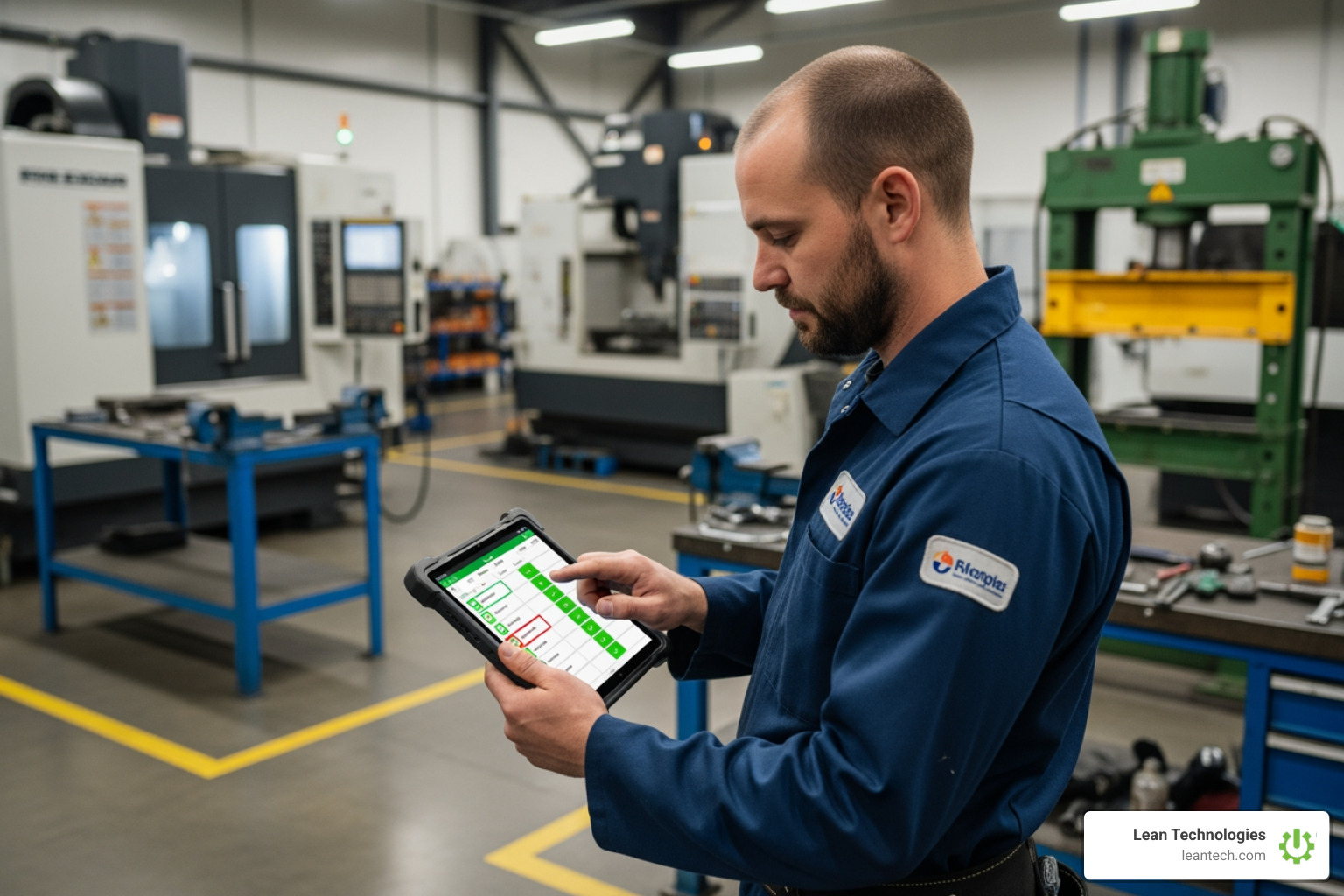
Mobile Access: Your technicians are on the shop floor, not at a desk. Thrive offers mobile access, allowing them to log work orders, check off tasks, and add notes directly at the machine, in real time. This improves data accuracy and makes their job easier.
Inventory Management: While Thrive doesn't manage MRO inventory directly, it helps you understand what parts you've used for specific PMs, which can inform your inventory planning. You know what's needed for upcoming tasks, helping you avoid delays due to missing parts.
By making technology your ally, you transform your preventive maintenance from a burden into a powerful, real-time tool for operational excellence.
Measuring Success and Avoiding Common Pitfalls
Building a preventive maintenance program is just the start. To truly get value, you need to measure its effectiveness and actively avoid common traps. Without clear metrics, you're just doing maintenance for maintenance's sake.
Key Metrics to Track Your PM Program
If you can't measure it, you can't improve it. Here are the preventive maintenance KPIs that matter:
Planned Maintenance Percentage (PMP): This tells you how much of your total maintenance work is planned versus reactive. A higher PMP indicates a more proactive, controlled operation. Aim for a high percentage here, as it shows you're ahead of breakdowns.
Mean Time Between Failures (MTBF): This is the average time an asset operates before it fails. An increasing MTBF shows your preventive maintenance is extending asset reliability and reducing unexpected breakdowns.
Asset Uptime: This measures the percentage of time your equipment is available and operational. PM aims to maximize uptime, keeping your production lines running smoothly.
Maintenance Backlog: This metric tracks the volume of uncompleted maintenance work. A growing backlog can indicate resource shortages or inefficient scheduling, putting you at risk for future failures.
Schedule Compliance: How often are your scheduled preventive maintenance tasks completed on time? High compliance means your program is being executed effectively.
Thrive helps you track the data needed for these KPIs. When work orders are completed and logged in real-time, you have the raw numbers to calculate these metrics and understand your program's impact.
Common Pitfalls (and How to Dodge Them)
Even with the best intentions, preventive maintenance programs can stumble. Here's how to avoid the most common pitfalls:
Over-maintenance: This is doing too much PM, too often. Only 11% of failures are age-related, so replacing parts simply because a calendar says so can be wasteful and even cause new problems (sometimes called "iatrogenic maintenance"). Use your data to optimize frequencies.
Budget Battles: Maintenance is often seen as a cost center. Use your KPIs and cost savings data (like the $4-$5 saved per $1 spent) to prove the value and ROI of your preventive maintenance program to leadership.
Team Resistance: Technicians might resist new processes if they don't see the benefit. Get their buy-in by involving them in program design, making the new digital tools easy to use, and showing how PM makes their jobs less stressful and more effective.
Training: Don't assume everyone knows the "why" and "how." Provide clear training on new procedures, digital tools, and the overall goals of the preventive maintenance program.
Data Quality: If the data going into your system is incomplete or inaccurate, your insights will be flawed. This is why real-time beats real-late. Ensure operators and technicians can easily and accurately log information at the source, as it happens, using mobile tools like Thrive. If data is captured on paper and entered hours or days later, it's already too late for effective analysis.
Frequently Asked Questions about Preventive Maintenance
What’s the difference between preventive and preventative maintenance?
Good news: there is no difference! Both terms refer to the same concept of proactive, scheduled maintenance to prevent equipment failures. While "preventative" is often used colloquially, "preventive" is the preferred and more common term in industrial maintenance literature.
Is replacing parts on a schedule wasteful?
Not necessarily, but it can be if not done strategically. If a part's failure mode is strongly age-related (e.g., a filter that degrades over time), then scheduled replacement makes sense. However, if failures are random or condition-dependent, replacing parts strictly by the calendar can lead to over-maintenance, wasting money and potentially introducing new issues. The key is to use data from your asset history and condition checks to optimize replacement intervals, rather than blindly following arbitrary schedules. Start with OEM guidelines and adjust based on your real-world experience.
How do I get started if I have a small team and budget?
Start simple and focused. You don't need expensive sensors or complex software to begin.
Prioritize: Identify your 2-3 most critical assets—the ones that would shut down your operation if they failed.
Define: For those assets, determine the most important preventive maintenance tasks (e.g., lubrication, visual inspection).
Schedule: Set up a simple time-based or usage-based schedule for those tasks.
Digitize: Use a flexible digital tool like Thrive to create simple checklists and work orders. This ensures tasks are tracked, and you build a valuable history for each asset without needing a massive budget or IT overhaul. Thrive is designed to help small to midsize manufacturers digitize lean work processes in real time without replacing existing ERPs or MES systems.
What to Do Next: Move from Chaos to Control
Unplanned breakdowns are a productivity killer. They chew up budget, frustrate your team, and jeopardize your production goals. Implementing a strategic preventive maintenance program is the fastest way to move your shop floor from reactive chaos to proactive control.
By digitizing your processes with a platform like Thrive, you empower your team to log issues and track actions in real time. This means no more lost paperwork, no more outdated spreadsheets, and no more guessing games about asset health. You get the real-time visibility you need to make informed decisions, optimize schedules, and keep your machines—and your business—running smoothly.
Stop letting breakdowns run your day. Preventive maintenance, tracked in real time, is the fastest way to cut downtime, boost safety, and keep your team focused on what matters.
Ready to ditch the spreadsheets and get real-time visibility? Let your team run lean—with fewer surprises and more control. Learn more about building a world-class maintenance program with Thrive.
Internal Linking Suggestions:
Link to Thrive’s Continuous Improvement page for more on driving shop floor accountability
Link to Production Tracking for real-time performance insights
Link to Safety Management for integrating PM with safety processes