
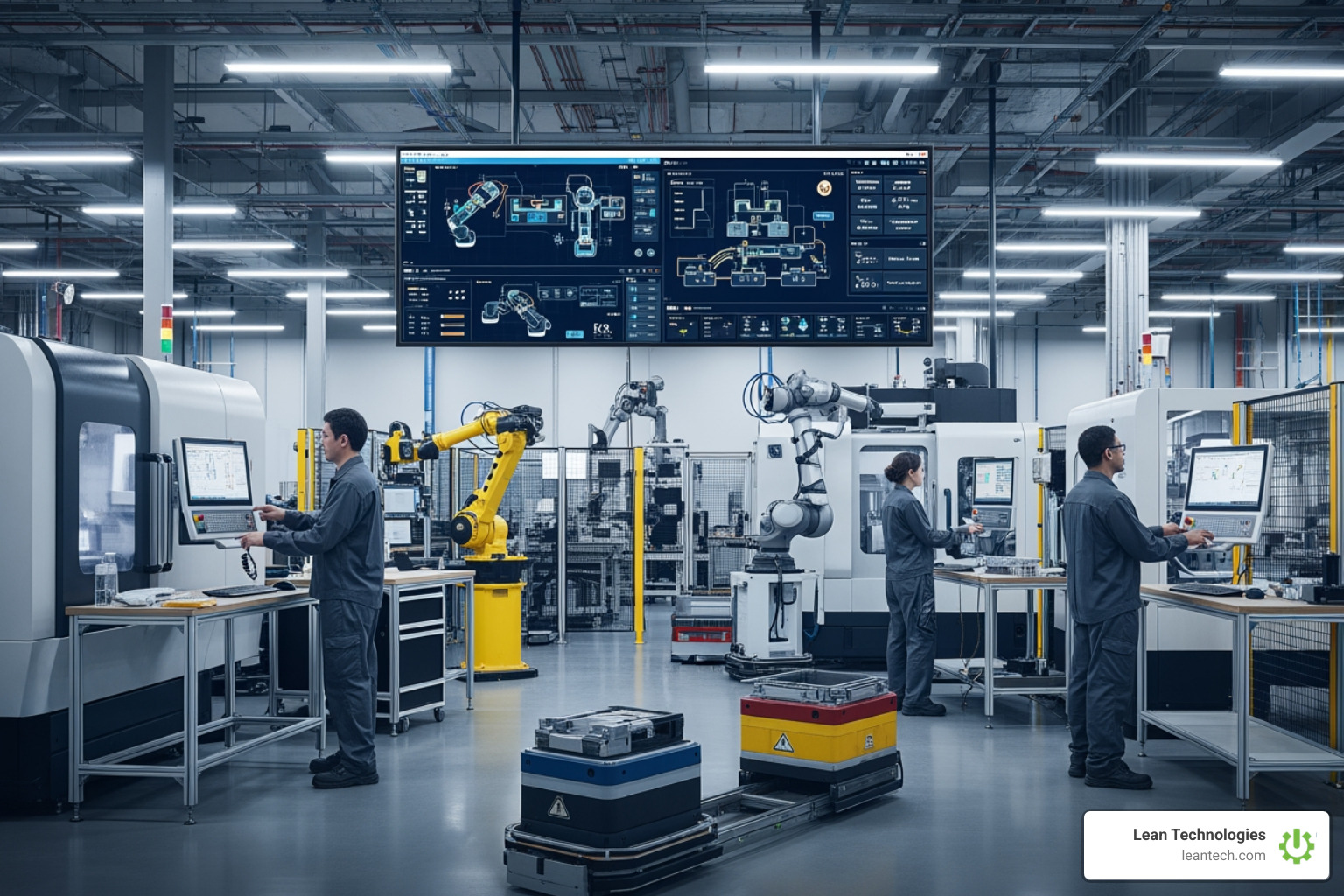
The Ultimate Guide to Real-Time Production Visibility
Why Real-Time Production Visibility Matters More Than Ever
Production efficiency software is a digital platform that helps manufacturing teams track, analyze, and improve shop floor performance in real time. These tools enable operators and supervisors to log downtime, monitor output, calculate OEE (Overall Equipment Effectiveness), and identify bottlenecks, without replacing an ERP or MES.
Key capabilities of production efficiency software:
Real-time visibility into machine status, cycle times, and output
Automated OEE tracking (Availability x Performance x Quality)
Downtime logging with root cause analysis
Mobile accessibility for operators and supervisors
Pareto analysis to prioritize improvement efforts
Integration with existing systems via CSV import, API, or manual entry
Most shop floors are still managed with spreadsheets, whiteboards, and memory. By the time yesterday's downtime numbers show up, the shift that caused them is already gone. People are working hard, but nobody can see where the time is leaking until it is too late.
That is the difference between real-time and real-late.
When data gets captured at the end of the shift, or worse, at the end of the week, it is already history. It is tough to fix what cannot be seen. And it is impossible to improve what is not being measured right now.
Production efficiency software changes that. It gives instant visibility into what is happening on the floor, so teams can respond while problems are still happening, not after they already cost time, money, and capacity.
According to industry data from the National Association of Manufacturers, manufacturers often lose capacity to everyday inefficiencies like late starts, long changeovers, or idle machines, without realizing the true impact.
The best part is speed. This does not require replacing an ERP or MES. It does not require a long implementation. Modern tools are lightweight, fast to deploy, and designed to work with existing processes.
Real-time visibility is not a luxury anymore. It is a practical way to create structured, accountable work processes that actually move the needle.
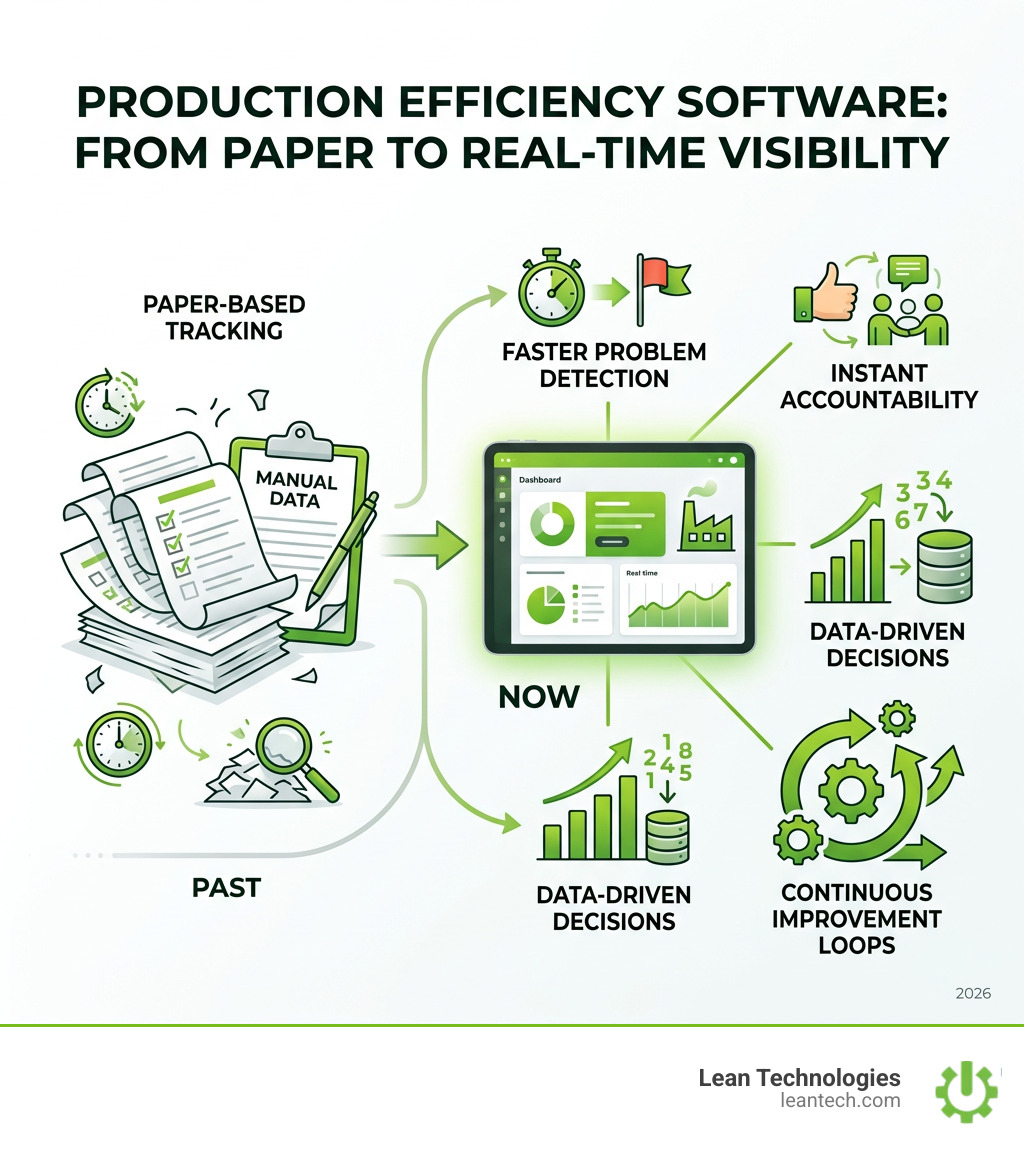
Why Real-Time Production Efficiency Software Changes the Game
If you are an operations manager, you know the frustration of "the morning meeting." You're looking at a report from yesterday that says Line 4 was down for two hours. You ask why. The supervisor shrugs; the operator who was there is now asleep at home. You’ve lost the opportunity to fix the root cause.
Production efficiency software eliminates this "data lag." By providing instant visibility, it allows teams to see exactly what is happening as it happens. This isn't just about watching numbers; it's about shop floor agility. When an issue is logged immediately, the maintenance team can respond faster, reducing the duration of unplanned downtime.
Furthermore, this software helps you maximize capacity utilization. Many plants believe they need to buy a new machine to increase output. In reality, they often have "hidden factories"—pockets of wasted time due to slow starts or micro-stops. By tracking these in real-time, you can produce more with the resources you already have. This is a core pillar of digital lean manufacturing, where technology is used to make waste obvious so it can be eliminated.
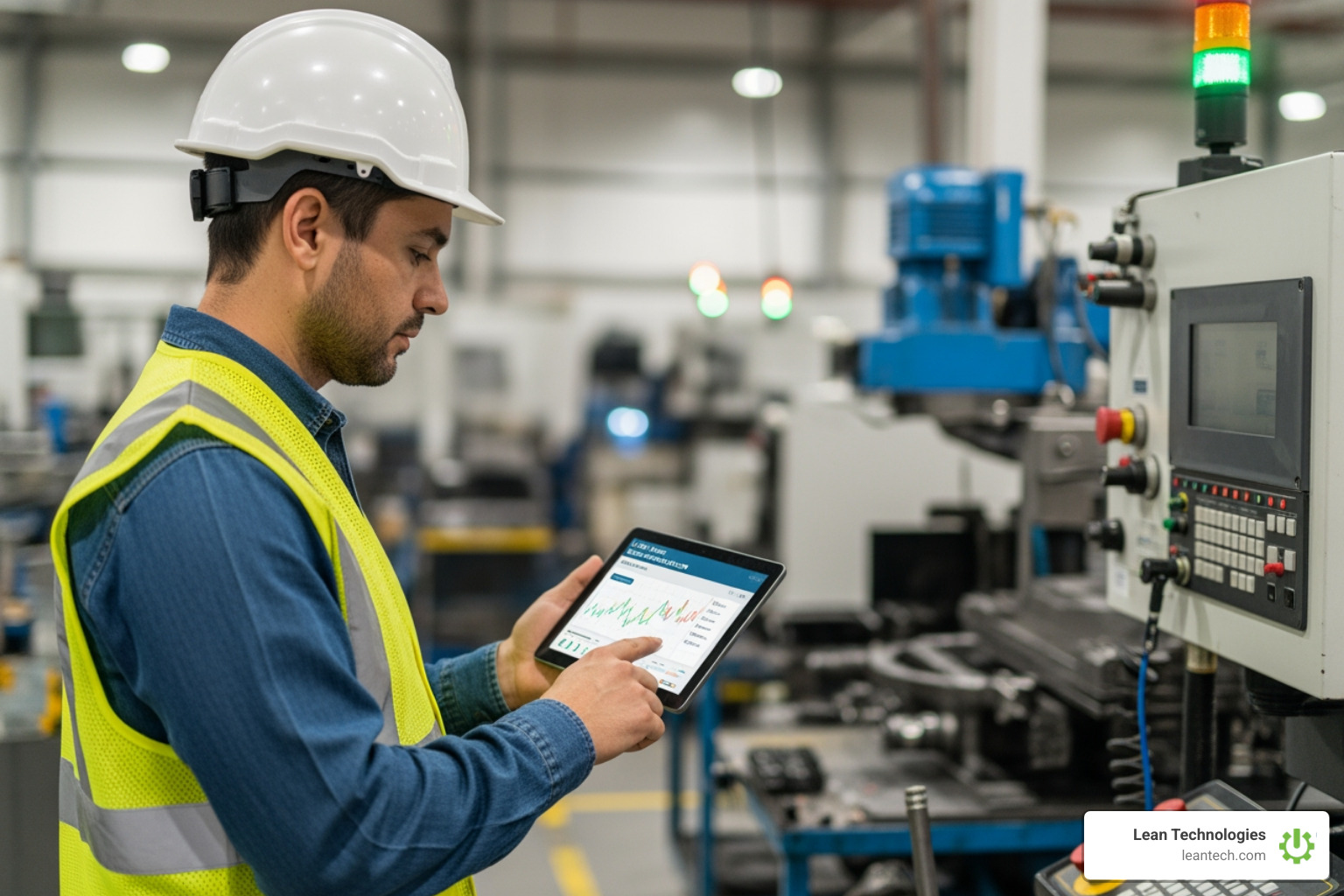
How to Calculate and Automate Production Metrics
To improve efficiency, it has to be defined. In manufacturing, a common baseline calculation is straightforward:
Production Efficiency (%) = (Actual Produced Quantity / Planned Production Quantity) x 100
The math is simple. The hard part is getting clean numbers without the chaos. With manual logs, "Actual Produced Quantity" is often a best guess written on paper at the end of the shift. Production efficiency software tightens this up by letting operators enter data at the source (tablet, mobile, or desktop), so production, downtime, and counts are captured while the work is happening.
Identifying the Bottleneck
Every plant has a bottleneck, the one machine or process that sets the pace for the whole operation. If the bottleneck stops, the schedule slips and expediting starts.
Software helps reveal the constraint by comparing actual output vs. standard output across work centers, shifts, and products. Instead of debating what happened, the team can see where the gap is and how often it repeats.
Feature Manual Spreadsheets Digital Tracking (Thrive) Data Accuracy High risk of "fat-finger" errors Validated at point of entry Timeliness End of shift/week (Real-late) Instant (Real-time) Accountability Hard to track who did what Clear digital audit trail Visibility Buried in a file on one PC Dashboards accessible anywhere
The Gold Standard: OEE
One of the most useful metrics for a production team is OEE (Overall Equipment Effectiveness). It shows how well equipment performed compared to its potential during scheduled time.
Availability: Was the machine running when it was supposed to be running?
Performance: Did it run at the expected speed?
Quality: Did it produce good parts?
OEE = Availability x Performance x Quality
By automating OEE tracking, teams move away from opinions and toward consistent data. Less arguing about whether there is a problem. More time fixing the problem.
Core Features of Production Efficiency Software
When selecting a solution, prioritize features that work for the floor, not just reporting.
OEE Tracking: Real-time dashboards showing Availability, Performance, and Quality.
Pareto Analysis: Automatically generated charts showing the top downtime reasons so the team focuses on the few issues driving most lost time.
Cycle Times: Visibility into run rates to confirm targets are realistic and being hit.
Mobile Accessibility: If data only lives on a supervisor's desk, it is already too slow. It has to be usable on the floor.
For more on how these metrics drive results, check out the latest research on manufacturing efficiency.
Connecting the Shop Floor: Bridging Old and New
One of the biggest myths in manufacturing is that you need "smart" machines to have a digital shop floor. You don’t. Whether you have a 40-year-old stamping press or a brand-new CNC, production efficiency software can bring them into the digital age.
The key is simple data entry. Instead of trying to wire up every legacy PLC (which is expensive and time-consuming), you empower the operator. A tablet mounted at the workstation allows the human "sensor" to log a downtime event in three clicks. This approach is often faster to deploy than complex sensor integrations.
Breaking Down Data Silos
Manufacturers often suffer from "siloed" data. The maintenance team has their logs, production has their spreadsheets, and HR has the training records. A cohesive platform like Thrive acts as a bridge. It allows for:
Manual Entry: Quick taps on a screen by operators.
CSV Import: Bringing in data from your existing ERP or scheduling tools.
API Integration: Connecting directly to other systems for a bidirectional flow of info.
This connectivity is especially vital for maintenance management. When an operator logs a "Machine Down" event in the production software, it can automatically trigger a notification for the maintenance lead, ensuring no time is wasted in the handoff.
The Role of Digital Tools in Shop Floor Problem-Solving
Visibility is the first step, but action is the goal. If a team can see a problem but has no structured way to respond, it is just a digital version of the same old paper mess.
Modern software supports structured action tracking. When downtime or a quality issue is logged, the system can capture the reason, add context, assign a task, set a due date, and track closure. That is how a plant builds real-time accountability without turning it into blame. Everyone sees the same numbers, in the same place, and the conversation shifts from finger-pointing to problem-solving.
Operators are more likely to enter data when it is clear the issues they log get handled. Quality teams can spot trends before a batch is at risk. Maintenance can prioritize the calls that are actually hurting the constraint.
According to user insights on manufacturing software agility, teams that use digital tools to solve problems faster report smoother handoffs and less stress during audits.
How Production Efficiency Software Solves the Scheduling Puzzle
Scheduling is usually the first thing to fall apart. A static schedule breaks the moment a rush order hits, material shows up late, or a critical machine goes down.
Software provides a real-time capacity view, so planners can see which work centers are overloaded and which have room. With constraint-based thinking, schedules become more realistic, lead times get more accurate, and the floor stops living in constant expediting mode.
For teams focused on continuous improvement, this visibility is the foundation for a more stable, predictable operation.
Frequently Asked Questions about Production Efficiency
How long does it take to see a return on investment (ROI)?
Most manufacturers see a return within 30 to 90 days. The ROI doesn't just come from "using software"—it comes from the actions you take once the software makes your waste visible. For example, reducing changeover time by just 10 minutes per shift can add up to thousands of dollars in recovered capacity over a month.
Can production efficiency software work with older, manual machines?
Yes. You don't need sensors to get value. By using tablets for manual operator input, you can track OEE and downtime on any piece of equipment, regardless of its age or make. This "human-in-the-loop" data collection is often more contextual and valuable than raw sensor data alone.
How does this software differ from our existing ERP or MES?
ERPs are great for "the office"—accounting, purchasing, and high-level planning. MES systems are often complex, rigid, and expensive. Production efficiency software like Thrive is designed for "the floor." It’s a flexible digital toolbox that fills the gaps your ERP leaves behind, focusing on real-time operator engagement and continuous improvement rather than just transaction logging.
In Summary
The goal on any shop floor is to move from reactive firefighting to proactive management. Production efficiency software is a practical way to make that shift, because it turns production into something the team can see, discuss, and act on in real time.
With Thrive, operators and supervisors can log downtime, track output, and close the loop on issues without replacing an ERP or MES. The win is not the dashboard. The win is a structured, repeatable process where problems get surfaced fast and resolved with accountability.
Stop managing the floor through spreadsheets and wishful thinking. If recurring breakdowns keep showing up, start with work order history. If OEE is stuck, start by tightening how downtime and counts get captured.
What to do next: pick one line, one shift, and one bottleneck. Start logging downtime in real time, review the Pareto weekly, and assign actions with due dates. That is how production efficiency software stops being a report and starts being a results engine.
Ready to stop being real-late and start being real-time? Let the team run lean with fewer workarounds and more accountability. It is time to thrive.