
How to Master Raw Material Management in Five Steps
The Hidden Cost of Poor Raw Material Management
Raw material management is the process of planning, procuring, storing, tracking, and consuming the physical inputs your production line depends on — and when it breaks down, everything else breaks down with it.
Here's a quick-reference breakdown of what it covers and why it matters:
Element What It Means Procurement Ordering the right materials at the right time and price Inventory Control Tracking stock levels to avoid shortages or overstock Storage Keeping materials in the right conditions until needed Quality Assurance Making sure incoming materials meet production standards Cost Management Knowing what materials actually cost vs. what you estimated
Managing raw materials can feel like juggling. Too little stock and production slows. Too much and storage costs eat your margins. Neither extreme is acceptable on a shop floor where every hour of delay has a price tag attached to it.
For operations managers, the pain is real and it's daily. You're fielding calls about missing components, chasing down purchase orders, and trying to reconcile inventory counts that don't match what's actually on the floor. Meanwhile, production schedules slip and nobody has a clear picture of why.
The stakes are high. In 2018, poor inventory management — including overstocked raw materials — contributed to an estimated $300 billion in retailer losses from markdowns alone. Manufacturers face a similar equation: capital locked in excess stock isn't earning anything, and stock that runs out stops the line cold.
The good news? Raw material management is a solvable problem — with the right processes, the right math, and the right tools in place.
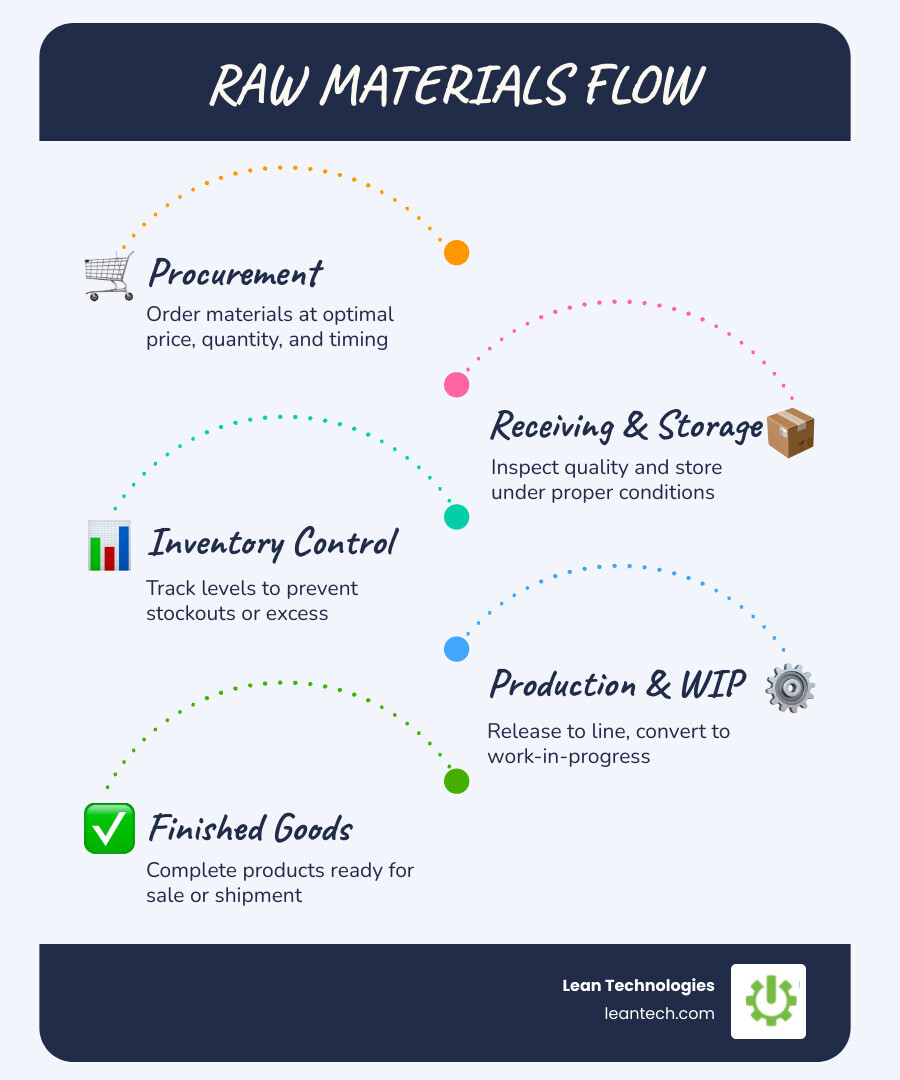
Step 1: Categorize Your Inventory (Direct vs. Indirect)
Not all inventory is created equal. If you treat a $0.05 washer the same way you treat a $5,000 specialized engine block, you are wasting time. Effective raw material management starts with a clear divide between direct and indirect materials.
Direct materials are the stars of the show. They are physically incorporated into your final product. Think of the steel in a car frame or the fabric in a designer sofa. These are listed on your Bill of Materials (BOM) and are the primary drivers of your Cost of Goods Sold (COGS).
Indirect materials (often called MRO - Maintenance, Repair, and Operations) are the supporting cast. They are used in the production process but don't end up in the customer’s hands. This includes lubricants for machines, disposable gloves, cleaning supplies, and even the tape used to seal boxes. While they aren't on the BOM, neglecting Parts Management for these items can halt production just as effectively as a missing direct component.
To manage this effectively, we use the famous 80/20 rule, or the Pareto Principle. In manufacturing, it’s common to find that 20% of your material types account for 80% of your total inventory value.
This leads us to ABC Analysis:
A-Items: High value, low quantity. These require tight control and frequent audits.
B-Items: Moderate value and quantity. Standard control.
C-Items: Low value, high quantity. These are your "bulk" items where you can afford a bit more buffer to avoid the headache of constant reordering.
The Difference Between WIP and raw material management
A common point of confusion on the shop floor is where raw materials end and Work-in-Progress (WIP) begins.
Raw materials are unprocessed inputs. They are sitting in the warehouse exactly as they arrived from the supplier. On your balance sheet, they are valued at their purchase cost plus any landed costs (shipping, duties).
WIP (Work-in-Progress) inventory consists of materials that have entered the production phase but aren't finished yet. Once a technician pulls a sheet of aluminum and starts laser cutting it, that material moves from "raw" to "WIP."
The key difference? Value-added labor. WIP includes the cost of the raw material plus the labor hours and overhead already invested in it. Mixing these up in your tracking system leads to massive accounting errors and a skewed view of your actual production costs.
Identifying Obsolete and Seasonal Stock
Inventory is like milk; it can go bad. Even if it doesn't physically rot, it can become obsolete. This happens when engineering changes a design, rendering old components useless, or when demand for a specific product line vanishes.
Slow-moving items eat up valuable floor space and tie up capital that could be used for high-turnover materials. You need to track the "inventory age." If a pallet hasn't moved in six months, it’s not an asset; it’s a liability.
Seasonal stock adds another layer of complexity. If you manufacture outdoor furniture, your demand for specific resins or fabrics will spike in early spring. Failing to identify these seasonal patterns leads to "bullwhip" effects—where you either have massive shortages during peak season or a warehouse full of dust-collecting materials in October.
Step 2: Master the Math of Procurement
If you're ordering based on a "gut feeling," you're leaving money on the table. Procurement math isn't about being a human calculator; it's about using standard formulas to remove the guesswork.
The most critical metric is the Economic Order Quantity (EOQ). This formula helps you find the "sweet spot" where the cost of ordering materials (shipping, admin time) balances perfectly with the cost of holding those materials (storage space, insurance, capital).
Next, you must define your Reorder Point (ROP). You don't wait until the bin is empty to order more. You calculate the ROP based on:
Lead Time: How long it takes from the moment you hit "order" until the truck arrives.
Average Daily Usage: How much of that material you burn through in a 24-hour period.
Safety Stock: The "emergency buffer" for when a supplier is late or a rush order comes in.
To simplify this, many teams use Purchasing Suggestions generated by their management systems, which flag exactly when and how much to buy based on real-time consumption.
Comparing Procurement Models
Feature EOQ (Economic Order Quantity) JIT (Just-in-Time) Primary Goal Minimize total cost (Ordering + Holding) Eliminate waste and minimize inventory Inventory Level Moderate to High (Bulk buys) Very Low (As needed) Supplier Relationship Transactional / Price-focused Partnership / Reliability-focused Risk High holding costs / Obsolescence High risk of stockouts if supply chain breaks
Calculating Inventory Turnover Ratio
How hard is your money working for you? The Inventory Turnover Ratio tells you how many times you’ve "cleared out" and replaced your stock in a year.
The Formula: COGS / Average Inventory Value
A high turnover ratio means you are lean and efficient. A low ratio suggests you are overstocked or have a lot of obsolete "dead wood" in the warehouse. Improving this ratio directly boosts your cash flow and liquidity—giving you the cash to invest in new equipment or better staff.
Determining Real vs. Estimated Manufacturing Costs
There is often a gap between what you think a product costs and what it actually costs.
Estimated Cost: What the BOM says. (5 lbs of steel + 2 hours of labor).
Real Cost: What actually happened. (6 lbs of steel used due to scrap + 2.5 hours of labor due to machine downtime).
The difference represents "money stopped earning." If your consumption waste is consistently higher than your BOM estimates, your raw material management process is failing to account for shop floor realities.
Step 3: Implement Lean Inventory Strategies
Lean isn't just for the assembly line; it’s for the warehouse too. The goal is to move materials through your facility with as little friction as possible.
Just-in-Time (JIT) is the gold standard for many, but it's risky. It requires a bulletproof supply chain. For most mid-sized manufacturers, a hybrid approach works better: JIT for high-volume items and Safety Stock for critical, long-lead components.
Six Sigma techniques can be applied to material handling to reduce defects and errors. For example, if 5% of your incoming fasteners are the wrong grade, that's a process defect that needs to be solved at the supplier level.
Kanban is perhaps the most visual and effective lean tool. Whether it's a physical card or a digital board, Kanban signals "pull" demand. When a bin is empty, the card goes to procurement. No card, no order. This prevents the "over-ordering" that leads to the $300 billion markdown problem mentioned earlier.
Reducing Waste Through Demand Forecasting
The best way to manage inventory is to know what you’ll need before you need it. Demand forecasting uses historical data and sales trends to predict future material requirements.
Without accurate forecasting, you fall into two traps:
Overstocking: You buy too much "just in case," leading to high carrying costs.
Understocking: You run out, leading to unplanned downtime which can cost an average manufacturing facility $25,000 per hour.
By leveraging predictive analytics, you can align your purchasing cycles with your actual production capacity, ensuring you have exactly what you need—no more, no less.
Strengthening Supplier Relationships
Your suppliers are an extension of your shop floor. If they are unreliable, your raw material management will always be reactive.
Move beyond just looking at price. Use Vendor Scorecards to track:
Lead Time Reliability: Do they actually deliver in 10 days?
Quality Consistency: How many items are rejected at receiving?
Communication: Do they tell you about delays before the truck is late?
Diversification is also key. Relying on a single supplier for a critical raw material is a recipe for disaster. Always have a "Plan B" vendor qualified and ready to go.
Step 4: Standardize Storage and Quality Assurance
A disorganized warehouse is a black hole for profits. If your team spends 20 minutes looking for a specific pallet, you are losing money.
Standardization starts with Materials Compliance. Every item should have a dedicated home, a clear label, and a corresponding Safety Data Sheets SDS if it's a chemical or hazardous material.
Implementing Quality Control at Receiving
The cheapest time to catch a material defect is the moment it hits your dock. Once a defective part is machined or assembled, the cost to fix it triples.
Your receiving process should include:
Inspection Protocols: Checking for shipping damage and quantity accuracy.
Quarantine Zones: Materials that don't pass inspection should be physically separated so they don't accidentally enter the production stream.
Defect Tracking: Log every issue. If a supplier consistently sends sub-par material, your data will show it, giving you leverage for negotiations or a reason to fire them.
Optimizing Floor Space and Material Flow
Think about the "travel time" of your materials. If your most frequently used raw materials are stored at the far end of the warehouse, your forklift drivers are spending half their shift just driving.
Use Point-of-Use Delivery. Store materials as close to the production cell as possible. Use vertical storage to maximize your footprint and ensure that forklift routes are clear and logical. The goal is to minimize the "touches"—every time a human moves a piece of material, there is a risk of damage and a cost in labor.
Step 5: Leverage Technology for Real-Time Visibility
If you are managing your shop floor via paper or Excel, you are seeing the past, not the present. By the time an Excel sheet is updated at the end of the week, the data is already "real-late."
True raw material management requires real-time visibility. This is where technology like barcode scanning and RFID comes in. When an operator scans a material into a work order, the inventory level should update instantly.
Using Requisitions digitally ensures that every pull from the warehouse is authorized and tracked. This eliminates "ghost inventory"—items that the system says are there, but aren't actually on the shelf.
Best Practices for raw material management Tracking
To maintain 99%+ inventory accuracy, you need more than a once-a-year "wall-to-wall" count.
Cycle Counting: Instead of shutting down for three days to count everything, count a small subset of items every single day. Over a quarter, you’ll have counted everything multiple times.
Perpetual Inventory: Your system should update with every transaction (receive, move, consume).
Mobile Accessibility: If your team has to walk to a central office to enter data, they won't do it. Give them tablets or handhelds on the floor.
The Role of Cloud-Based Shopfloor Software
Modern shopfloor software like Thrive acts as a digital toolbox that connects your people to your process. It’s not about replacing your ERP; it’s about filling the gaps where the ERP fails—on the actual floor.
Cloud-based systems allow for cross-functional communication. When a quality tech logs a material defect on a tablet, the production manager and procurement lead see it instantly. This creates a digital audit trail that is essential for compliance and continuous improvement.
Overcoming Common Challenges in raw material management
The world is volatile. Price volatility in commodities like steel or oil can wreck your margins overnight. Supply chain disruptions — from port strikes to geopolitical shifts — are the new normal.
To survive, you must eliminate data silos. If the purchasing team doesn't know that production just scrapped 20% of a batch, they won't know to order more until it's too late.
Common inventory pitfalls to avoid:
Ghost Inventory: Your system says it's there, but the shelf is empty.
Hoarding: Tying up cash in "just-in-case" stock that eventually becomes obsolete.
Manual Entry Lag: Using spreadsheets that are only updated at the end of the shift or week.
Single-Source Reliance: Having no backup plan when a primary vendor hits a snag.
Managing Global Supply Chain Complexity
When sourcing globally, the "sticker price" is a lie. You must calculate the Landed Cost, which includes:
International freight
Customs duties and taxes
Insurance
Local drayage
Long lead times from overseas suppliers require larger buffer stocks, which increases your financial risk. Successful managers balance these long-lead items with local suppliers who can provide smaller batches quickly, even if the unit price is slightly higher.
Eliminating Manual Spreadsheet Errors
Spreadsheets are where data goes to die. They suffer from:
Version Control Issues: Is "InventoryFinalv2" actually the final version?
Human Error: One fat-fingered keystroke can throw off an entire procurement plan.
Tribal Knowledge: If the one person who understands the complex Excel macros leaves the company, your system collapses.
Moving to a structured, automated process ensures that the "truth" is available to everyone in real-time, not hidden in someone's "My Documents" folder.
Frequently Asked Questions about Raw Material Management
What is the difference between direct and indirect raw materials?
Direct materials are physically incorporated into the final product (like the engine in a lawnmower), while indirect materials support the process but aren't in the final product (like the coolant for the CNC machine or the floor cleaner used in the facility).
How do you calculate the value of raw materials inventory?
The standard formula is: Beginning Inventory + Net Purchases - Raw Materials Used = Ending Inventory. This value is typically recorded on the balance sheet as a current asset. Methods like FIFO (First-In, First-Out) or Weighted Average Costing are used to assign a specific dollar value to that stock.
Why is inventory turnover important for manufacturers?
It measures efficiency. A high turnover means you are moving product quickly and keeping your capital liquid. A low turnover means your cash is "trapped" in boxes on a shelf, and you’re at higher risk for material obsolescence.
In Summary
Mastering raw material management is the difference between a shop floor that runs like a machine and one that is constantly firefighting. By categorizing your stock, mastering the procurement math, and embracing lean strategies, you move from reactive chaos to proactive control.
Operational excellence isn't a destination; it's a result of structured, accountable work processes. When your team has real-time visibility into what materials they have and where they are, they spend less time searching and more time building.
Lean Technologies offers Thrive to help manufacturing teams move from reactive firefighting to proactive, real-time material control. Stop managing your shop floor through spreadsheets and start mastering your inventory with our Guide to Digital Lean Manufacturing.