

The Ultimate Guide to Maintenance Types: Reactive, Preventive, Predictive, and Proactive
Why Understanding Maintenance Types Matters for Your Shop Floor
Reactive preventive predictive proactive maintenance strategies determine whether your plant runs like a well-oiled machine or burns through cash fighting fires. Here's what you need to know:
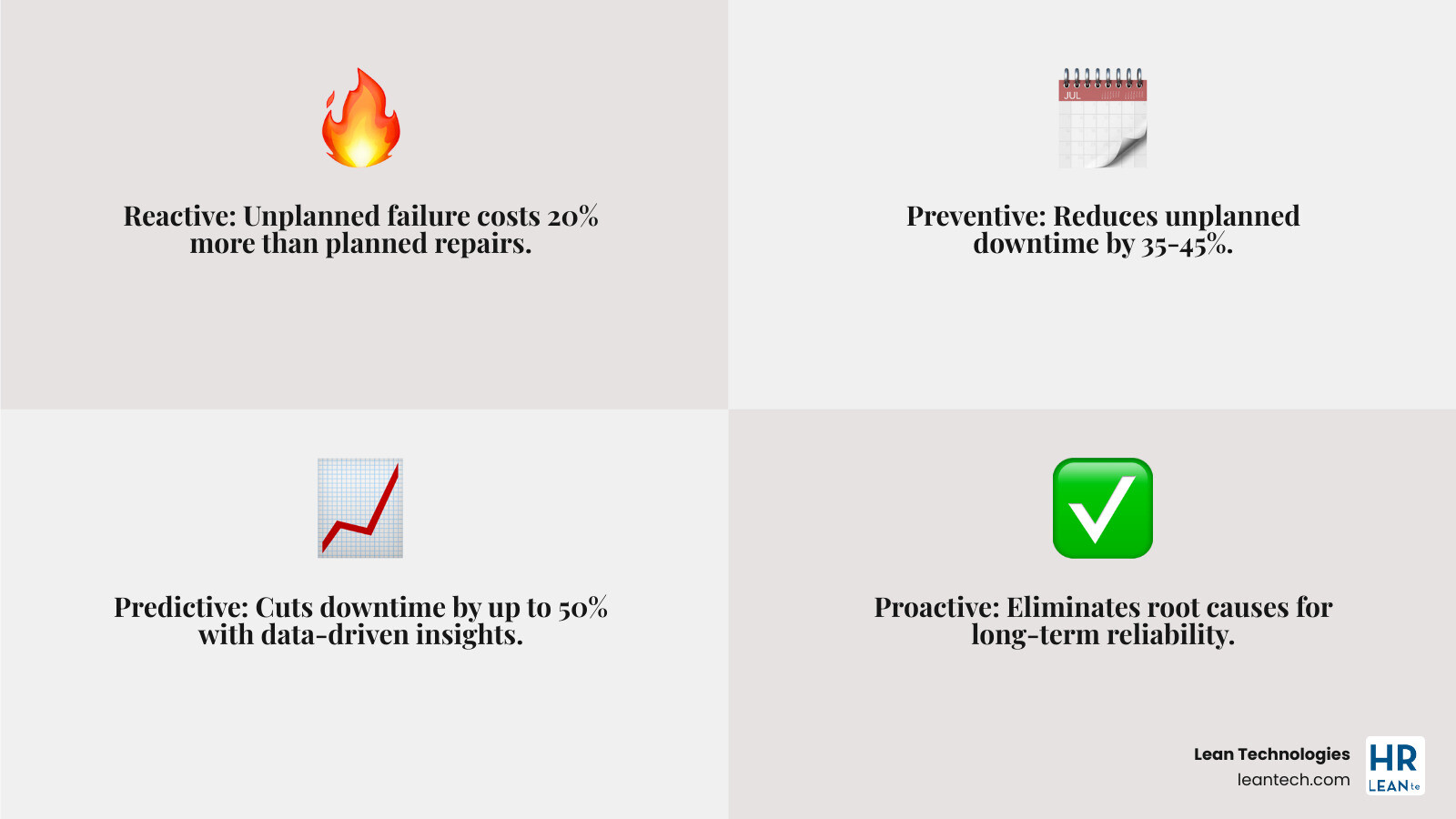
Maintenance Type When It Happens Best For Main Benefit Reactive After equipment breaks Low-cost, non-critical assets No upfront maintenance cost Preventive On a fixed schedule (time/usage) Most production equipment Reduces unplanned downtime by 35-45% Predictive When data shows it's needed Critical, expensive assets Can cut downtime by 50% Proactive Before problems develop Assets with recurring failures Eliminates root causes
Every minute of unplanned downtime costs money.
For some manufacturers, a single hour can cost $25,000 or more.
Yet many plants still operate in reactive mode—waiting for equipment to fail before taking action.
The cost difference is staggering: corrective maintenance after failure costs 20% more than preventive maintenance.
And preventive maintenance itself costs 20% less than breakdown strategies.
The real question isn't which maintenance strategy is best.
It's which mix is right for your specific equipment, production demands, and team capabilities.
A critical robot on your main assembly line needs a different approach than a hand tool in your quality department.
I'm Jamie Gyloai, and over the past 20+ years in manufacturing operations—from assembly line manager to continuous improvement champion to my current role at Lean Technologies—I've seen how the right balance of reactive preventive predictive proactive maintenance strategies can transform a struggling operation into a profit center. In this guide, I'll break down each approach in plain language so you can build a maintenance strategy that actually works for your shop floor.
The Four Core Maintenance Strategies: Quick and Dirty Breakdown
This isn’t theory. It’s how you spend your time, money, and sanity. Are you a firefighter or a planner?
Let’s get straight to it. Here’s a quick overview of the four core maintenance strategies.
Strategy Trigger Goal Cost Implications Best For Reactive Equipment failure Restore operation Low upfront, high long-term (unplanned downtime, emergency repairs) Non-critical, inexpensive assets where downtime impact is minimal Preventive Time or usage interval Prevent failure, extend asset life Moderate upfront, lower long-term than reactive (planned tasks, reduced breakdowns) Assets with predictable failure patterns, moderate criticality Predictive Condition data analysis Optimize maintenance timing, avoid failure Higher upfront (sensors, software), significant long-term savings Critical assets with high failure impact, observable failure modes Proactive Root cause analysis Eliminate failure causes Moderate to high upfront (RCA, engineering changes), maximum long-term reliability Assets with recurring failures, complex systems, safety-critical equipment
Reactive Maintenance (Run-to-Failure)
Fix it when it breaks. This is the simplest approach. No fancy planning, no scheduled downtime. You just run the machine until it quits.
Then you scramble. This strategy has no upfront maintenance cost. But you pay later, usually through the nose. Think emergency repairs, chaos, and lost production.
It’s a high-risk gamble for anything critical.
The potential cost savings of reactive maintenance may diminish over time. Corrective maintenance can cost 20% more than preventive maintenance.
What are the hidden costs of reactive maintenance?
Reactive maintenance incentivizes a quick fix rather than a true solution. You end up with the same issues over and over. Your equipment won’t last as long if it’s not regularly maintained. Unscheduled maintenance takes time away from planned projects. It often means overtime pay for rushed repairs. Poorly maintained assets consume more energy. And it increases the likelihood of accidents due to failing equipment.
If you’re relying on paper or Excel for downtime logs, it’s already too late. Real-time beats real-late. You need immediate visibility to even understand the true cost.
Preventive Maintenance (Time-Based)
Fix it before it breaks. This is a planned approach. You schedule preventive maintenance based on intervals of time, equipment usage, or historical data. It’s also known as routine maintenance.
The goal is to ensure equipment is always ready to go. It reduces failures, but it can also mean over-maintenance. You might be replacing a part long before it's actually needed.
How to schedule preventive maintenance that actually works
Preventive maintenance costs 20% less than breakdown maintenance strategies. It allows you to plan ahead. You schedule labor and order parts before you need them. This means less unplanned downtime and longer asset life.
For example, regularly lubricating bearings on a critical asset prevents unexpected failures. Or inspecting fire extinguishers every six months. The aviation industry pioneered this with scheduled "D Checks" where planes are taken apart for inspection.
But you need a system for this. Thrive helps you digitize essential equipment details. You can assign recurring repair assignments and review asset history. All from a tablet or desktop on the shop floor.
Predictive Maintenance (Condition-Based)
Fix it at the right time. This is where data becomes your crystal ball. Predictive maintenance uses historical data and sensor measurements. Think temperature, vibration, and noise.
A computerized system predicts when maintenance will be needed. This optimizes timing. You perform maintenance only when completely necessary. The benefit is you can schedule work in advance while maximizing the life of your assets.
Predictive maintenance can reduce downtime by up to 50%. And it can increase performance by 25%. It’s like having a doctor who can predict when you're likely to get sick based on subtle changes in your vital signs.
What is predictive maintenance on the shop floor?
Predictive maintenance relies on collecting substantial volumes of specific data. This data comes from sensors and team input. Modern technologies like AI, machine learning, and IoT support these efforts. They enable real-time data analysis for live asset condition monitoring.
However, Thrive does NOT collect sensor data or run predictive machine alerts. What we do is organize and drive action from machine data. This is key. If your team enters the data, or if it's imported from other systems, Thrive makes it actionable. We help you structure the process so that this valuable information leads to actual work orders and continuous improvement.
For example, monitoring a pump with vibration sensors. If anomalies appear, Thrive helps you log that, assign a task, and track its resolution. This is about making the data work for your team, not just collecting it.
Proactive Maintenance (Root-Cause Elimination)
Stop it from breaking in the first place. This is the ultimate goal. Proactive maintenance focuses on root cause analysis (RCA). You’re not just fixing a problem, or predicting it. You’re eliminating why it happened.
Why did that bearing fail? Was it misalignment? Poor lubrication? An operator error? Once you know the root cause, you can implement a permanent solution. This improves long-term reliability and prevents recurrence.
How to drive proactive maintenance with your team
A proactive maintenance approach might cost more in terms of initial investment. But it will easily pay for itself the first time unplanned downtime is averted. It requires a culture of continuous improvement. Your team needs to be empowered to investigate and solve problems.
One key element of proactive maintenance is condition monitoring technology. This allows maintenance teams to plan based on machine data. Thrive helps you foster this culture by providing a platform for:
Logging issues
Tracking actions
Driving continuous improvement
It’s about giving your team the tools to not just react, but to prevent.
From Firefighting to Future-Proofing: Deep Dive on Each Approach
Let’s get real about the pros and cons.
The "Run-to-Failure" Trap: Reactive Maintenance
“If it ain’t broke, don’t fix it.” This mindset can be tempting. Sometimes it’s fine for non-critical, cheap assets. Like a $20 hand tool for a quality inspector. If it breaks, you just grab another one.
But for most equipment? It’s a gamble that leads to the "run-to-failure" trap. The costs are often far greater than any perceived savings.
Unplanned downtime: This is the big one. A main assembly line robot in automotive manufacturing? Downtime costs can reach $600 per second. An hour of unplanned downtime can cost a facility around $25,000. For larger organizations, it can be over $500,000.
Higher repair costs: Emergency repairs are always more expensive. You pay for urgency, expedited parts, and overtime. One study found that corrective maintenance costs 20% more than preventive maintenance.
Safety risks: Failing equipment is dangerous. The explosion of the Deepwater Horizon in 2010 cost 11 lives and released 210 million gallons of oil. Choosing the right maintenance strategy is critical—not just for cost savings, but also for safety.
Production bottlenecks: When one machine goes down, it can halt an entire line. This creates bottlenecks, disrupts schedules, and impacts delivery. Poor maintenance strategies can reduce production capacity by up to 20%.
Downtime logs that are incomplete or late won't help you here. You need a system that captures data at the source, immediately.
The "Scheduled" Approach: Preventive Maintenance
Your scheduled oil change. This is maintenance based on time or usage. You change the oil every 5,000 miles or three months. This is a huge step up from firefighting.
Planned downtime: You schedule maintenance when it’s least disruptive. This minimizes impact on production. You know when your assets will be down.
Longer asset life: Regular maintenance keeps equipment in optimal condition. It prevents small issues from becoming big failures. Preventive maintenance can extend asset lifespans by 20-40%.
Improved safety: Well-maintained equipment is safer to operate. Many insurance providers offer lower premiums for companies that practice and document their preventive maintenance routines.
Cost savings: Preventive maintenance costs 20% less than breakdown maintenance. Companies that are PM-heavy save an average of 12 to 18 percent.
The risk: Over-maintenance. You might be replacing parts that aren’t worn out. This can increase costs due to unnecessary parts and labor. It’s why continuous optimization of your PM schedule is crucial. Thrive helps you track these tasks and ensure they are completed efficiently.
The "Data-Driven" Forecast: Predictive Maintenance
Let the machine (or your team’s data) tell you when it needs attention. This is about using information to make smart decisions. You use inspections, production logs, and simple sensors. No need for fancy tech to start, though it helps.
Condition monitoring: You constantly observe the asset’s health. This includes vibration analysis for bearings, infrared thermography for electrical issues, or oil analysis for gearboxes. These techniques help determine the condition of in-service equipment.
Reduces downtime: By catching potential failures before they occur. Predictive maintenance strategies contribute to less unplanned downtime. It can reduce downtime on a robotic manufacturing line by 50 percent.
Optimizes timing: You perform maintenance only when warranted. This avoids running to failure AND replacing healthy parts. The U.S. Department of Energy reports predictive maintenance can produce 8-12% cost savings over traditional preventive programs.
High value for critical assets: For assets where failure is less predictable and the business impact is high, predictive maintenance is advantageous. Think aerospace engine health monitoring or wind turbines.
We know what you’re thinking: "Do I need to invest in a massive sensor network?" Not necessarily, especially when starting. Thrive works by organizing and driving action from machine data. If your operators are logging visual inspections or specific readings on a tablet, that's data Thrive can structure. This gives you real-time visibility without needing to install expensive sensors everywhere. It’s about making your existing data smarter.
The "Root Cause" Fix: Proactive Maintenance
The final boss of maintenance. This isn’t just predicting failure—it’s eliminating it. Proactive maintenance uses root cause analysis (RCA) to solve problems permanently.
Why did the bearing fail? Was it due to chronic misalignment? Perhaps an incorrect installation procedure? Or is the asset operating outside its design parameters? This process helps you identify the underlying cause, not just the symptom.
Problem elimination: You fix the source of the problem. This prevents the same failure from happening again. It’s about making engineering changes or improving operational procedures.
Long-term reliability: By tackling root causes, you build a more robust operation. This leads to significant improvements in equipment uptime and performance. NASA has saved more than $300,000 in maintenance costs by practicing Reliability-Centered Maintenance (a framework that includes proactive elements). The National Ignition Facility saved $2 million by cutting out unproductive routine maintenance tasks and focusing on potential problems.
Needs skilled team and real analysis: This isn't a quick fix. It requires trained personnel who can perform thorough RCA. It’s an investment in your team’s analytical skills.
Fosters a culture of improvement: When problems are solved permanently, it motivates the team. They see their efforts leading to lasting change. This is a key driver for continuous improvement on the shop floor. Thrive helps you structure these problem-solving efforts. It provides a platform to log findings, track corrective actions, and verify their effectiveness. This ensures CI teams can close the loop effectively.
Beyond the Basics: How Other Concepts Fit In
You’ll hear other terms. Let’s clear up the confusion.
Condition-Based Maintenance (CBM) vs. Predictive Maintenance (PdM)
These two are often confused. They're closely related, but distinct.
CBM: Act when you see a problem now. You respond when a measurement crosses a predefined threshold. Think of a 'check engine' light coming on in your car. Or a temperature sensor in a data center’s server room hitting a critical value. Condition-based maintenance involves tracking the status of equipment and maintaining it as needed. Sensors alert you that upkeep is needed after something goes wrong, but before a catastrophic failure.
PdM: Use that data to forecast a problem before it happens. Predictive maintenance builds on CBM. It uses advanced analytics to predict when a threshold will be crossed or when a failure will occur. It forecasts failure before thresholds are breached. This allows for earlier, planned interventions.
CBM is a red light, telling you there’s an issue now. PdM is your GPS warning you about traffic ahead, giving you time to reroute. For example, CBM would be reacting to a high vibration reading. PdM would be analyzing that reading, along with historical data, to predict that the bearing will fail in two weeks.
What About Reliability-Centered Maintenance (RCM)?
RCM is a framework, not a single strategy. It's a process to establish the safe minimum levels of maintenance. It helps you pick the right approach for each asset. RCM asks critical questions about each piece of equipment:
What is its primary function?
How can it fail?
What are the causes of each failure?
What happens when each failure occurs?
How can we prevent or minimize the impact of each failure?
RCM is about making data-driven decisions. It leads to a blended strategy. You might use reactive for a non-critical part, preventive for another, and predictive for a high-value asset. It was pioneered by the aviation industry and is used by organizations like NASA. RCM implementation requires more upfront time and labor. But it yields significant ROI in the long run.
Building Your Winning Maintenance Strategy
There’s no single “best” strategy. The answer is a mix—custom to your floor.
A critical robot on your main line? That needs predictive and proactive maintenance. The cost of downtime can be astronomical. A $20 hand tool? Maybe just reactive maintenance is fine. If it breaks, you just replace it.
How to Find the Right Mix for Your Shop Floor
This isn't a one-size-fits-all solution. You need to assess each asset.
Start with asset criticality. What happens if this machine goes down? Is it a minor inconvenience or a complete shutdown of production?
High-impact, high-cost-of-failure assets: These demand predictive and proactive strategies. They have a direct impact on your bottom line, safety, or compliance. For example, a main injection molding machine or a critical pump in a chemical plant.
Low-impact, easy-to-replace assets: Reactive maintenance is often fine here. Think backup pumps or standard light fixtures. The cost of preventing failure outweighs the cost of replacing it.
You need to consider risk assessment. What's the cost of downtime? What's the production impact? What are the safety implications?
The optimal maintenance mix often leans towards 80% preventative/predictive/proactive and 20% reactive. This ratio should be adjusted based on your industry and equipment. Thrive helps you structure the data collection that informs these decisions. It gives you the visibility to understand which assets are critical and how they are performing.
The KPIs That Actually Matter
You can’t improve what you don’t measure. Stop guessing. Start tracking. Here are the key performance indicators (KPIs) we recommend:
Mean Time Between Failures (MTBF): How long does an asset run before breaking down? Higher is better.
Mean Time To Repair (MTTR): How long does it take to fix an asset once it fails? Lower is better.
Overall Equipment Effectiveness (OEE): A comprehensive measure of availability, performance, and quality.
Maintenance cost as % of asset value: Helps you understand the cost-effectiveness of your maintenance efforts.
Schedule compliance: How often are planned maintenance tasks completed on time?
Unplanned downtime %: The percentage of time equipment is down unexpectedly.
Thrive gives you real-time visibility into these metrics. No more waiting until the end of the month to know what happened. You see it as it happens, allowing for faster problem-solving.
Overcoming Problems: People and Process
The biggest challenge isn’t tech. It’s getting your team on board and your process tight. You can have the best sensors and software. But if your people aren't engaged, it won't work.
Operator buy-in: Your operators are the first line of defense. They know the machines best. Involve them in basic maintenance and reporting. Empower them to log issues and suggest improvements.
Standardized work: Clear, documented procedures for every task. This reduces errors and ensures consistency. It's foundational for any effective maintenance program.
Data discipline: Garbage in, garbage out. Your data needs to be accurate and consistent. This requires training and a commitment to real-time data entry.
Training: Invest in your team's skills. Whether it's for new technologies or RCA techniques. A skilled workforce is your greatest asset.
Thrive was built to solve these exact problems. It digitizes lean work processes in real time. It's a flexible digital toolbox that helps operators and supervisors:
Log issues
Track actions
Drive continuous improvement
It helps you foster that cultural shift necessary for adopting more advanced maintenance strategies. Want to see how? Learn how to digitize lean manufacturing with Thrive.
Frequently Asked Questions about Maintenance Strategies
What’s the main difference between preventive and predictive maintenance?
Preventive maintenance is based on a fixed schedule. Think time (e.g., every 3 months) or usage (e.g., every 500 hours). Predictive maintenance is based on the actual condition of the asset. It uses data to forecast when maintenance is needed, optimizing the timing.
Can a company use all four maintenance strategies?
Yes, and the best ones do. A blended strategy is the most effective. It means applying the right maintenance type for the right asset. This optimizes reliability, cost, and safety across your entire operation.
How does corrective maintenance relate to reactive maintenance?
Corrective maintenance is simply fixing something. If that fix is unplanned and happens after a failure, it’s a form of reactive maintenance. However, if you catch a small defect during a scheduled preventive inspection and fix it before it causes a failure, that’s also corrective maintenance, but it's part of a planned, proactive approach.
What to Do Next
Stop managing your maintenance through spreadsheets and wishful thinking. The first step to a better maintenance strategy is real-time visibility into what’s actually happening on your shop floor.
You need a simple, structured way for your team to log issues, track actions, and drive improvement.
Thrive was built by manufacturing experts to help you digitize your work processes and create a single source of truth for your maintenance activities.