
Digging Deeper: Essential Root Cause Analysis Software Tools
Stop Firefighting: Why Problems Keep Coming Back
Looking for the right root cause analysis software to solve your shop floor problems? Here's a quick look at the main types:
Integrated Shop Floor Platforms: Best for daily issues, real-time tracking, and use by your shop floor teams. They embed RCA directly into your daily work processes.
Standalone Deep-Dive Tools: For complex, high-stakes investigations. Think major incidents, often used by expert continuous improvement or safety teams.
Collaborative Digital Whiteboards: Great for brainstorming and visual mapping, especially with remote teams. However, they usually don't link directly to your live shop floor data or trigger actions.
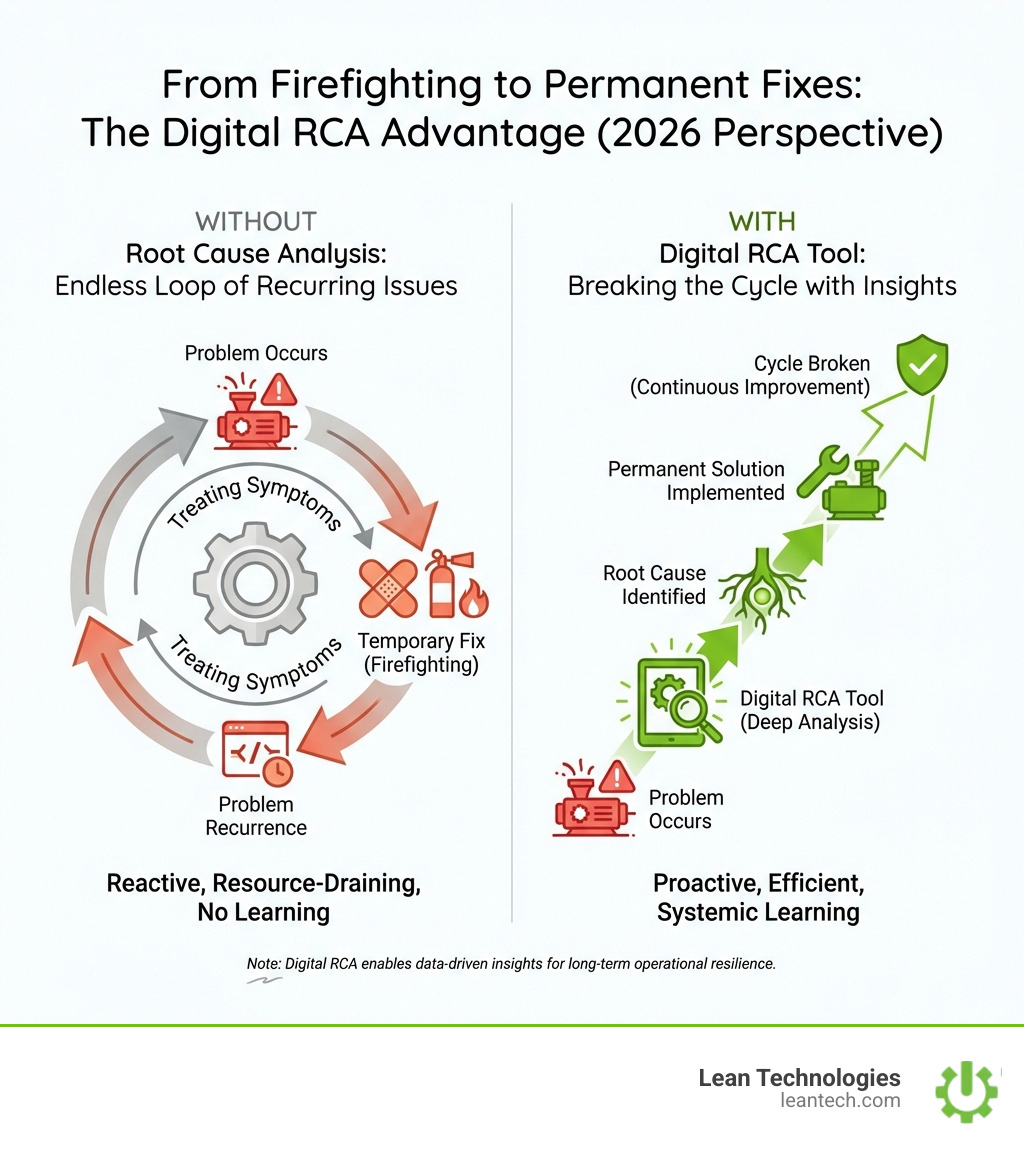
Tired of the same old problems popping up again and again? You fix a machine, only for it to break down days later. Quality issues keep recurring, and safety incidents feel like a game of whack-a-mole. This endless cycle of "firefighting" isn't just frustrating; it drains your team, wastes resources, and crushes productivity. It's time to stop just treating symptoms and start finding real, lasting solutions.
That's where root cause analysis software comes in. It’s your secret weapon to understand why problems happen, not just what happened. The right software helps you move beyond the surface, dig deep, and fix issues at their source. This reduces operational risk, boosts efficiency, and stops those costly recurring headaches for good. It's about building a system that learns from every incident, turning problems into opportunities for improvement.
What is Root Cause Analysis (RCA) and Why Digitize It?
Root cause analysis software is a digital solution that helps businesses pinpoint the underlying reason for recurring problems. It acts as a detective for your operations, uncovering the truth behind every glitch, breakdown, or quality defect. The goal is to treat the illness, not just the symptoms.
The primary goal of RCA is to prevent recurrence. Instead of just reacting to problems, you proactively build a more resilient and efficient operation. By analyzing incidents and addressing the source of the problem, RCA software reduces operational risk and improves process efficiency.
According to the American Society for Quality (ASQ), RCA is a structured process for solving production-related problems, helping you move from short-term fixes to long-term solutions. This focus on prevention applies to safety, quality, and engineering, helping avoid future incidents. For a deeper dive into how this impacts workplace safety, you can explore more on safety and compliance.
Why Move RCA Off Paper and Into a Digital Platform?
If your team uses paper, whiteboards, and spreadsheets for RCA, you're losing time and insights. Manual methods are inefficient, and lessons are often lost when a whiteboard is erased or paper is misplaced. This forces teams to solve the same problems repeatedly, creating knowledge silos.
Root cause analysis software digitizes and automates the RCA process, helping managers find the fundamental cause of any issue. The benefits are clear:
Faster, more accurate data capture: Use digital forms to collect data in the field, attaching photos and videos for full context.
No more lost information: Centralized records ensure all incident data is stored securely and is easily accessible.
Real team collaboration: A digital platform enables cross-functional teams to collaborate on problem-solving through a centralized dashboard.
Data-driven decisions: Analytics speed up data exploration and forecasting, empowering you to make informed decisions.
RCA time slashed: Users report cutting RCA time by up to 75%, leading to faster problem resolution and implementation of preventive actions.
Standardized, repeatable process: Digital workflows ensure consistent investigation and analysis across your organization.
By digitizing your RCA process, you minimize manual labor, cut costs, and ensure your results are effective, changing how your organization learns from incidents.
Common RCA Methods You Can Run Digitally
The beauty of root cause analysis software is its ability to structure and support various methodologies. The software often provides templates for several common approaches, making them easier to implement.
Here are some practical RCA methods that shine when run digitally:
5 Whys: A technique that establishes cause-and-effect relationships by repeatedly asking "Why?" Digital tools help build and visualize these "why" chains to track the progression to the root cause.
Fishbone (Ishikawa) Diagrams: These cause-and-effect diagrams help brainstorm and organize potential causes into categories (e.g., Man, Machine, Method). Digital templates make them easy to create, modify, and share. Learn more at Fishbone (Ishikawa) diagrams.
Fault Tree Analysis (FTA): A top-down analysis that maps how component failures or human errors lead to an undesirable event. Software helps construct and analyze complex fault trees for high-risk systems.
Failure Mode and Effects Analysis (FMEA): A systematic method to identify and analyze potential failure modes and their impact. Digital platforms help document the process, assign risk priority numbers (RPN), and track actions.
Pareto Analysis: Based on the 80/20 rule, this technique identifies the few causes responsible for most problems. Software can automatically generate Pareto charts from failure codes to help you prioritize fixes.
8D Problem-Solving: An eight-discipline approach to identify, correct, and eliminate recurring problems. Digital tools guide teams through each step, from problem definition to verifying corrective actions.
Must-Have Features in Root Cause Analysis Software
Choosing the right root cause analysis software isn't just about picking a name off a list; it's about finding a tool that genuinely empowers your team. The best solutions offer a robust set of features that transform your problem-solving process.
When you're evaluating options, look for these essential capabilities:
Digital Data Capture: The ability to collect information directly at the source using mobile devices, with support for photos, videos, and annotations.
Customizable Workflows: Software that adapts to your existing processes, allowing you to define steps, assign responsibilities, and track progress for each RCA.
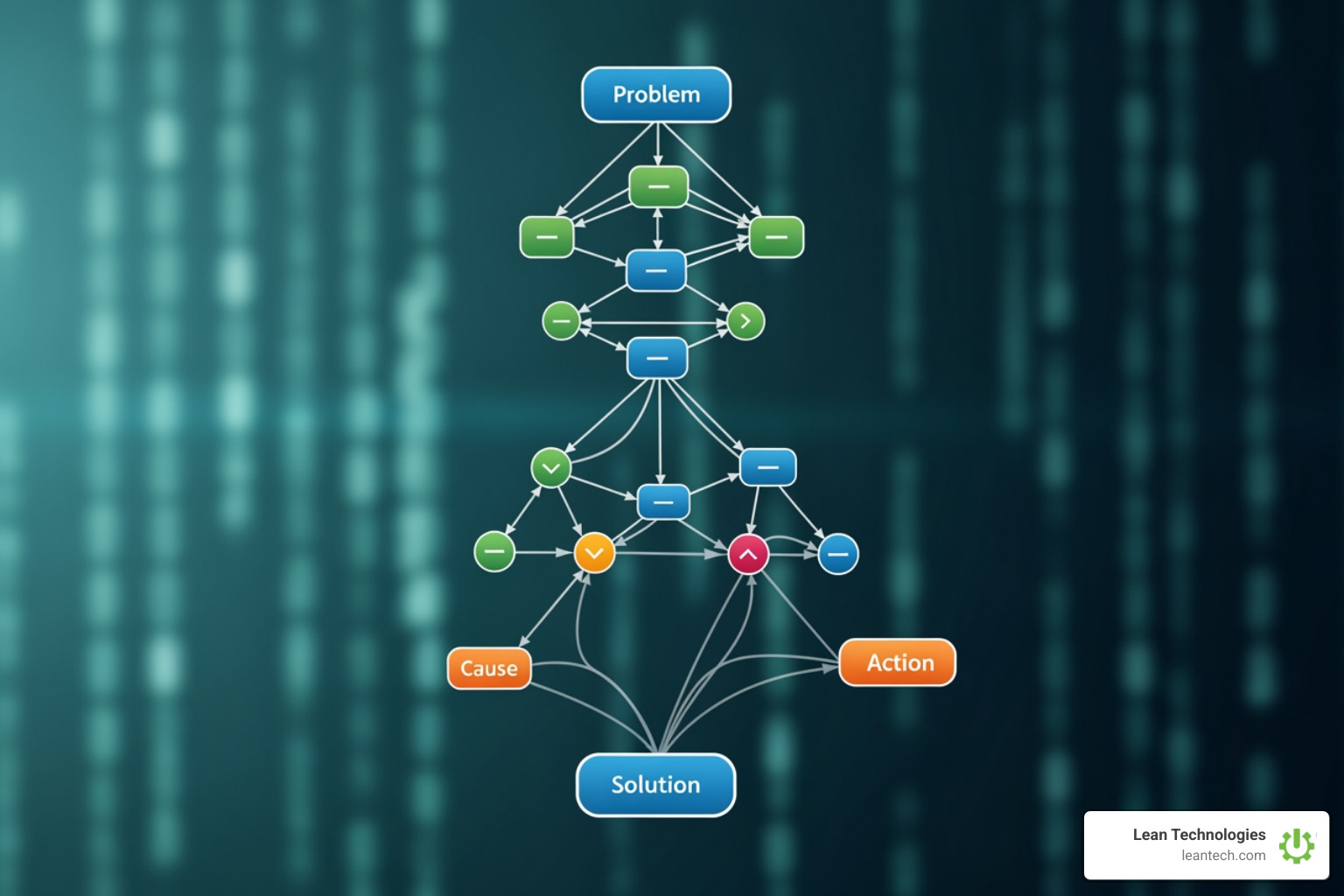
Visual Analysis Tools: Built-in support for methodologies like Fishbone diagrams, 5 Whys, and logic trees to help visually map out causes and effects.
Incident and Action Tracking: A comprehensive system to log incidents, assign corrective actions, set due dates, and monitor their completion.
Trend Reporting: Features that analyze historical data to identify recurring patterns, hotspots, and systemic issues across incidents.
Integration Capabilities: The ability to connect seamlessly with your other business systems, like CMMS, ERP, or EHS platforms, to create a unified data ecosystem.
Data Collection and Integration: One Source of Truth
Effective RCA requires accurate, timely data. Data on paper or in spreadsheets is often incomplete, late, or lost. A robust root cause analysis software solves this by providing a single, reliable source of truth.
Your team can capture data in real-time on mobile devices, attaching photos and videos for rich context. This eliminates paperwork, speeds up the process, and ensures consistency.
The best RCA software isn't isolated. It connects with your existing systems, like a Computerized Maintenance Management System (CMMS) or Enterprise Resource Planning (ERP) system. This integration is vital because "if your RCA data lives in a different system than your Work Orders, you break the feedback loop." This means:
Seamless Data Flow: Information from maintenance work orders, quality inspections, or safety incidents can automatically feed into your RCA process.
Enriched Context: When performing an RCA, you have immediate access to full asset history, OEE performance data, and past spare parts usage—all on the same screen.
Automated Updates: If an RCA reveals a missing preventive task or a flawed procedure, the software can trigger immediate updates to preventive maintenance schedules or standard operating procedures.
No More Knowledge Silos: All relevant data is centralized, searchable, and available to everyone who needs it, preventing teams from solving the same problems repeatedly.
This integration isn't just a nice-to-have; it's fundamental to building a truly learning organization that can adapt and improve continuously.
Visual Analysis and Reporting: Clarity from Chaos
When you're in the middle of a complex problem, you need clarity, not more confusion. Strong visual analysis and reporting capabilities are non-negotiable in root cause analysis software. These features turn raw data into clear, actionable insights.
Look for software that offers:
Logic Trees and Cause-and-Effect Diagrams: Visually map relationships between factors and the root cause to see how events unfolded.
Incident Timelines: Build timelines to document the sequence of events, helping reconstruct what happened and identify critical points.
Custom Dashboards: Display relevant KPIs and trends to see the status of RCAs, problem areas, and solution effectiveness at a glance.
Automated Reports: Generate comprehensive, audit-ready reports with one click, documenting your investigation, findings, and corrective actions for compliance.
Evidence Linking: Link evidence like photos and documents directly to causes in your visual maps to ensure your analysis is data-backed.
By providing these visual and reporting tools, root cause analysis software helps your team communicate findings effectively, gain consensus on root causes, and justify permanent fixes with hard data. This clarity is essential for driving real change and preventing recurrence.
Types of Root Cause Analysis Tools: What Fits Your Team?
Choosing the right root cause analysis software isn't a one-size-fits-all decision. What works for a major incident investigation might be overkill for a daily production hiccup. It's about matching the tool to the task, and more importantly, to your team's needs and workflow.
Consider whether you're tackling daily operational issues on the shop floor or investigating complex, high-stakes events. Different tools excel in different scenarios.
Tool Category Best For Key Characteristics Integrated Shop Floor Platforms Daily operational issues, recurring breakdowns, quality defects, safety incidents. Embedded in daily workflow, used by operators and supervisors, real-time data capture, structured failure codes, fast action tracking, habit-building, direct link to work orders and asset history. Standalone Deep-Dive Tools Complex, high-stakes investigations (e.g., major safety incidents, systemic failures, regulatory non-conformances). Advanced logic mapping, human factor analysis, extensive knowledge management, detailed reporting for formal investigations, often used by CI or safety leaders. Not typically integrated into daily operational workflows. Collaborative Digital Whiteboards Brainstorming sessions, remote team collaboration, initial cause mapping, training. Visual and easy-to-use digital whiteboard interface, flexible for brainstorming, good for visualizing ideas. Often lacks hard links to operational data, action tracking, or integration with core business systems.
Why Integrated Shop Floor Platforms Win for Daily RCA
For manufacturing operations, an integrated shop floor platform is often the most effective choice for daily root cause analysis. Why? Because it embeds RCA directly into your team's daily routines, making it a natural part of their work process, not a separate "science project."
These platforms are designed to be used by operators, technicians, and supervisors right at the source of the problem. This means:
Real-time Entry: Issues are logged as they happen, eliminating delays and ensuring data accuracy. This aligns perfectly with the principle that "real-time beats real-late" – if it's captured on paper and entered at the end of the shift, it's already too late for immediate action.
Structured Failure Codes: Technicians can select structured Problem, Cause, Remedy (PCR) codes, which automatically generate valuable data for Pareto charts of root causes. This provides a consistent way to categorize and analyze failures.
Drives Accountability and Speed: When RCA is built into the workflow, it forces teams to not just fix a machine but to understand why it failed. This drives faster problem-solving and immediate action tracking.
Embedded Context: When performing an RCA, your team has immediate access to full asset history, OEE performance data, and past spare parts usage on the same screen, providing the context needed for effective analysis.
Closes the Loop: If an RCA reveals a missing preventive task, the PM schedule can be updated immediately within the same platform, ensuring that analysis directly leads to corrective action.
An integrated platform helps you build a learning organization where every incident becomes an opportunity for improvement. It supports Lean Technologies' core value of streamlining operations, boosting productivity, and improving profit through a cohesive, integrated platform. This approach ensures that RCA becomes a habit, not a burden, leading to continuous improvement across your manufacturing processes.
When to Use Deep-Dive or Whiteboard Tools
While integrated shop floor platforms are excellent for daily RCA, there are specific situations where specialized deep-dive tools or collaborative digital whiteboards become invaluable. These tools serve different, yet equally important, purposes:
For Major Safety or Quality Events: When you're dealing with a significant safety incident, a major quality recall, or a systemic failure with high financial or reputational impact, a deep-dive RCA tool is essential. These platforms offer advanced logic mapping, human factor analysis, and extensive knowledge management capabilities. They are designed for rigorous, formal investigations that might involve regulatory bodies and require highly detailed documentation. Think of scenarios like a complex equipment explosion or a significant environmental spill. These are often used by dedicated Continuous Improvement or Safety leaders who need to carefully trace cascading failures and human errors to their ultimate source.
For Advanced Logic Mapping: Some problems are so intricate that they require sophisticated charting tools to visualize complex interdependencies. Deep-dive tools excel here, allowing investigators to build detailed cause maps and fault trees that go beyond what's practical in a daily operational system.
For Collaborative Brainstorming: Digital whiteboard tools are perfect for the initial phases of an RCA, especially for remote or hybrid teams. They provide a flexible, visual space for brainstorming potential causes, mapping out ideas, and organizing thoughts. Teams can easily create Fishbone diagrams or simple cause maps together, fostering creative problem-solving. However, these tools often act as standalone brainstorming aids and usually don't have hard links to live shop floor data or the ability to trigger automated actions within your core operational systems.
These specialized tools are not built for daily shop floor use or fast action tracking. They complement, rather than replace, the integrated platforms that drive continuous improvement in day-to-day operations.
How to Select and Roll Out the Right RCA Tool
Choosing the right root cause analysis software is a critical decision that can significantly impact your operational efficiency and long-term success. It's not just about features; it's about finding a solution that fits your team, your processes, and your future growth.

Here's how to select and effectively roll out the right RCA tool for your organization:
Define Your Real Needs (Speed, Depth, Integration): Start by clearly outlining what problems you need to solve. Are you looking to tackle frequent, smaller issues quickly, or are you focused on deep dives into rare, complex failures? How crucial is it for the RCA process to integrate with your existing CMMS, ERP, or EHS systems? Your answers will guide you toward an integrated platform, a deep-dive tool, or a combination.
Prioritize Ease of Use: This is non-negotiable. If the software is clunky, complicated, or requires extensive training, your team won't use it. An intuitive, user-friendly interface ensures faster adoption and consistent data entry, especially for operators and technicians on the shop floor.
Check Integration with Your Current Systems: A seamless connection with your CMMS, ERP, and other operational software is vital. This prevents data silos, enriches RCA investigations with historical context, and ensures that corrective actions are linked directly to your maintenance and production workflows.
Make Sure It Scales as You Grow: Your business needs will evolve. Choose a solution that can grow with you, accommodating more users, sites, and complex processes without requiring a complete overhaul.
Assess Vendor Support and Training: Look for a vendor that offers robust support, comprehensive training, and resources to ensure your team can maximize the software's potential. A good partner will help you with implementation and ongoing optimization.
By following these steps, you can ensure you're investing in a solution that truly empowers your team to solve problems effectively. For more insights on digital change in manufacturing, check out More on digital lean manufacturing.
The Role of AI in Modern RCA
Artificial intelligence (AI) and machine learning (ML) are rapidly changing how we approach problem-solving, and root cause analysis software is no exception. The use of cloud-native technologies and the complexity of today's modern applications make it increasingly difficult to determine the root cause of issues, especially in software development. However, AI is stepping up to the challenge.
Modern RCA software leverages AI to:
Flag Anomalies: AI algorithms can continuously monitor data streams from your equipment, processes, or IT systems to detect deviations from normal behavior. This means identifying potential issues before they escalate into full-blown failures.
Surface Likely Causes: Instead of manually sifting through mountains of data, AI can analyze patterns and correlations to suggest the most probable root causes. This significantly speeds up the diagnostic process.
Spot Log Patterns: In IT and manufacturing, log data can be overwhelming. AI and ML excel at identifying subtle patterns in logs that human analysts might miss, pointing to the underlying reasons for system glitches or machine malfunctions.
Predict Risk: By analyzing historical data and current conditions, AI can predict the likelihood of future failures, allowing for proactive intervention and resource allocation.
Speed Up Analysis: AI can automate many of the initial data analysis steps, freeing up your team to focus on validating hypotheses and developing effective solutions.
Suggest Next Steps: Some advanced systems can even suggest corrective actions or recommend preventive maintenance schedules based on identified root causes.
While AI doesn't replace human expertise, it acts as a powerful co-pilot, augmenting your team's capabilities and enabling them to solve problems faster and with greater accuracy.
Connecting RCA Software with Your Existing Systems
We've said it before, and we'll say it again: "if your RCA data lives in a different system than your Work Orders, you break the feedback loop." This isn't just a catchy phrase; it's a fundamental truth for effective problem-solving in manufacturing. The goal of Root Cause Analysis is to prevent recurrence, and that only happens when insights lead directly to action.
That's why seamless integration with your existing business systems is a non-negotiable feature for any effective root cause analysis software. Here’s how this connectivity transforms your operations:
Link to Work Orders: When an RCA identifies a problem, the software should be able to generate or update work orders in your CMMS. This ensures that the corrective actions are scheduled, tracked, and completed.
Update PM Schedules: If an RCA reveals that a lack of preventive maintenance contributed to a failure, the software should allow you to update your PM schedules immediately. This closes the loop between analysis and prevention.
Track Cost of Fixes: By integrating with your ERP or financial systems, RCA software can help you track the actual cost associated with specific root causes. This data is invaluable for justifying investments in permanent fixes and demonstrating ROI for your improvement initiatives.
Seamless Data Flow: API (Application Programming Interface) access is key. It allows different software systems to communicate and exchange data effortlessly, creating a unified operational picture. This means less manual data entry, fewer errors, and more reliable insights.
Prevent Knowledge Silos: When all relevant data—from incident reports to maintenance histories, quality checks, and RCA findings—resides in a connected ecosystem, your team gains a holistic view. This collective intelligence accelerates learning and prevents the same mistakes from recurring.
Connecting your RCA software with your CMMS, ERP, and other platforms isn't just about convenience; it's about embedding problem-solving into the very fabric of your operations, making reliability and continuous improvement a natural outcome.
Frequently Asked Questions about Root Cause Analysis Software
How does RCA software drive continuous improvement?
Root cause analysis software creates a closed feedback loop. Every incident becomes a learning opportunity, not just a one-off fix. When teams consistently use the software to identify root causes, implement corrective actions, and track their effectiveness, they gain insights into what works, what doesn't, and where systemic weaknesses lie. This data-driven approach allows for real process changes and continuous optimization. It's how you move from reactive firefighting to proactive, data-informed improvement, ensuring that problems are solved permanently, not just temporarily.
How does RCA software differ in manufacturing, IT, and healthcare?
While the core goal of RCA remains the same across industries—to fix the real problem—the application and specific features of root cause analysis software can differ:
Manufacturing: Focuses heavily on equipment reliability, process optimization, and safety. Software integrates deeply with CMMS/ERP systems to track asset history, OEE data, and maintenance records. It supports methodologies like FMEA and Fault Tree Analysis for equipment failures, and Fishbone diagrams for process deviations.
IT (Software Development): Concentrates on debugging, crash analysis, performance degradation, and security vulnerabilities. Software often integrates with observability tools, log management systems, and distributed tracing to analyze code, system behavior, and network issues. AI and ML play a significant role in anomaly detection and surfacing likely causes from vast amounts of log data.
Healthcare: Emphasizes patient safety, medical error prevention, and compliance with regulations. RCA in healthcare often involves analyzing human factors, communication breakdowns, and procedural issues. As suggested by the National Center for Biotechnology Information (NCBI), better RCA would enable healthcare professionals and patients to minimize such mistakes. Software might include specific templates for incident reporting, human factors analysis, and compliance tracking.
Despite these differences, the underlying principles of systematic problem-solving and preventing recurrence are universal.
Can RCA software prevent all recurring problems?
No tool is magic, and root cause analysis software is no exception. It's a powerful enabler, but it's not a silver bullet that will automatically make all your problems disappear. The software provides the structure, the data, and the analytical tools, but its effectiveness ultimately depends on your team.
For RCA software to truly prevent recurring problems, your team must:
Use it Consistently: Make RCA a standard part of your operational workflow, not an optional extra.
Follow Through on Corrective Actions: Identifying a root cause is only half the battle; implementing and verifying effective solutions is crucial.
Own the Process: Encourage a culture where operators, technicians, and managers are empowered to investigate, learn, and contribute to solutions.
When used diligently and integrated into a culture of continuous improvement, RCA software gives you the best shot at solving problems for good, moving your organization beyond simply reacting to issues.
What to Do Next
Stop managing your shop floor with spreadsheets and wishful thinking. The key to ending recurring problems isn’t working harder—it’s working smarter with real-time root cause analysis software. When RCA is built into your daily operations, you move from reactive firefighting to proactive problem-solving. A platform like Thrive gives your team the digital tools to log issues, track actions, and drive continuous improvement—right at the source. Want faster problem-solving? It starts with better visibility. Learn more about Thrive Quality.