
Everything you need to know about the smart manufacturing platform
How Smart Manufacturing Differs from Traditional Methods
Traditional manufacturing is often a game of "telephone." Data starts at the machine or with an operator, gets scribbled on a paper log, sits on a supervisor’s desk, and finally gets typed into a spreadsheet days later. By the time leadership sees the "results," the opportunity to pivot has vanished. For a Plant Manager, this is the definition of "real-late" data. You aren't managing production; you're performing an autopsy on last week's failures.
Smart manufacturing flips this script. It creates a closed-loop system where data collection and analysis happen simultaneously. According to Canadian Manufacturers and Exporters, while Industry 4.0 refers to the broader environment of connectivity, smart manufacturing is the practical application of those technologies to day-to-day operations. It is the difference between having a "connected factory" and actually having a factory that runs better because of that connection.
The result is operational resilience. When a traditional plant hits a bottleneck, they might not know why for 24 hours. A plant using a smart manufacturing platform sees the trend lines shifting in minutes. This agility allows teams to maintain capacity even during labor shortages or supply chain disruptions. Instead of guessing why the second shift underperformed, you have the data to see exactly where the friction occurred.
Breaking Down Data Silos with a smart manufacturing platform
The biggest enemy of efficiency is the "data silo." Your maintenance team has their own records, quality has theirs, and production is running on a completely different set of numbers. This lack of alignment leads to finger-pointing during production meetings. A smart manufacturing platform acts as a "canonical data model"—a fancy way of saying it creates a single version of the truth that everyone from the shop floor to the front office can trust.
It integrates:
OT Data: Machine signals, PLC outputs, and sensor readings that tell you what is happening.
IT Data: Orders from the ERP and specifications from the PLM that tell you what should be happening.
Tribal Knowledge: The "why" behind the data that only operators know—the specific way a machine sounds before it jams or the trick to loading a specific material.
By capturing this tribal knowledge through digital lean tools, you ensure that when your most experienced operator retires, their insights don't walk out the door with them. You are essentially downloading the collective intelligence of your workforce into a system that stays with the company.
The Role of Digital Twins and AI in a smart manufacturing platform
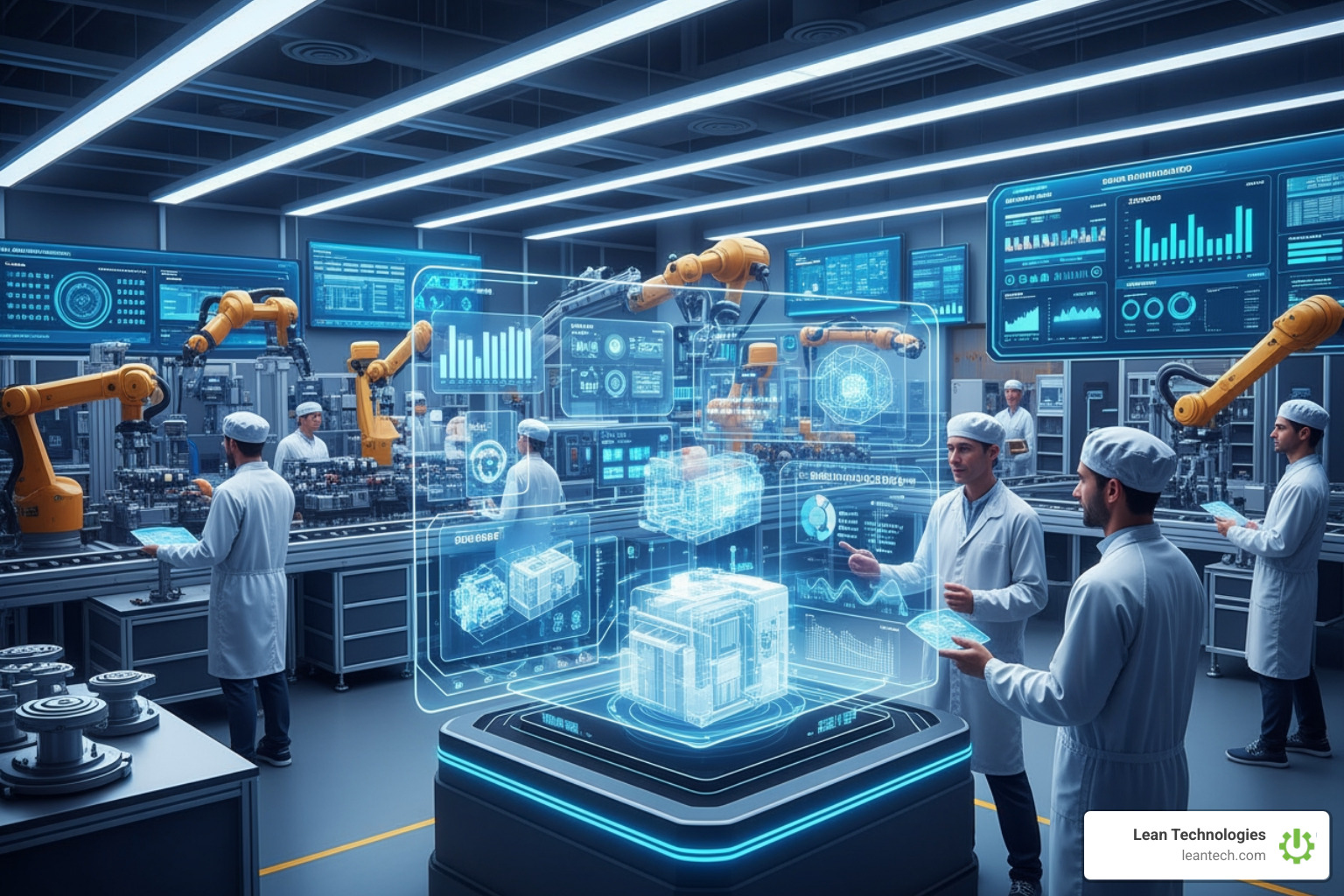
You’ve likely heard the buzz about "Digital Twins." In a smart factory, a digital twin is a computerized replica of a physical asset or process. It allows teams to run simulations—like testing a new line speed or a different material—without risking actual production time. For a Continuous Improvement Manager, this is a playground for optimization without the cost of downtime.
When you layer AI and machine learning on top of this data, you move from reactive to predictive. McKinsey research shows that a predictive maintenance strategy can reduce machine downtime by 30-50% and increase asset life by 20-40%. Instead of waiting for a bearing to seize and shutting down the whole line, the platform identifies vibration anomalies and triggers a work order before the failure occurs. This keeps the Maintenance Manager ahead of the curve and the production schedule on track.
Core Technologies Powering the Modern Shop Floor
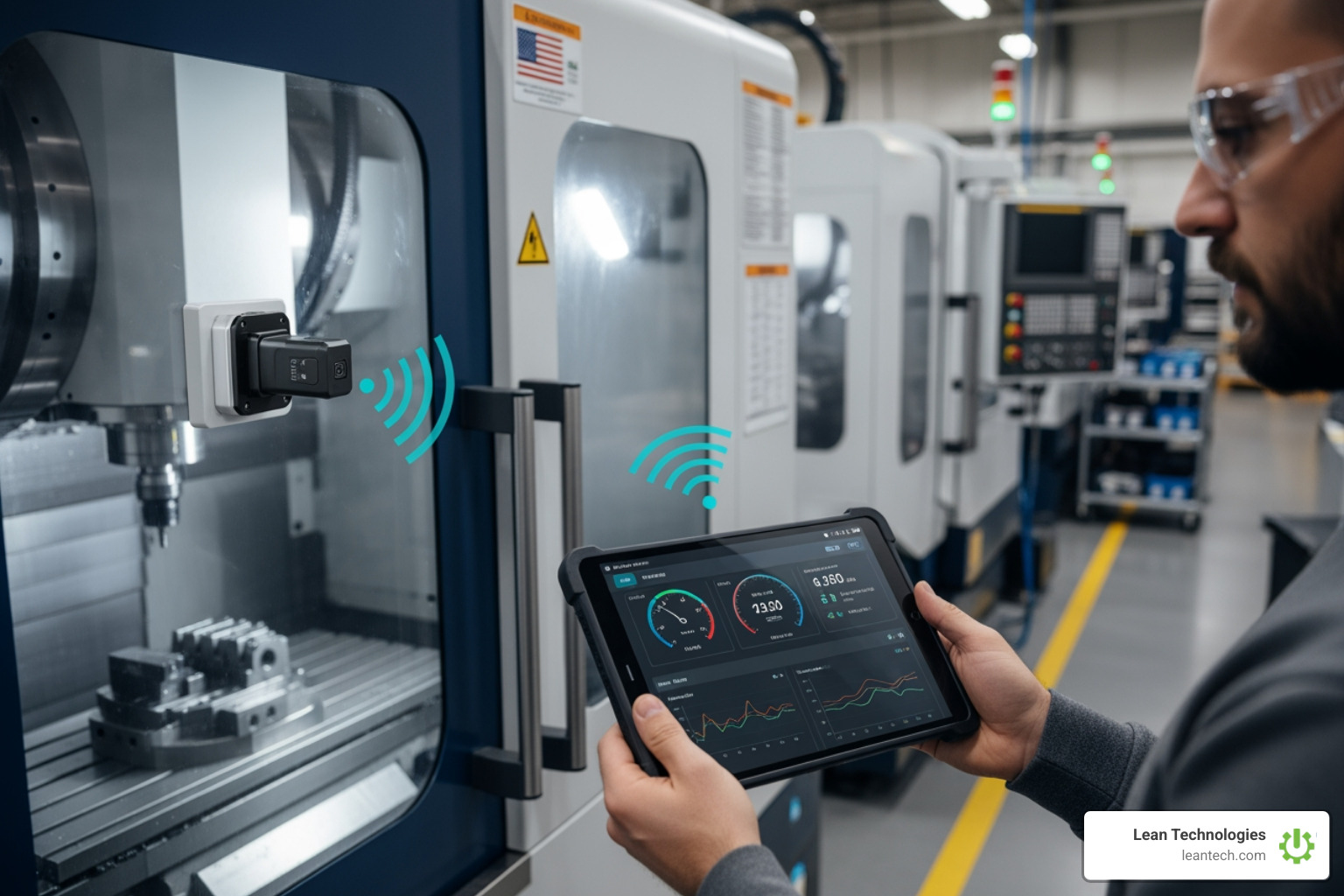
A modern smart manufacturing platform isn't just one piece of software; it’s an ecosystem. It starts with IIoT (Industrial Internet of Things) sensors that monitor everything from temperature to spindle speed. These sensors feed data to edge computing devices, which process the information locally for speed, before sending the big-picture data to a cloud-native infrastructure for deep analysis. This architecture ensures that you get the speed of local processing with the power of global data visibility.
Enhancing Maintenance and Quality Control
Maintenance shouldn't feel like "fighting fires." For most Maintenance Technicians, the day is spent reacting to emergencies. Smart platforms shift the focus to condition-based monitoring. If a motor starts running hot, the platform doesn't just send an alert—it automatically generates a work order in your maintenance management system. This allows the team to schedule the repair during a planned changeover rather than losing four hours of peak production.
For quality managers, this means predictive quality. By analyzing real-time data from the line, the platform can predict when a process is drifting out of spec. This cuts lab costs—sometimes by as much as 80% in industries like CPG—because you’re testing for prevention rather than just catching defects after they’ve been made. You stop making scrap before the first bad part even hits the bin.
Empowering the Frontline Workforce
The "skills gap" is a massive headache for HR and plant managers. As older workers retire, they take decades of experience with them. Smart platforms help bridge this gap by putting information directly into the hands of the people who need it, exactly when they need it.
Mobile-first platforms: Operators log issues and view instructions on tablets, not clipboards. This ensures data is entered at the source, in real-time, making it actually useful for decision-making.
Real-time alerts: Technicians get prescriptive guidance on how to fix a specific fault code, reducing the "guesswork" that leads to long repair times.
XR Training: Using tools like Microsoft HoloLens 2 or Autodesk VRED for on-the-job training helps close the skills gap by providing immersive, hands-on guidance without stopping a live line.
This focus on the frontline ensures that quality management becomes everyone’s responsibility. When an operator can see their own performance metrics in real-time, they take ownership of the results. It transforms the culture from "doing what I'm told" to "owning the process."
Key Benefits: Why Real-Time Visibility Beats "Real-Late" Data
The numbers don't lie. Manufacturers who move to a smart manufacturing platform see immediate, measurable impacts on their bottom line. It isn't just about "better data"; it's about better outcomes. When you remove the lag between an event and the response, you stop losing money to inefficiency.
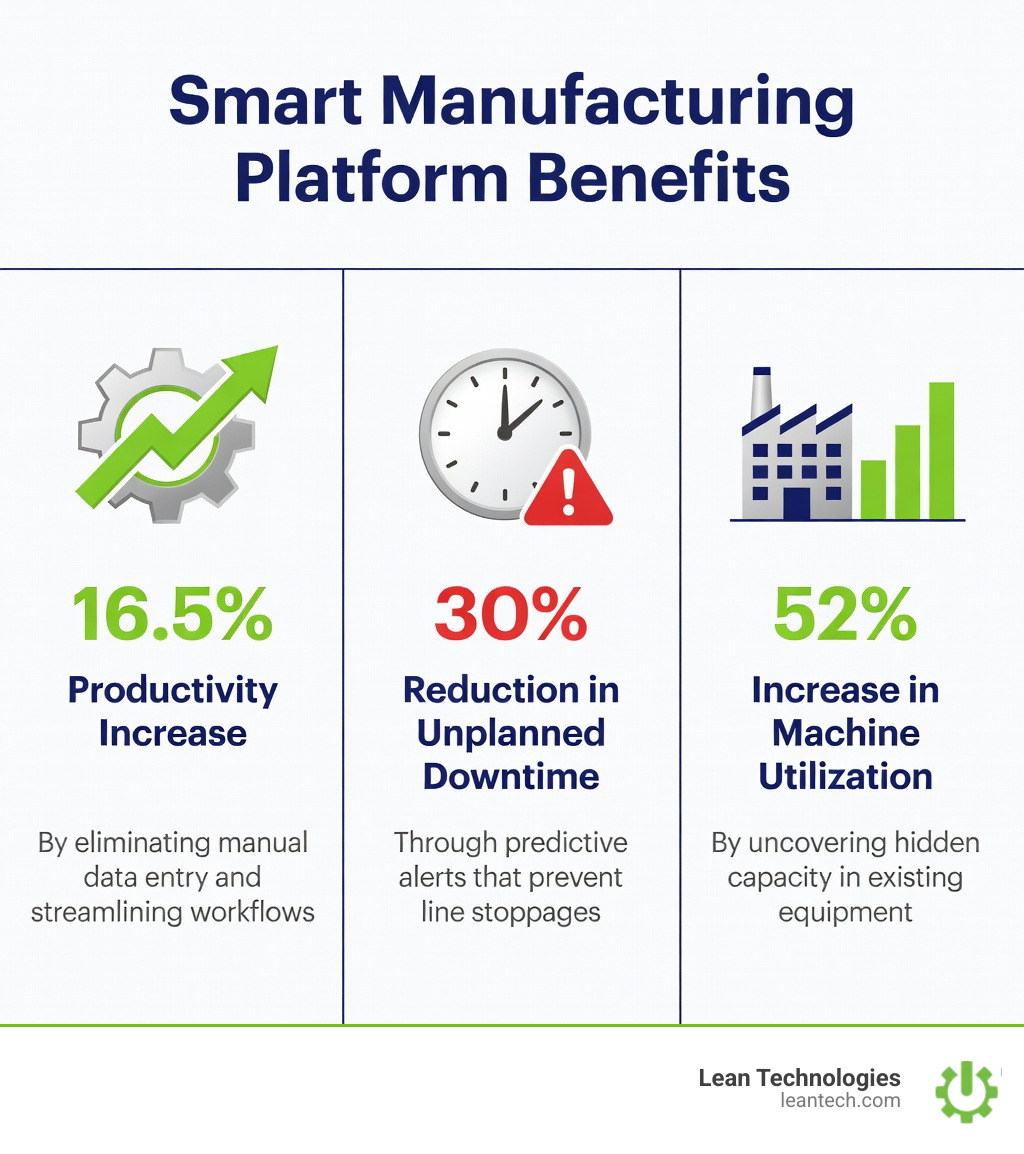
16.5% Productivity Increase: Achieved by eliminating manual data entry and streamlining communication. When operators aren't spending 30 minutes a shift filling out paper logs, they're spending 30 minutes more on value-added production.
30% Downtime Reduction: Predictive alerts catch issues before they stop the line. This means fewer "all-hands-on-deck" emergencies and a more predictable production schedule.
52% Utilization Increase: Identifying "hidden capacity" allows you to produce more with the machines you already have. Many plants find they don't need to buy a new machine; they just need to stop the existing ones from sitting idle for unknown reasons.
$50K+ Saved on Parts: Better inventory tracking prevents overspending on spare parts. You stop ordering "just in case" and start ordering "just in time" because you actually know what's in the cage.
Beyond the stats, there's the human element. When you have continuous improvement tools that actually work, your team feels more empowered and less frustrated by broken processes. High turnover is often driven by the frustration of working in a chaotic environment. A smart platform provides the structure that allows people to succeed, which is the best retention tool a company can have.
A Phased Approach to Implementing Your smart manufacturing platform
You don't have to automate the entire factory overnight. In fact, trying to do too much at once is a great way to fail. The most successful companies take a phased approach that builds momentum and proves ROI at every step:
Visibility First: Start by digitizing your basic logs. Get your downtime, production counts, and safety tracking off paper and onto screens. This provides the baseline data you need to identify your biggest "pain points."
Data Context: Link that data to specific products, shifts, and operators. This is where you move from knowing that you have downtime to knowing why you have downtime. You might find that a specific material or a specific shift is the root cause of your bottlenecks.
Standardization: Use those insights to create "best practice" workflows across all lines or sites. If Line 1 has found a way to reduce changeover time by 20%, use the platform to push that standard work to Line 2 and Line 3.
Scaling: Once you’ve proven the ROI on one line or one department, roll it out to the rest of the plant. This phased rollout minimizes risk and allows the team to learn and adapt the system to their specific needs.
By following this roadmap, you avoid the "pilot purgatory" where projects stall out because they were too ambitious or lacked clear goals. Start small, win fast, and then grow.
Frequently Asked Questions about Smart Manufacturing
Is smart manufacturing the same as Industry 4.0?
Not exactly. Industry 4.0 is the overall "revolution"—the environment where everything is connected via the internet and cloud. Smart manufacturing is the specific set of practices, tools, and software (like Thrive) that you use to get results within that environment. Think of Industry 4.0 as the highway and smart manufacturing as the high-performance vehicle you drive on it.
How long does it take to see ROI from a smart platform?
Most manufacturers see a "break-even" point within 12 to 18 months. However, simple wins—like a 30% reduction in unplanned downtime or catching a major quality drift early—can often pay for the software within the first few months of full adoption. The faster you get your team to enter data at the source, the faster the ROI appears.
Do I need to replace my existing ERP or MES?
No. A good smart manufacturing platform should complement your existing systems, not replace them. It acts as the "connective tissue" that handles the messy, real-time shop floor data that ERPs aren't built to manage. While an ERP is great for financial records and high-level planning, a smart platform is built for the minute-by-minute reality of the shop floor.
How does this help with safety and compliance audits?
By digitizing your safety tracking, you create an immutable, time-stamped record of every inspection and incident. When an auditor walks in, you aren't scrambling to find three-ring binders. You simply pull up the dashboard. This level of transparency usually leads to faster audits and fewer findings.
What if my operators aren't "tech-savvy"?
The best platforms are designed with the operator in mind. If they can use a smartphone to check the weather or send a text, they can use a well-designed smart manufacturing platform. The key is to provide a clean, intuitive interface that makes their job easier, not harder. When operators see that the tool helps them log issues faster than a paper form, adoption happens naturally.
What to do next
Stop managing your shop floor through spreadsheets and wishful thinking. If you're ready to move from "real-late" data to real-time action, it's time to look at a solution built by people who actually understand the shop floor. The cost of waiting is measured in lost productivity, wasted material, and frustrated employees.
Lean Technologies offers Thrive, an all-in-one, customizable shopfloor software designed to streamline your operations without the headache of a total system overhaul. Whether you're looking to boost productivity, improve profit, or finally get a handle on your maintenance backlog, Thrive provides the cohesive, integrated platform your team needs. We don't just provide software; we provide a path to a more efficient, accountable, and profitable operation.
Let your team run lean—with real-time visibility and fewer workarounds.
Explore how Thrive can transform your shop floor at LeanTech.com