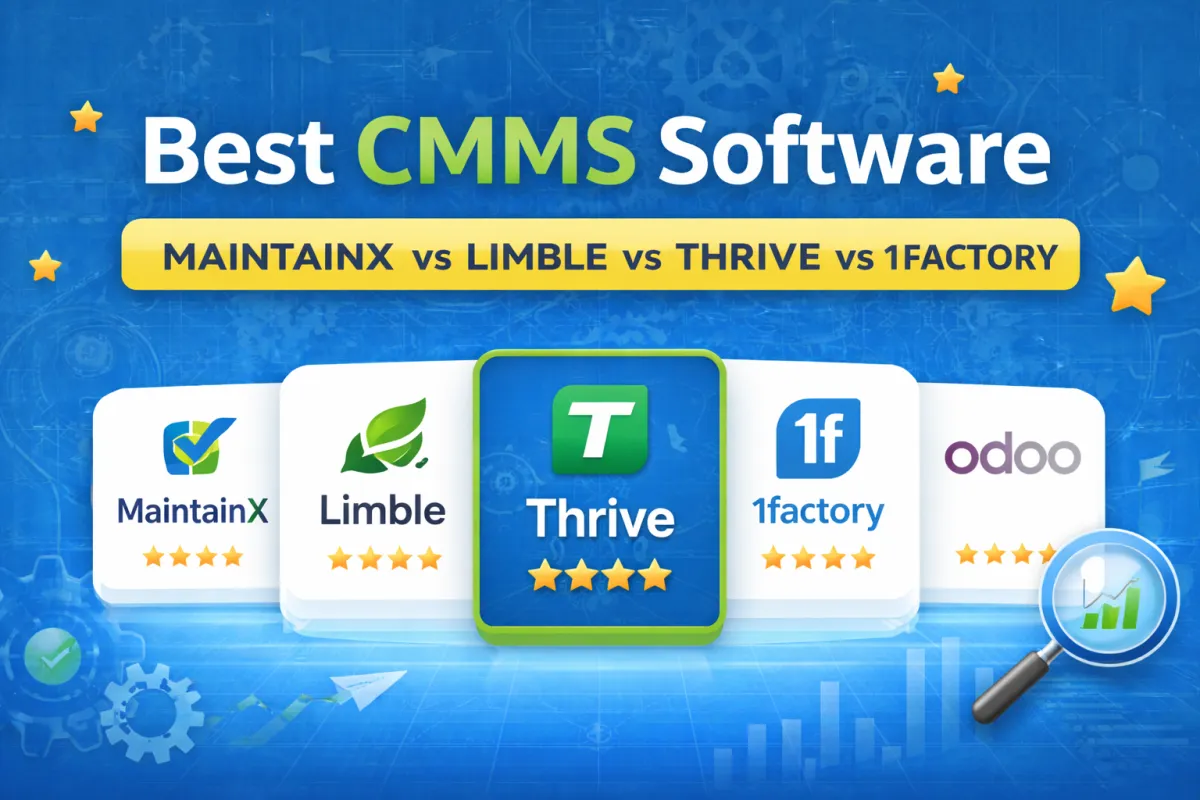
Thrive vs. MaintainX vs. Limble CMMS vs. Odoo vs. 1factory
CMMS Comparison: MaintainX vs Limble CMMS vs Odoo vs 1factory vs Thrive
CMMS comparison is one of the most searched topics in manufacturing software — because choosing the wrong system slows everything down.
You’re probably asking:
Should we go with MaintainX or Limble?
Is Odoo enough?
Do we need a full ERP?
What about 1factory for quality?
And where does Thrive fit?
If you’re a 50–500 employee manufacturer trying to reduce downtime, clean up spreadsheets, and drive real accountability on the shop floor, this decision matters more than you think.
Let’s break it down clearly.
No fluff.
No buzzwords.
Just what each platform does — and who it’s actually built for.
What a Traditional CMMS Actually Does
A CMMS (Computerized Maintenance Management System) helps you:
Track assets
Schedule preventive maintenance
Manage work orders
Control spare parts inventory
Log downtime
That’s it.
And for many maintenance teams, that’s enough.
But here’s the real question:
Is maintenance the only problem your plant is trying to solve?
Most growing manufacturers don’t just struggle with PM scheduling.
They struggle with:
Paper-based quality tracking
Safety incidents living in email
CI projects stuck in spreadsheets
Downtime data that never closes the loop
No real-time visibility across departments
That’s where the difference between a maintenance tool and a digital operations platform becomes clear.
Let's Begin Here
Effective maintenance and quality management are crucial. Several software solutions cater to these needs, including MaintainX, 1factory, Limble CMMS, and Thrive. This article compares these platforms to help you make an informed decision. Learn more about the differences when comparing MaintainX vs. 1factory vs Limble CMMS vs Thrive, or if you’re looking for MaintainX alternatives.
Discover how the top shop floor software for manufacturing stacks up. Compare MaintainX vs. Limble CMMs vs. Odoo vs. 1factory vs Thrive.
Thrive
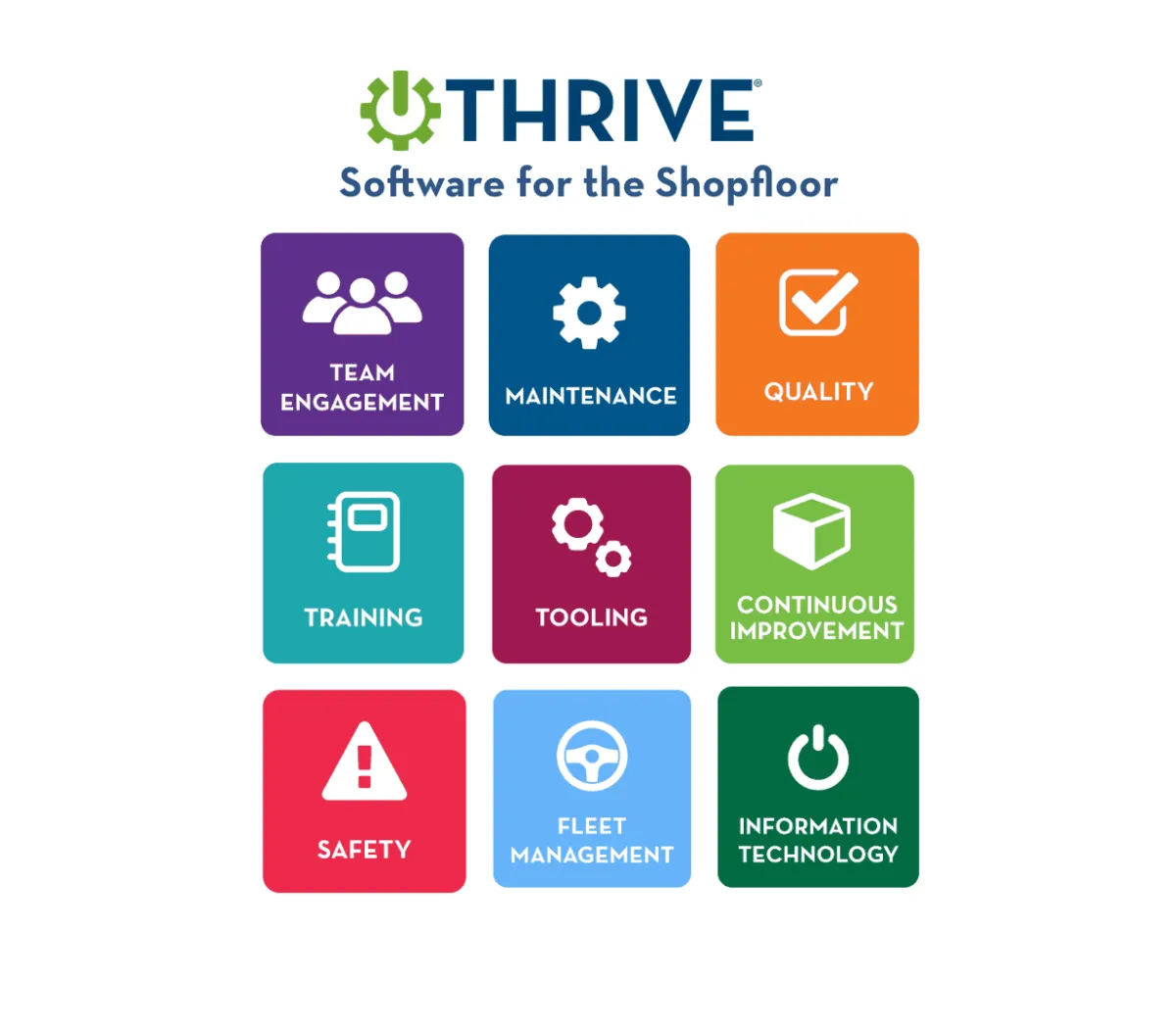
Thrive is an all-in-one shop floor management platform designed to organize, visualize, and act upon manufacturing data. It integrates various functional modules to streamline operations.
Key Features:
Centralized Data Hub: Serves as a central repository for all shop floor data, enhancing clarity leader-standard work, and accessibility.
Modular Approach: Offers modules for maintenance, safety, continuous improvement, quality, human resources, and project management, allowing businesses to customize the platform to their needs.
Real-Time Reporting: Provides sharable, real-time reports and personalized dashboards for informed decision-making.
Integration Capabilities: Integrates with ERP systems and machinery, ensuring seamless data flow across operations.
Thrive is particularly suited for organizations seeking a comprehensive, integrated solution to manage various aspects of shop floor operations.
MaintainX
MaintainX is a mobile-first platform designed for maintenance and operations management. It offers work order management, preventive maintenance scheduling, asset tracking, and real-time messaging. The software emphasizes user-friendly interfaces and real-time communication to enhance team collaboration. MaintainX also provides AI-powered features like anomaly detection and voice memo transcriptions to streamline workflows.
1factory
1factory focuses on quality control and quality management for manufacturers. It digitizes processes such as document control, training management, quality planning, inspection, statistical process control (SPC), and gage calibration. The platform aims to simplify quality management, improve factory yield, and ensure compliance with industry standards.
Odoo
An all-in-one business management software that offers a comprehensive suite of applications, including ERP, CRM, inventory management, and accounting. Known for its modular approach, Odoo allows manufacturers to start with basic features and expand as needed. Its open-source model provides flexibility and customization, making it a popular choice for businesses of all sizes. With strong ERP integration and a user-friendly interface, Odoo helps streamline production workflows, inventory control, and financial management on the shop floor.
Limble CMMS
Limble CMMS is a comprehensive maintenance management system offering work order management, preventive maintenance automation, asset tracking, and inventory management. It provides features like predictive maintenance through IoT sensor integration and customizable dashboards for detailed reporting. Limble emphasizes flexibility and scalability, catering to both small teams and large enterprises.
Thrive
Thrive is an all-in-one shop floor management platform that offers a suite of modules, including maintenance, safety, continuous improvement, quality, human resources, and project management. It serves as a central hub for shop floor data, providing real-time visibility, streamlined workflows, and accountability tools. Thrive is designed to integrate seamlessly with existing systems, aiming to reduce inefficiencies and enhance operational performance.
Comparison Summary
Focus Areas:
MaintainX: Maintenance and operations management with a strong emphasis on real-time communication and AI-powered workflow enhancements.
1factory: Quality control and management, focusing on digitizing and automating quality assurance processes.
Limble CMMS: Comprehensive maintenance management with advanced features like predictive maintenance and customizable reporting.
Thrive: Holistic shop floor management encompassing various operational modules for integrated data management and process optimization that allows for you to scale without any added cost – all modules and unlimited users are appointed thereof.
Key Features:
MaintainX: Real-time messaging, AI-powered anomaly detection, voice memo transcriptions, user-friendly mobile interface.
1factory: Document control, training management, inspection data collection, SPC, gage calibration.
Limble CMMS: IoT sensor integration for predictive maintenance, customizable dashboards, asset and inventory management.
Thrive: Modular approach covering maintenance, safety, quality, and more; real-time data visibility; as well as real-time notifications and escalations. This allows for a people-centric culture through innovative tools and workflows.
Usability:
MaintainX: Known for its intuitive mobile application, it facilitates easy adoption among field technicians.
1factory: Offers a user-friendly interface tailored for quality management professionals.
Limble CMMS: Provides a balance between feature richness and ease of use, with customizable options to fit various organizational needs.
Thrive: Designed for seamless integration and user-friendly navigation across its multiple modules, with the benefits of a user-friendly mobile interface.
Scalability:
MaintainX: Suitable for small to medium-sized businesses looking for straightforward maintenance management solutions.
1factory: Ideal for manufacturers aiming to enhance their quality control processes, regardless of size.
Limble CMMS: Scales effectively from small teams to large enterprises with complex maintenance requirements.
Thrive: Offers scalability through its modular design, allowing organizations to adopt functionalities as needed. Provides unlimited users and an ability to integrate with other systems or to build custom solutions within it.
Selecting the right software to manage shop floor operations is crucial. Several solutions offer unique features tailored to different aspects of production management. Below is a comprehensive analysis of five popular platforms: MaintainX, Limble CMMS, Odoo, 1factory, and Thrive.
MaintainX
MaintainX is a cloud-based Computerized Maintenance Management System (CMMS) designed to streamline maintenance and operations. It focuses on real-time communication and efficient work order management.
Key Features:
Real-Time Messaging: Facilitates instant communication among team members, allowing sharing of images, documents, and updates to expedite issue resolution.
Advanced Root Cause Analysis: Offers custom asset statuses for accurate root cause analysis and real-time monitoring, enhancing equipment reliability.
Precise Downtime Tracking: Enables recording of downtime during work request submissions or work order creations, providing immediate insights into asset status.
Robust ERP Integrations: Integrates seamlessly with major ERP systems like SAP, Oracle, and Microsoft Dynamics 365, ensuring cohesive data flow across platforms.
MaintainX is particularly suitable for organizations seeking to enhance maintenance operations with real-time communication and detailed analytics.
Limble CMMS
Limble CMMS is a versatile maintenance management platform emphasizing user-friendliness and comprehensive asset management. It caters to organizations aiming to optimize maintenance workflows and asset performance.
Key Features:
Customization: Allows easy creation of new asset fields and tailored workflows, enabling organizations to adapt the system to their specific needs.
Enterprise-Level Scalability: Designed to support both small teams and large enterprises, offering flexibility to grow with organizational demands.
Preventive Maintenance Automation: Automates scheduling and assignment of preventive maintenance tasks, reducing unplanned downtime.
Spare Parts Inventory Management: Provides a searchable database of parts with automatic reordering to ensure critical components are always in stock.
Limble CMMS is ideal for organizations looking for a scalable and customizable maintenance management solution.
1factory
1factory specializes in quality control and quality management, providing tools to digitize and automate inspection processes in manufacturing environments.
Key Features:
Inspection Data Collection: Simplifies data collection for inspections, first articles, and production parts approval processes (PPAP).
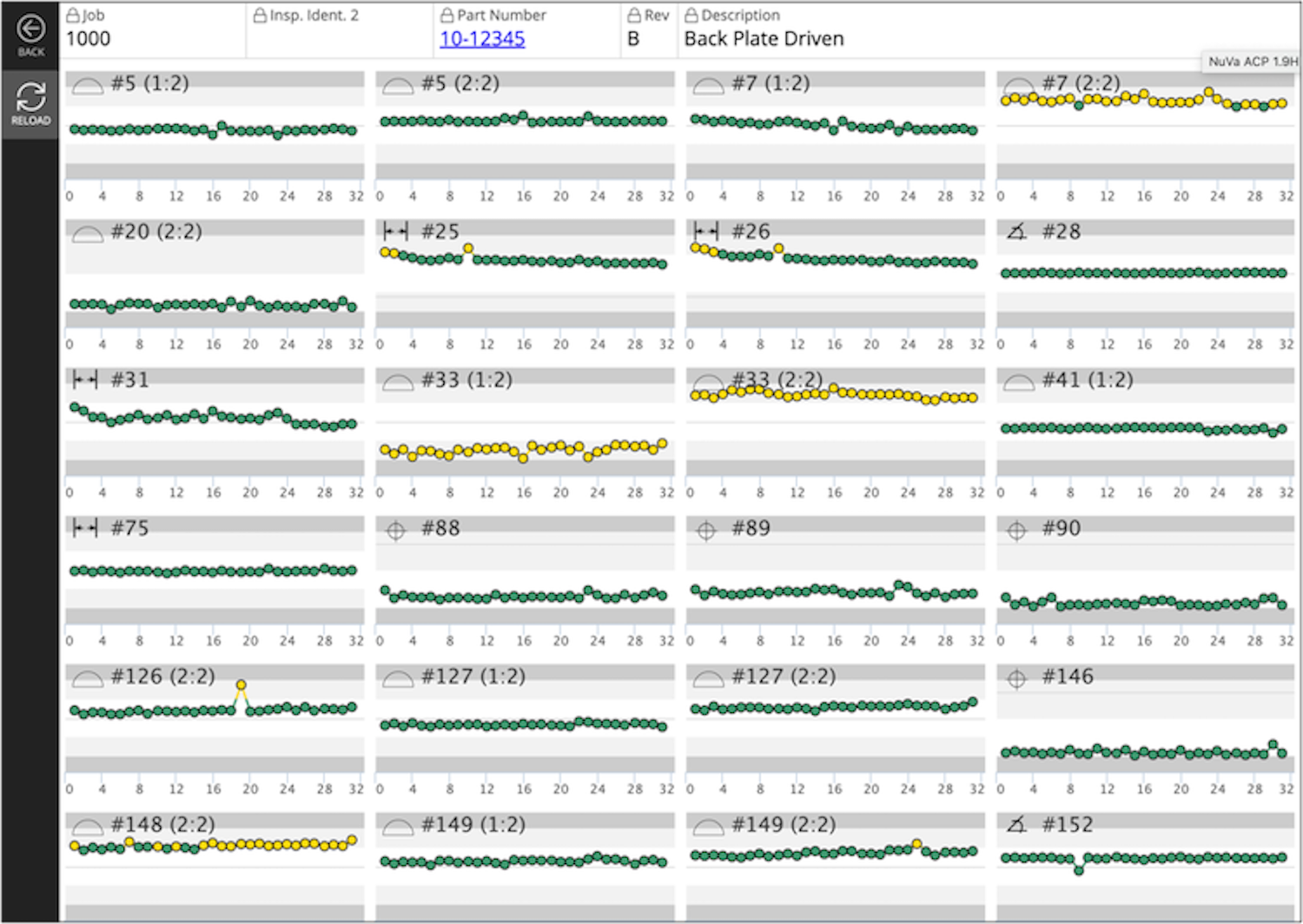
Statistical Process Control (SPC): Offers real-time SPC charts to monitor manufacturing processes and maintain quality standards.
Gage Management: Manages calibration schedules and records for measurement instruments, ensuring accuracy in inspections.
Supplier Quality Management: Facilitates collaboration with suppliers on quality issues, streamlining communication and corrective actions.
1factory is ideal for manufacturers focusing on stringent quality control and compliance with industry standards.
MaintainX
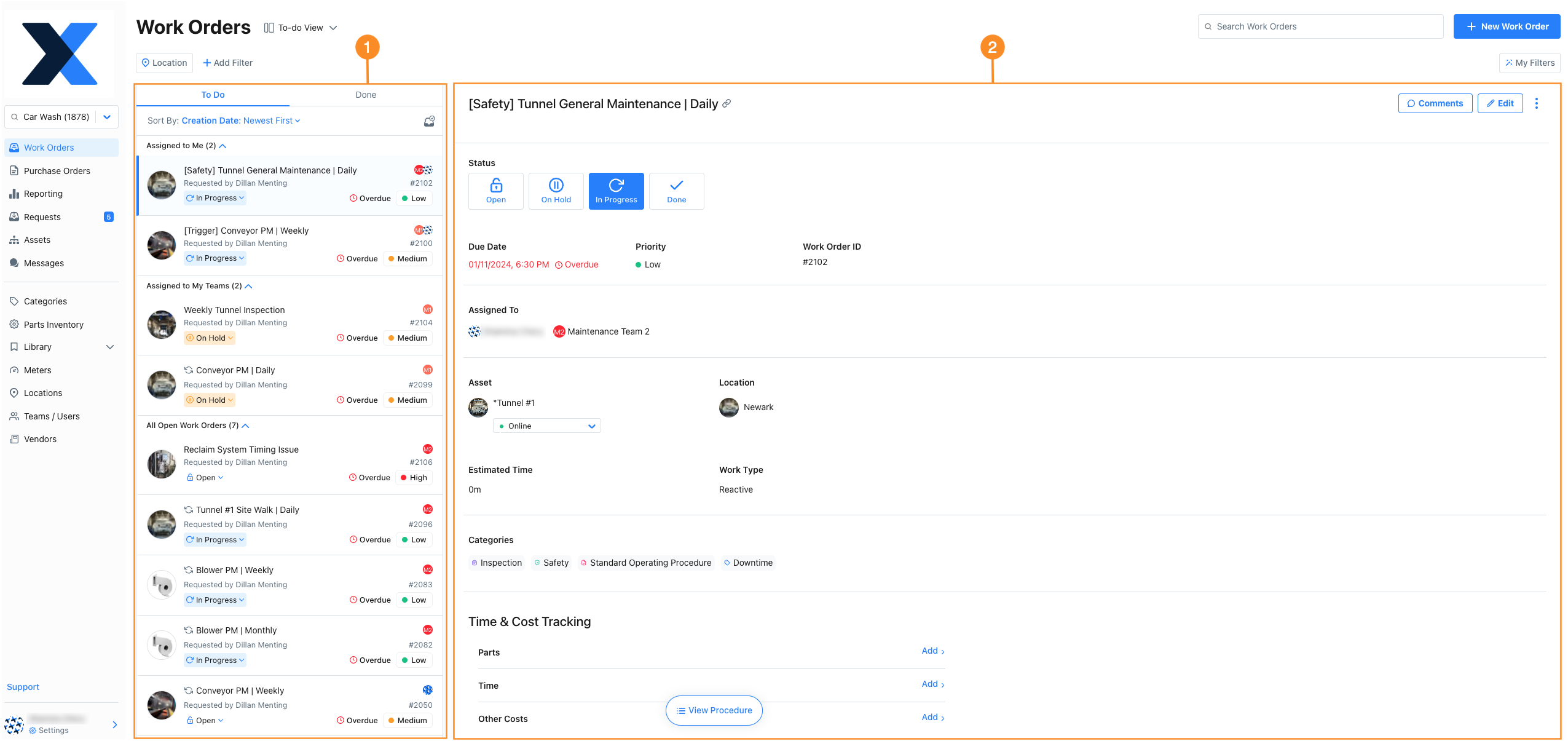

What it is:
A mobile-first CMMS focused on maintenance and work order management.
Strengths:
Very easy to use
Strong mobile experience
Fast technician adoption
Simple PM scheduling
Solid for small maintenance teams
Limitations:
Primarily maintenance-focused
Limited cross-department functionality
Not built as a plant-wide lean operations system
MaintainX is ideal if:
You’re a maintenance manager who wants to get out of paper work orders quickly.
It’s not designed to manage your quality program, CI events, safety workflows, or plant-wide accountability.
Limble CMMS
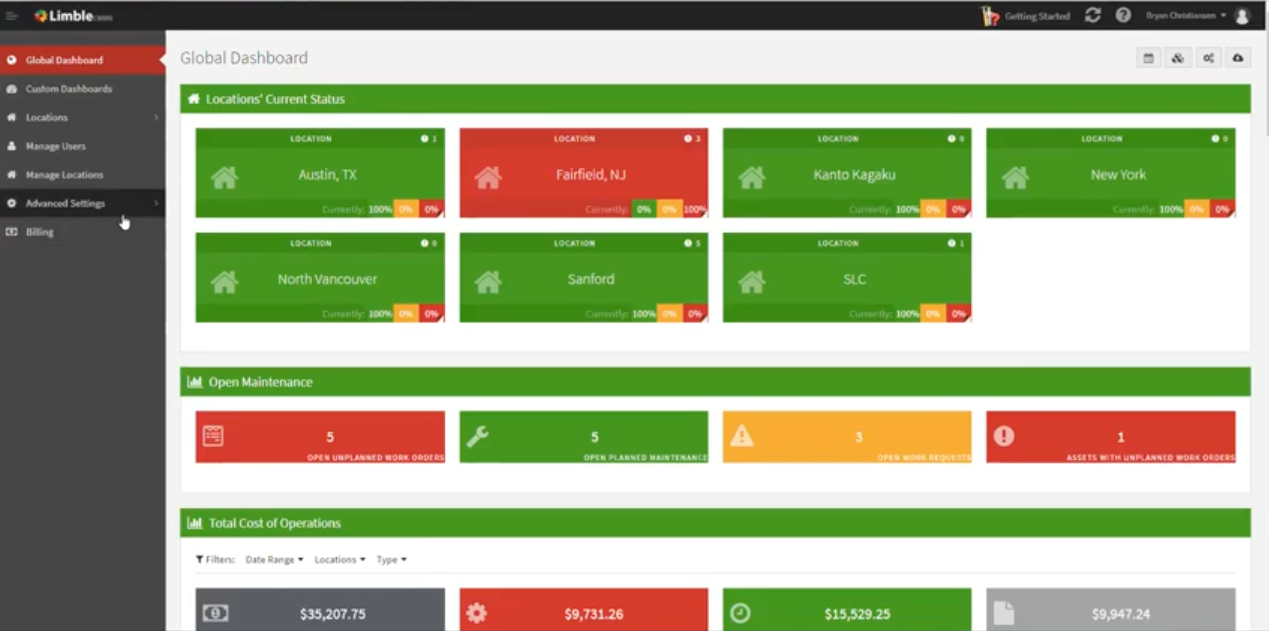
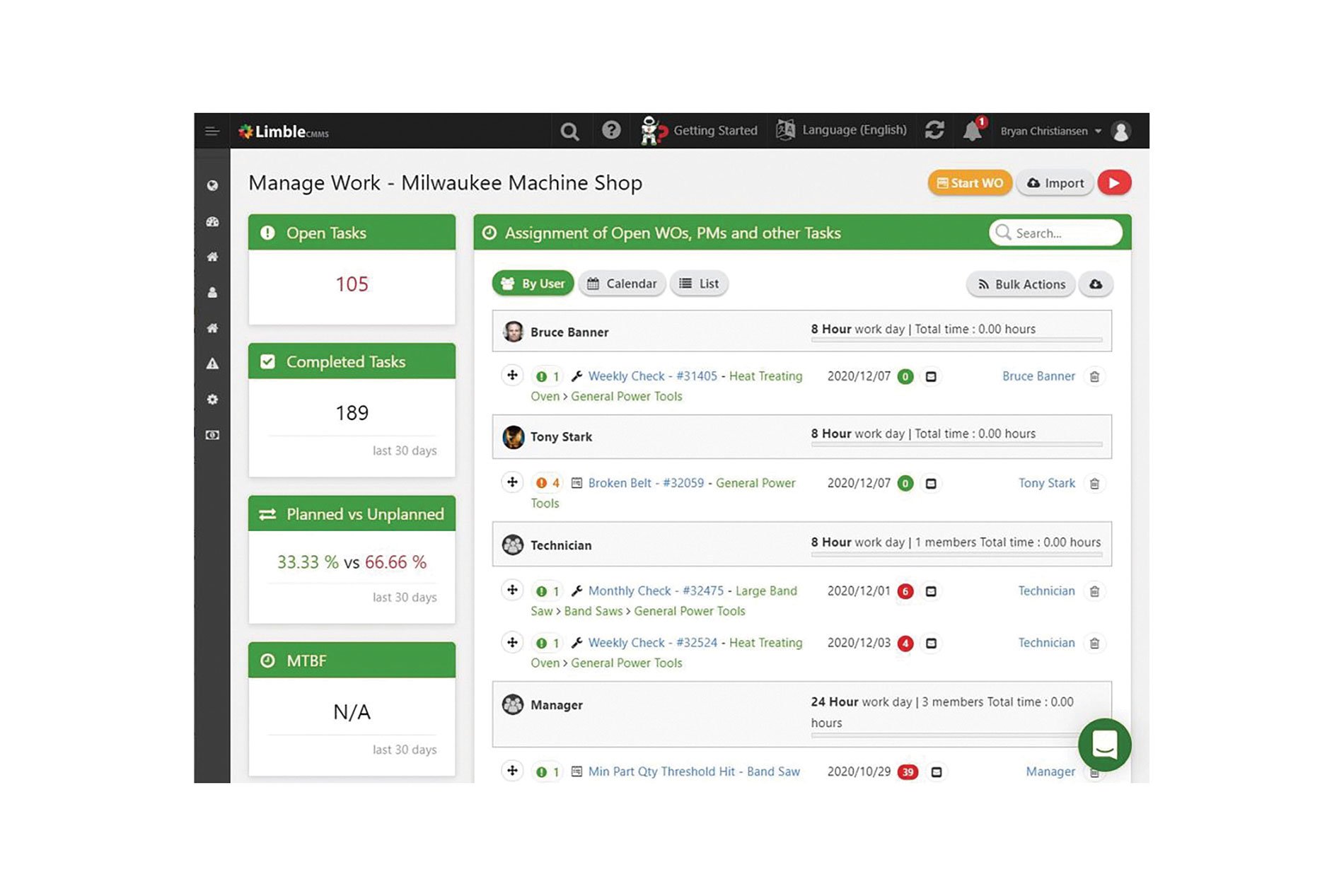

What it is:
A modern CMMS platform focused on preventive maintenance and asset tracking.
Strengths:
Clean UI
Strong PM automation
Asset hierarchy structure
Reporting focused on maintenance KPIs
Limitations:
Maintenance-centric
Limited quality or CI integration
Not designed as a lean operating system
Limble vs MaintainX usually comes down to feature depth vs simplicity.
Both are solid CMMS platforms.
Neither is built to digitize your entire lean system.
Odoo
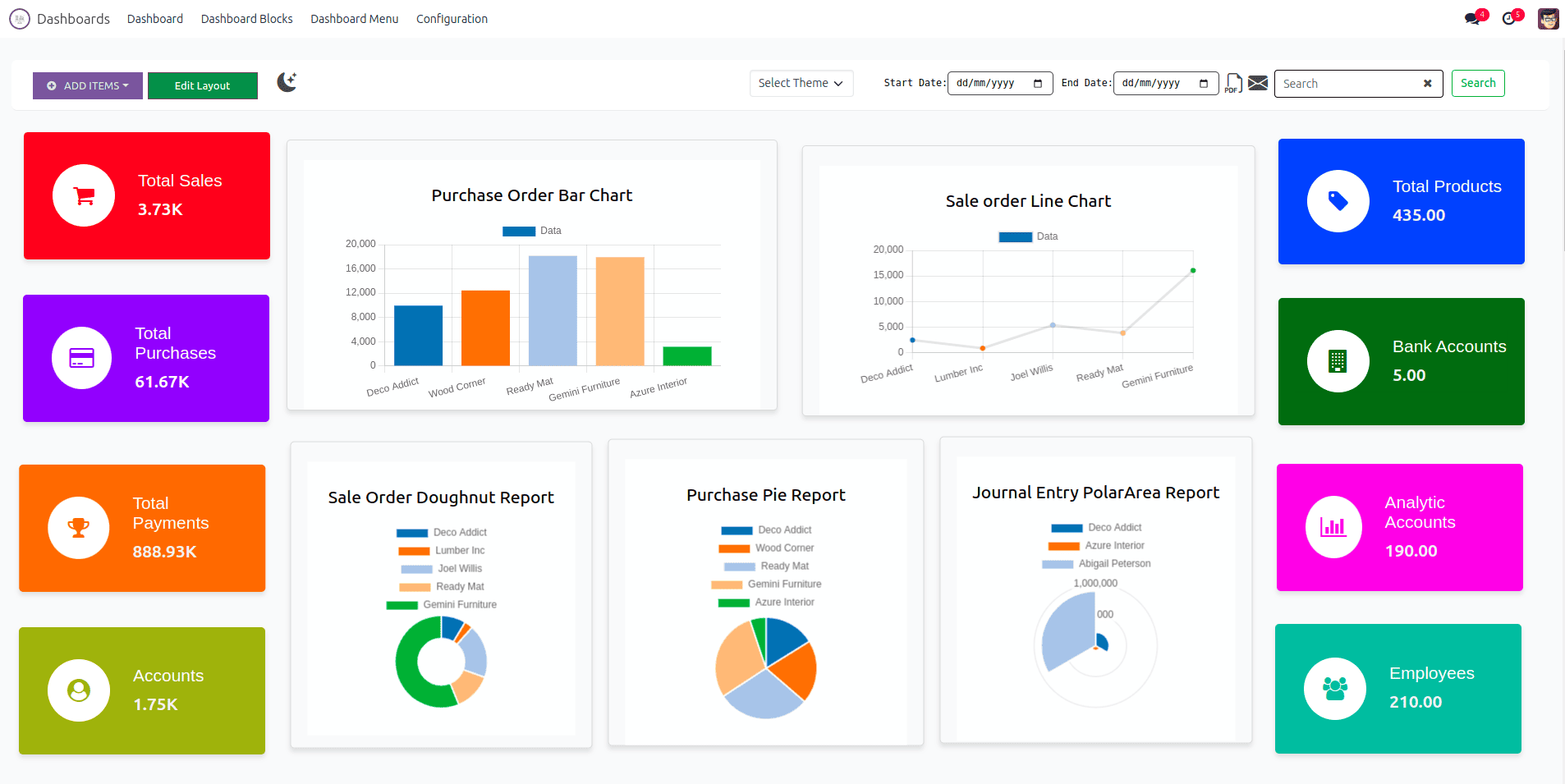
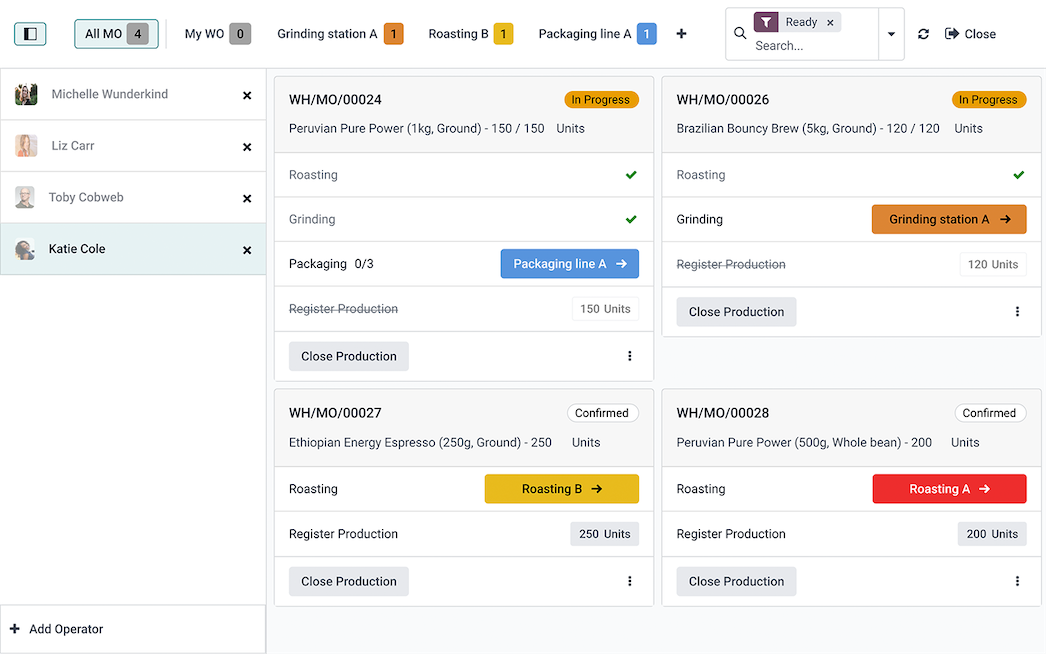
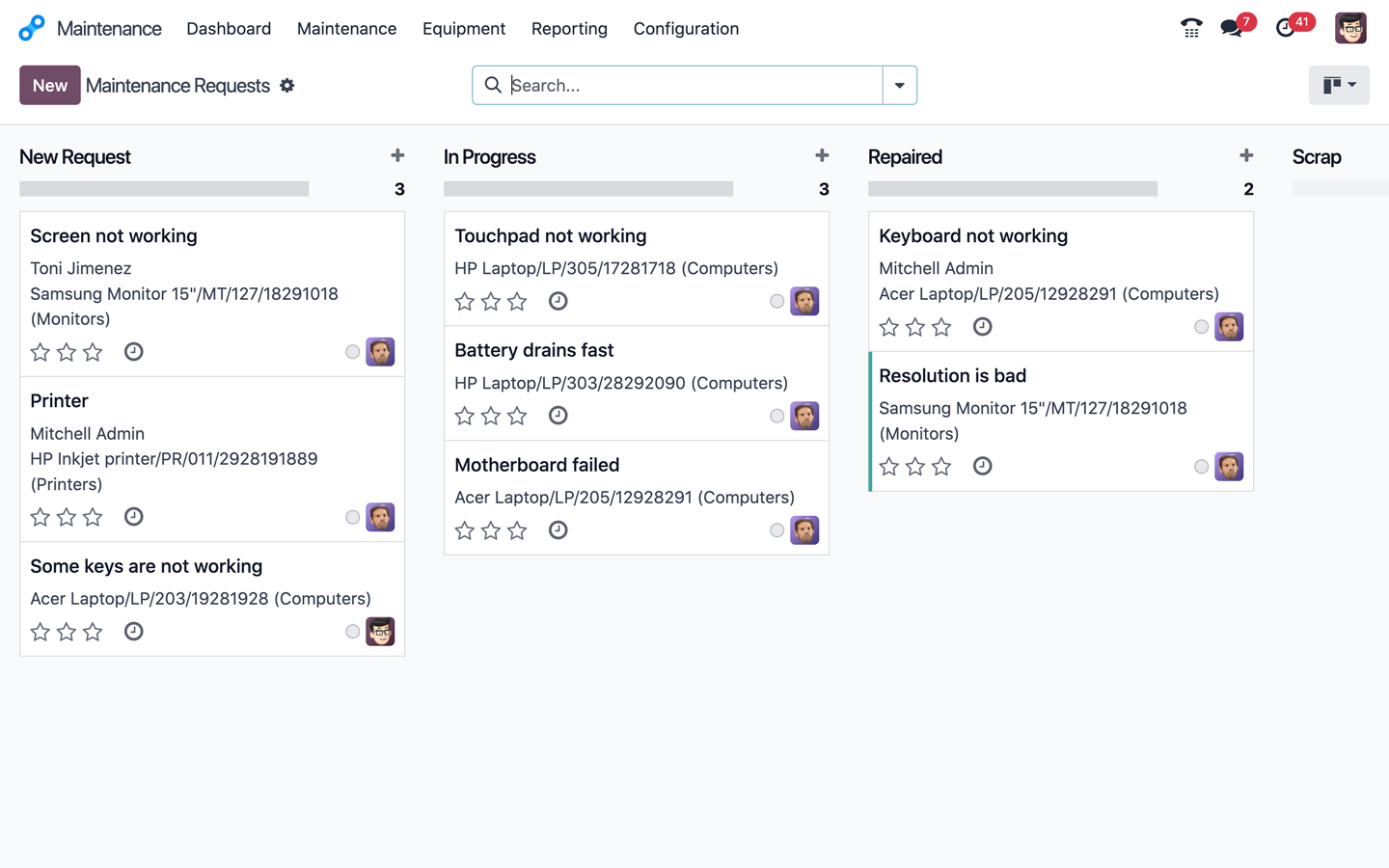
What it is:
An ERP system with optional maintenance and manufacturing modules.
Strengths:
Full ERP capabilities
Financial tracking
Inventory, purchasing, sales integration
Customizable modules
Limitations:
Not built specifically for shop floor usability
Maintenance is one module inside a broader ERP
Can become complex quickly
If you’re comparing Odoo vs CMMS platforms, the real question is:
Do you need enterprise financial control?
Or do you need fast, operator-driven shop floor visibility?
ERP systems are critical.
But they aren’t designed to run daily lean work processes on the floor.
1factory
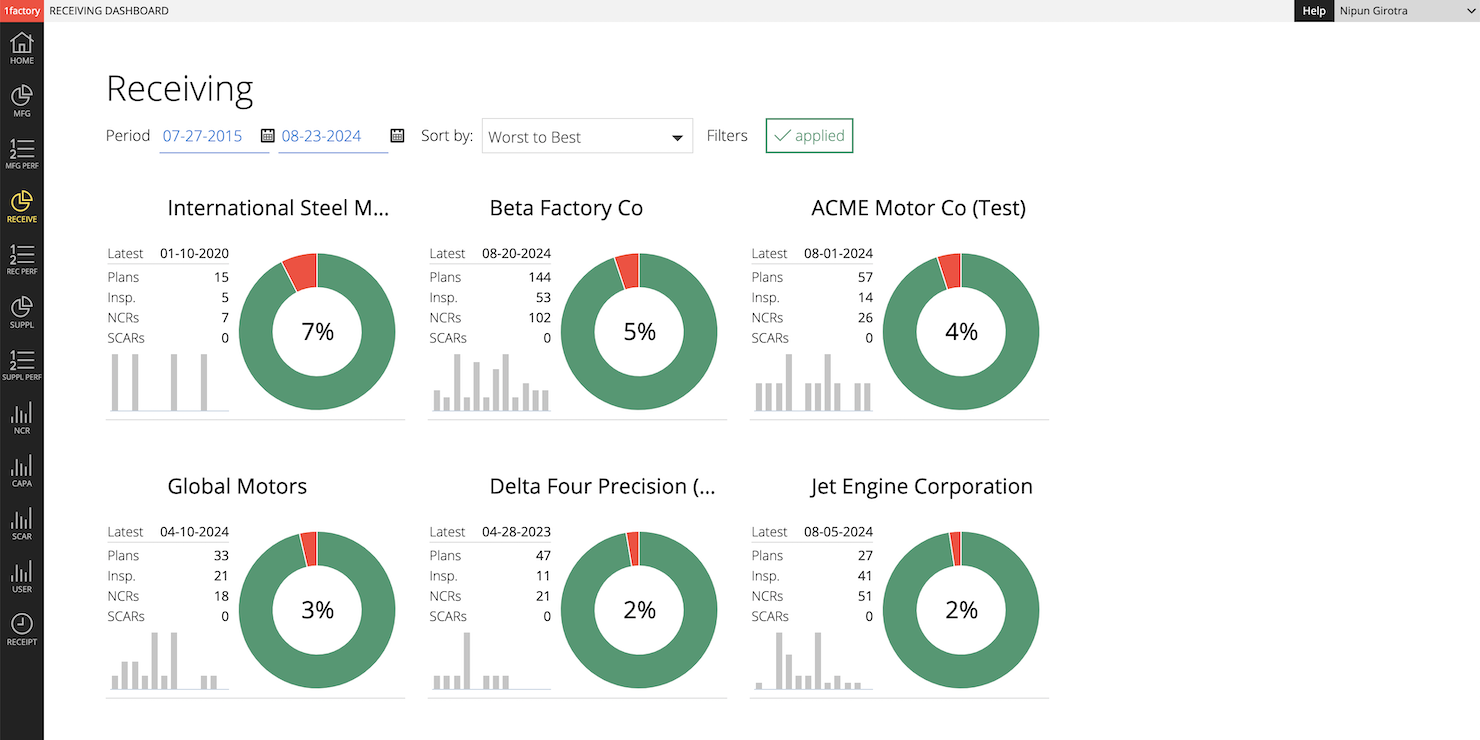
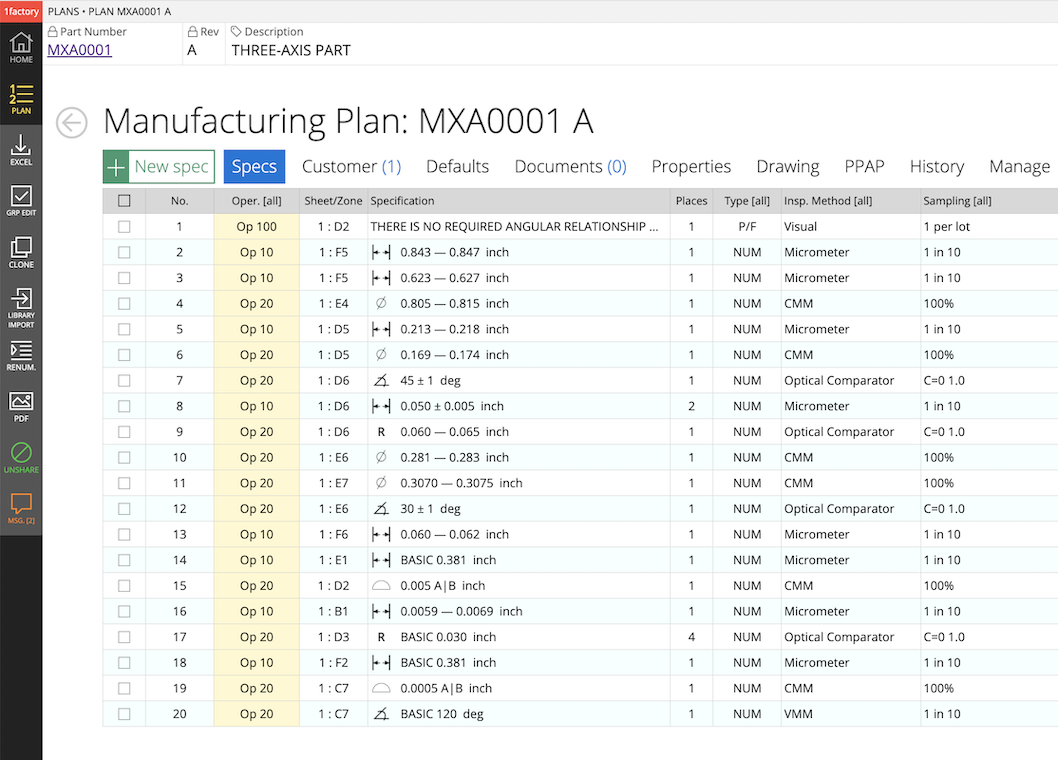
What it is:
A quality management and inspection-focused platform.
Strengths:
Strong inspection workflows
SPC tracking
Quality analytics
Supplier quality use cases
Limitations:
Quality-focused only
Not a full maintenance platform
Not a plant-wide operational system
1factory is strong for manufacturers who want better inspection control and analytics.
But it doesn’t manage maintenance, safety, CI, or operator-driven workflows across departments.
Thrive

What it is:
A digital lean operations platform built specifically for small to midsize manufacturers.
Not an ERP.
Not an MES.
Not a predictive machine monitoring system.
Thrive focuses on making shop floor processes visible, accountable, and actionable in real time.
As long as operators enter the data, you get minute-by-minute visibility.
What Makes Thrive Different
1. It’s Not Maintenance-Only
Yes, Thrive includes:
Work orders
Preventive maintenance
Downtime tracking
Spare parts inventory
But it also includes:
Quality (non-conformance, audits, calibration)
Safety (incident tracking, OSHA logs, SDS management)
Continuous improvement (go boards, projects, time studies)
That means one platform.
One login.
One consistent workflow system across departments.
2. It Drives Accountability
Thrive doesn’t predict downtime.
It doesn’t monitor vibration sensors.
It doesn’t replace your PLC system.
What it does is:
Make downtime visible immediately
Assign ownership
Trigger notifications
Close the loop
Track recurring issues
It organizes and drives action from machine data.
That’s a huge difference.
3. It Supports Digital Lean
Digital lean isn’t about more dashboards.
It’s about faster problem-solving, real-time visibility, and structured work processes.
Thrive supports:
Standardized processes
Real-time operator input
Cross-functional visibility
Faster root cause tracking
Actionable leading indicators
Paper systems create lag.
Lag creates blind spots.
Blind spots create waste.
Thrive removes the lag.
Side-by-Side Snapshot
Pricing Comparison
When people search “MaintainX pricing”, “Limble pricing”, or “Odoo cost”, they’re not casually browsing.
They’re budgeting.
They’re comparing.
They’re deciding.
Here’s a clear snapshot based on publicly available pricing tiers and common buyer experiences.
⚠️ Note: Pricing can change. Always confirm directly with the vendor.
Pricing Comparison Table
What This Actually Means
MaintainX Pricing
Entry-level plans are attractive for small teams.
Per-user pricing can scale quickly.
Works well for small maintenance departments.
Free plan is limited but good for trial.
Best if: You want a low barrier to entry and simple maintenance tracking.
Limble Pricing
Typically, higher per-user cost than MaintainX.
Stronger maintenance feature depth.
No true free tier.
Implementation support varies.
Best if: You’re investing specifically in a maintenance-first system.
Odoo Cost
Core ERP pricing looks affordable.
Costs increase as you add modules.
Customization and implementation can add significantly.
ERP projects typically require internal IT resources.
Best if: You’re building around financial and ERP control, not just shop floor execution.
1factory Pricing
Pricing is typically custom.
Positioned as a quality analytics platform.
Cost depends on inspection volume and user count.
Best if: Quality inspection and SPC are your primary focus.
Thrive Pricing
Thrive does not price per user.
That matters.
Unlimited users at your site.
Built for plant-wide adoption.
Onboarding and setup support included.
Pricing based on facility size and scope.
That means:
You’re not penalized for adding operators, supervisors, CI leaders, or maintenance techs.
Which is critical for digital lean adoption.
The Real Pricing Question
It’s not just:
“What’s the cheapest?”
It’s:
How many users will you need?
Will you expand beyond maintenance?
Will you need multiple disconnected tools?
Will implementation drag for months?
Sometimes the cheapest per-user software becomes the most expensive system long term.
Because you end up buying:
A CMMS
A separate quality system
A safety tracking tool
A CI project tracker
And now you’re integrating four systems.
Quick Take on Pricing
Lowest barrier entry → MaintainX
Maintenance-focused mid-tier → Limble
ERP investment play → Odoo
Quality-first investment → 1factory
Plant-wide digital lean platform → Thrive
When people search MaintainX pricing, Limble pricing, or Odoo cost, they’re really asking:
“What will this actually cost my plant over 3–5 years?”
The answer depends on whether you’re buying a tool.
Or building a system.
Pricing comparison matters — but total operational impact matters more.
Limitations of Each System
No software is perfect.
If an article only talks about strengths, it reads like a sales page.
Here’s the balanced view buyers are actually looking for.
MaintainX Limitations
Primarily maintenance-focused
Limited built-in quality management tools
Minimal continuous improvement functionality
Not designed as a plant-wide lean platform
Per-user pricing can scale quickly as adoption grows
MaintainX works well for maintenance teams.
But it’s not built to digitize your entire operation.
Limble Limitations
Strong for maintenance only
Not built for production management
Limited quality and safety functionality
CI tools are minimal
Per-user pricing can increase total cost at scale
Limble is a solid CMMS.
It’s not a cross-department operations system.
Odoo Limitations
ERP-first design, not shop-floor-first
Maintenance is one module among many
Can require customization to fit manufacturing workflows
Implementation can become complex
Often needs internal IT support
Odoo excels at transactional control.
It’s not optimized for operator-driven, real-time lean execution.
1factory Limitations
Focused primarily on quality and inspections
Not a full maintenance platform
Limited safety functionality
Not built for CI or production tracking
Pricing not publicly transparent
1factory is strong for quality analytics.
But it doesn’t replace a CMMS or plant-wide operations platform.
Thrive Limitations
Not an ERP system
Does not provide direct machine sensor monitoring
Does not generate predictive maintenance alerts
Requires operator data entry for real-time visibility
May be broader than needed for plants seeking only simple work orders
Thrive focuses on structured, operator-driven workflows.
It organizes and drives action from machine and process data — but it does not sense or predict machine behavior on its own.
Shop Floor Software Comparison Reviews
Capterra Ratings Comparison
When you’re evaluating CMMS software, features matter.
Pricing matters.
But real-world user feedback matters even more.
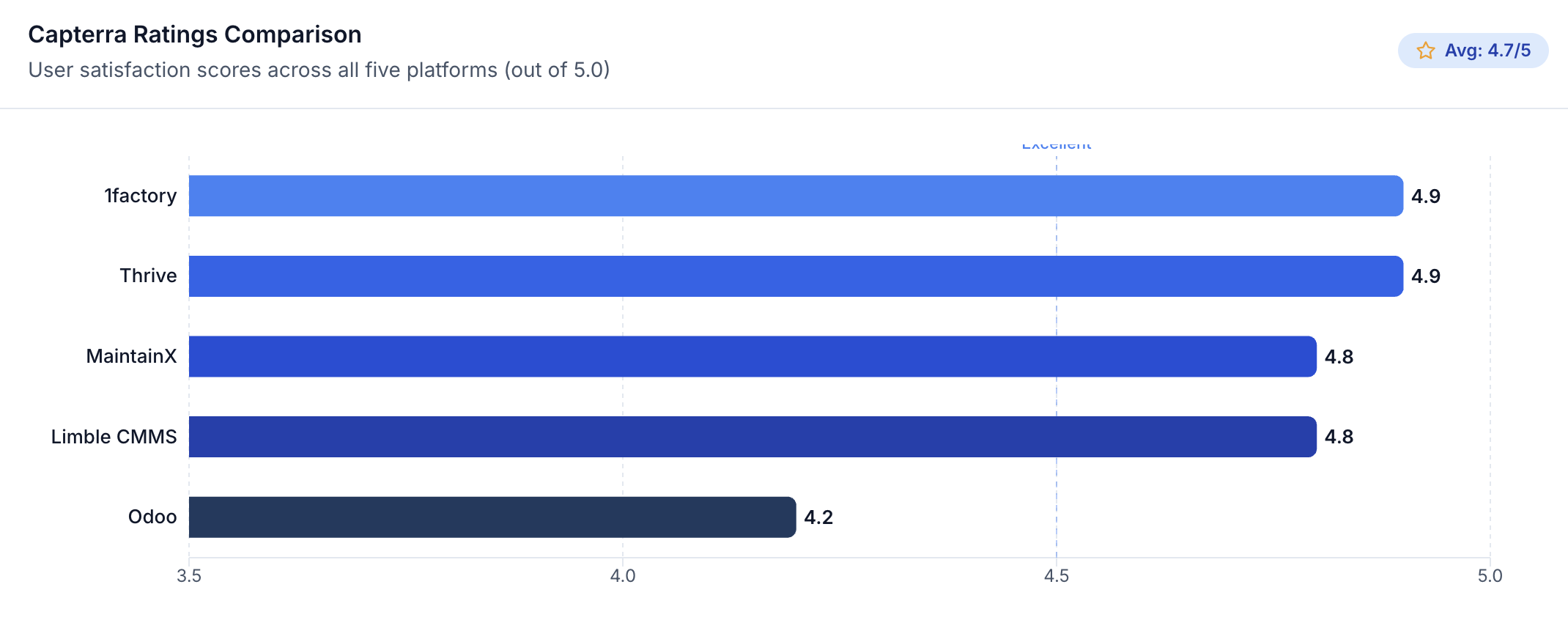
This Capterra ratings comparison shows how MaintainX, Limble CMMS, Odoo, 1factory, and Thrive perform based on verified user reviews (out of 5.0).
Here’s what stands out:
1factory and Thrive lead at 4.9/5
MaintainX and Limble follow closely at 4.8/5
Odoo trails at 4.2/5
That tells an important story.
Highly focused manufacturing platforms tend to earn stronger satisfaction scores than broad ERP systems trying to cover everything.
But ratings alone don’t tell the full picture.
The real question is:
Are you optimizing for ease of use, depth of maintenance features, ERP control, or plant-wide lean execution?
Use this graphic as a credibility snapshot — then pair it with your operational goals to make the right decision.
Why This Matters
Balanced comparisons build trust.
Every platform in this list solves a specific problem well.
The mistake isn’t choosing the “wrong” software.
The mistake is choosing software that doesn’t match your operational priorities.
Know your problem.
Then pick the tool built to solve that specific problem.
So Which System Is Right for You?
If you only need work order tracking, MaintainX or Limble may be perfect.
If you need full financial control and ERP depth, Odoo makes sense.
If quality inspection is your main pain, 1factory is strong.
But if your plant is trying to:
Eliminate spreadsheet chaos
Digitize lean processes
Improve cross-department visibility
Close the loop on downtime
Engage operators in real time
Scale without adding disconnected tools
Then Thrive fits differently. It’s the digital toolbox for the shop floor.
Built for manufacturers who want structured processes, real-time visibility, and measurable improvement — without turning into an ERP project.
Which CMMS Is Best For Your Situation?
This is the part most articles skip.
Features are nice.
Pricing matters.
But what really drives the decision is this:
What kind of plant are you running?
Let’s break it down by real-world scenarios.
Small Maintenance Teams
Best Fit → MaintainX
If you have:
1–5 technicians
Paperwork orders
Basic PM scheduling needs
Limited IT support
MaintainX is usually the fastest win.
It’s simple.
It’s mobile.
It gets you out of paper quickly.
You don’t need a full operations platform.
You need maintenance visibility.
MaintainX does that well.
Multi-Site Manufacturing Operations
Best Fit → Thrive
If you’re managing:
Multiple plants
Cross-site reporting
Standardized processes
Shared maintenance, quality, or safety workflows
You don’t just need work orders.
You need:
Consistent workflows
Standard dashboards
Centralized visibility
Unlimited user access without per-seat penalties
Thrive’s site-based pricing and unified platform model make multi-site rollouts cleaner and more scalable.
Adding users shouldn’t double your software cost.
Plants Needing Quality + Safety + Maintenance Together
Best Fit → Thrive
If your pain looks like this:
Quality issues tracked in spreadsheets
Safety incidents living in email
Maintenance in one tool
CI projects somewhere else
You don’t have a CMMS problem.
You have a disconnected systems problem.
Thrive brings:
Maintenance
Quality
Safety
Continuous improvement
Into one operator-driven platform.
That eliminates lag between departments.
And lag is where waste hides.
ERP-Driven Companies
Best Fit → Odoo
If your primary focus is:
Financial control
Inventory management
Purchasing
Sales integration
Company-wide ERP visibility
Then Odoo makes sense.
It’s built as an ERP first.
Maintenance is a module.
If your executive team is ERP-focused, this aligns with that strategy.
Just understand:
ERP systems manage transactions.
They don’t typically drive daily shop floor accountability.
Lean / Continuous Improvement Teams
Best Fit → Thrive
If your plant runs on:
Leader standard work
Hour-by-hour tracking
CI events
Root cause workflows
Action-item accountability
Then you need more than a CMMS.
You need:
Real-time visibility
Structured workflows
Operator data entry
Notification-based follow-up
Cross-functional dashboards
That’s digital lean.
And it’s where Thrive was built to play.
As long as operators enter the data, you get minute-by-minute status visibility.
Paper can’t compete with that.
Quick Scenario Summary
Simple maintenance shop → MaintainX
Maintenance-heavy but focused team → Limble
ERP-first organization → Odoo
Inspection-driven quality shop → 1factory
Lean-driven, cross-functional manufacturer → Thrive
Google rewards decision-based clarity.
More importantly — so do buyers.
The best CMMS isn’t about features.
It’s about fit.
Choose the system that matches the way your plant actually operates.
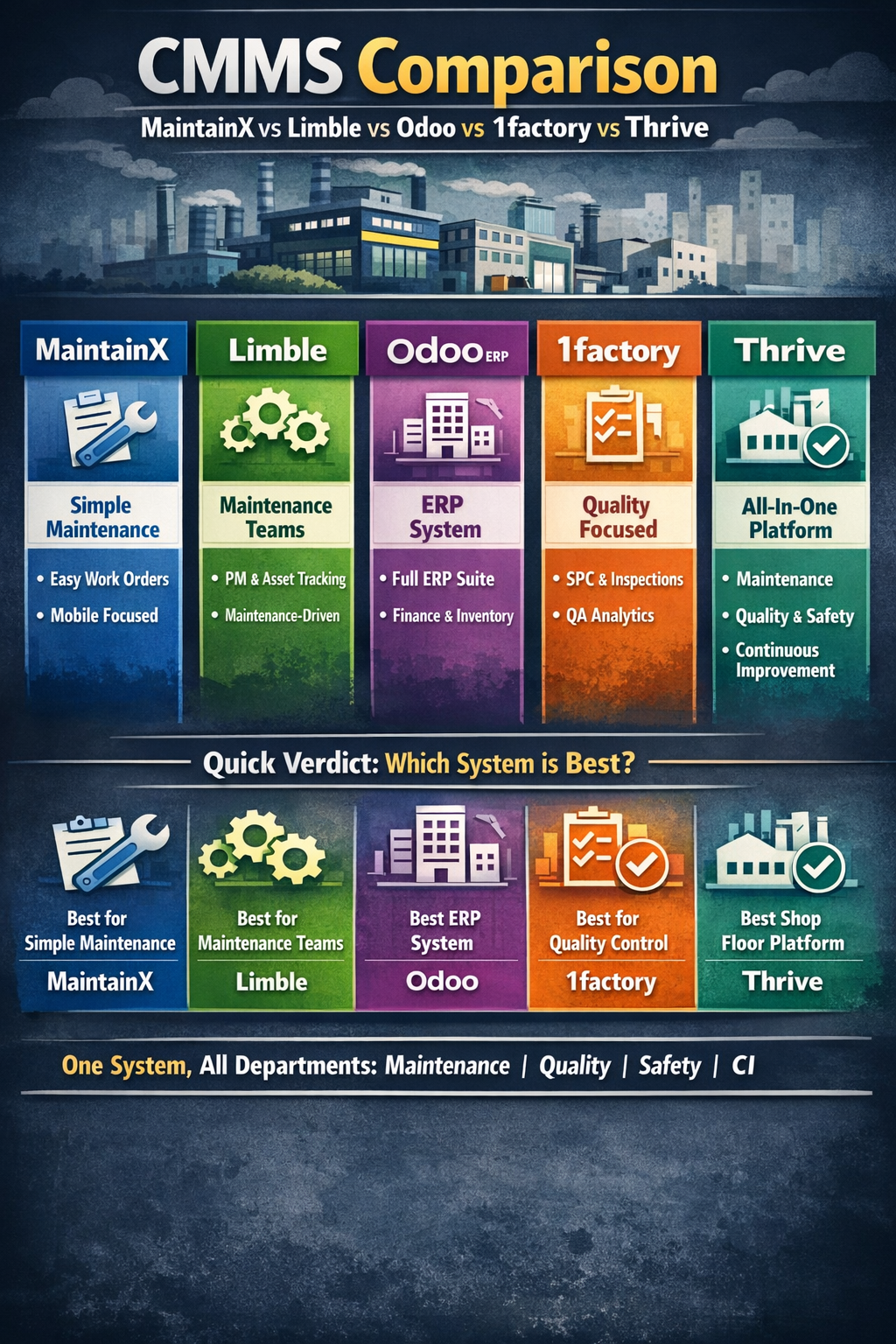
Quick Verdict: Which System Is Best?
If you don’t want to read the whole breakdown, here’s the straight answer.
Best for simple maintenance → MaintainX
Great if you just need fast, mobile work order management without complexity.Best for pure maintenance teams → Limble
Strong preventive maintenance and asset tracking for maintenance-driven operations.Best ERP-style system → Odoo
Ideal if your priority is financial control, inventory, purchasing, and full ERP functionality.Best quality-focused platform → 1factory
Strong inspection workflows, SPC, and quality analytics.Best all-in-one shop floor system → Thrive
Built for manufacturers who want maintenance, quality, safety, and continuous improvement in one connected, operator-driven platform.
The real decision isn’t which system has the most features.
It’s which system solves the problem your plant is actually trying to fix.
What This Means
CMMS comparison isn’t just about features.
It’s about philosophy.
Are you buying a maintenance tracker?
Or are you building a digital lean operating system for your plant?
The best CMMS for manufacturing depends on what problem you’re actually trying to solve.
If you’re ready to move beyond maintenance-only thinking and build plant-wide accountability, Thrive is built for that.
CMMS comparison matters — but clarity on your operational goals matters more.
In Summary
While each of these platforms offers unique strengths tailored to specific aspects of manufacturing management, Thrive distinguishes itself as a comprehensive, all-in-one solution. Its modular design allows for customization to meet specific operational needs, and its integration capabilities ensure seamless data flow across various functions. For manufacturers aiming to streamline their shop floor operations with a unified platform, Thrive presents a compelling choice.
When comparing MaintainX vs. Limble CMMS vs. Thrive and others, the scalability and pricing of Thrive make it an attractive solution for manufacturing shop floor software and an excellent alternative to MaintainX.
To explore how Thrive can transform your manufacturing processes, consider scheduling a demo to experience its capabilities firsthand.
Frequently Asked Questions (FAQ)
If you’re researching CMMS software, you probably have more questions than vendors want to answer directly.
Here are the real ones manufacturers are searching for.
1. What is the best CMMS for manufacturing?
The best CMMS for manufacturing depends on what problem you're solving.
If you only need maintenance tracking → MaintainX or Limble
If you need ERP-level control → Odoo
If you want maintenance + quality + safety + CI together → Thrive
There is no universal “best.”
There is only best for your situation.
2. MaintainX vs Limble — which is better?
MaintainX is often easier to adopt and works well for small teams.
Limble typically offers deeper maintenance functionality and asset tracking.
If you're strictly comparing maintenance features, it comes down to:
Simplicity → MaintainX
Maintenance depth → Limble
Neither is built as a full lean operations system.
3. Is Odoo a CMMS?
Not exactly.
Odoo is an ERP system that includes a maintenance module.
It handles:
Financials
Inventory
Purchasing
Sales
Manufacturing
Maintenance is one component inside a broader ERP structure.
If you’re looking for a maintenance-only solution, Odoo may be more system than you need.
4. What is the easiest CMMS to use?
For most small maintenance teams, MaintainX is often considered the easiest to use.
It’s mobile-first.
It requires minimal setup.
It gets technicians logging work quickly.
Ease of use matters — especially if your team isn’t software-heavy.
5. What CMMS includes quality and safety?
Most traditional CMMS platforms focus only on maintenance.
If you need:
Maintenance
Quality tracking
Safety incident management
Continuous improvement tools
Then you’re looking beyond traditional CMMS.
Thrive is designed to include maintenance, quality, safety, and CI in one platform.
That’s not typical in most CMMS tools.
6. What’s the difference between a CMMS and an ERP?
A CMMS manages:
Work orders
Preventive maintenance
Asset tracking
Spare parts
An ERP manages:
Financials
Inventory
Purchasing
Sales
Company-wide transactions
CMMS tools run maintenance.
ERP systems run the business.
Some ERP systems include maintenance modules, but they aren’t always optimized for shop floor usability.
7. What is the best CMMS for small manufacturing companies?
If you're a small manufacturer with:
Limited IT support
1–5 technicians
Paper work orders
MaintainX or Limble may be the fastest solution.
If you’re small but focused on lean operations, cross-department accountability, and long-term scalability, Thrive may be worth evaluating.
8. Do CMMS systems track downtime automatically?
Most CMMS platforms do not automatically sense machine data.
They rely on:
Operator entry
Manual logging
Or integration with third-party systems
Some systems integrate with machine monitoring platforms, but they don’t typically provide predictive sensor-based alerts on their own.
Thrive, for example, focuses on making downtime visible and actionable — but does not directly sense machine vibration or temperature.
9. What is the best CMMS for multi-site manufacturing?
Multi-site companies need:
Standardized processes
Centralized reporting
Scalable user access
Cross-plant visibility
Platforms with per-user pricing can become expensive at scale.
Thrive’s site-based model and unified workflow structure are often better suited for multi-site rollouts.
10. Can a CMMS support lean manufacturing?
Traditional CMMS tools help with maintenance reliability.
But lean manufacturing requires:
Real-time visibility
Structured workflows
Leading indicators
Cross-functional accountability
Some CMMS tools partially support this.
Platforms built with digital lean principles in mind go further by structuring daily work processes beyond maintenance.
11. What is the difference between CMMS and MES?
A CMMS manages maintenance activities.
An MES (Manufacturing Execution System) manages production execution — tracking orders, machine performance, and production data.
They serve different purposes.
Thrive is neither a traditional MES nor a sensor-driven predictive platform — it focuses on structured, operator-driven workflows that support lean execution on the shop floor.
12. How much does a CMMS cost?
CMMS pricing typically ranges from:
$15–$70 per user per month for basic systems
Custom pricing for enterprise solutions
Additional implementation costs depending on complexity
Per-user pricing models can increase costs as adoption grows.
Site-based models may offer more scalability for larger teams.
If you’re researching CMMS software, the smartest move isn’t asking:
“Which one has the most features?”
It’s asking:
“Which system matches how our plant actually runs?”
That’s where clarity turns into confidence.